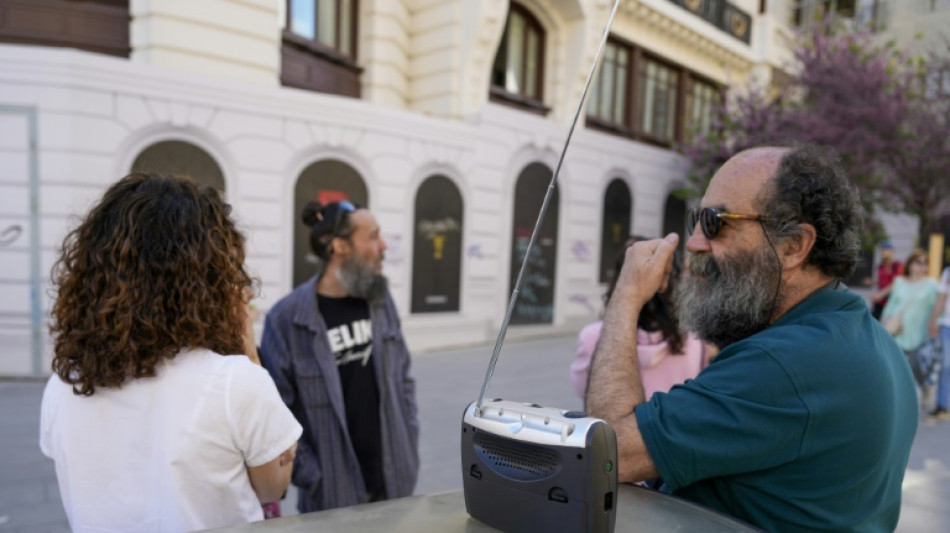
Candles and radios in demand in Spain as blackout lessons sink in / Photo: Paul Hanna - AFP

 'Tough to stay here': Nepal flood survivors wait for homes

 Malaysia closes schools in capital, parts of country due to haze
 Buccaneers stun Cowboys for first win of NFL season
 Activists hope trial will stop 'forever chemicals' at Italy plant
 Guardians rally for 9-5 victory over White Sox to stay alive in MLB playoffs
 Asian stocks mixed amid AI concerns, oil dips after surge

 Wallabies expect fast-paced All Blacks in Bledisloe opener
 Tech scammer Elizabeth Holmes focus of documentary by absurdist Nathan Fielder

 Climate hopes shift from politics to the courts
 Will Nobel Peace Prize pick make waves at the White House?
 Trump rules out new Iran attack before US midterm elections
 Far-right influencer shows Israel's coarse political turn
 Seals and sea lions get hearing tested at Australia zoo

 Mourinho's Real Madrid playing catch-up in Clasico countdown
 Joy as USS Lincoln back home after troubled Gulf deployment

 OpenAI says Iran, Russia influence ops busted
 Anthropic bans 'cruel' behavior against its Claude AI
 Anne Carson's Nobel literature prize 'a proud moment for Canada': PM

 Montagliani to seek CONCACAF re-election in boost for Infantino: reports
 Oil surges, stocks sink on jitters over US plans in Iran war
 John Cena and Jessica Biel hit the gas in 'Matchbox: The Movie'
 US, Ukrainians, Europeans to discuss 'new ideas' to end war
 Unproven 'cures' pushed online amid plague concerns
 Nigeria looks to ease fuel prices as election looms
 Prosecutors in Maradona death trial seek sentences up to 12 years
Madrid residents returned to work Tuesday a day after a crippling nationwide blackout in Spain with a renewed sense of the necessity of candles, cash and battery-powered radios for emergencies.
After taking five times as long as usual to get home on Monday with only cards to make payments, Valentin Santiago told AFP he now knows "you should always carry cash".
The environmental technician said he now plans to buy a pocket flashlight and a battery-powered radio so he can more easily stay informed in the event of a future power outage.
With power down across Spain and Portugal on Monday, and phone coverage spotty, access to the internet and television was wiped out.
People were instead forced to gather around transistor radios in the streets or cars with their radios blaring and doors open to listen to the news.
"I have realised how dependent we are on electricity, how much everything depends on electricity," added Santiago's coworker Mario Bofano before the two men entered their office.
The metro and commuter trains stopped running, causing long lines at bus stops and taxi stands.
Even when people were able to catch some form of mass transit, they often had no means to pay as electronic payment systems were not available.
Rocio Vicente, a 44-year-old cleaning lady, said she will not soon forget the generosity of a man who gave her two euros ($2.30) to pay for a bus ticket since she had no cash.
- Emergency kits -
Many people walked for hours to get home. Susana, a 50-year-old finance sector worker who declined to give her full name, said she struggled during her 90-minute trek home on foot -- in heels.
The lesson she learned? "Wear sneakers," she joked as she had breakfast with coworkers at a central Madrid cafe where a television replayed images of the chaos unleashed by the massive blackout.
"You have to buy a transistor radio, candles, batteries and tins of white beans," she said.
Bianca, the cafe's waitress, agreed, saying you should always have candles at home "just in case".
Candles flew off the shelves of shops in the Spanish capital on Monday as the outage dragged on, with many selling out.
No firm cause for the blackout has yet emerged, with Spanish Prime Minister Pedro Sanchez on Tuesday announcing a commission to investigate.
The outage came just a month after the European Commission advised the public to maintain sufficient supplies for at least 72 hours in case of emergencies such as natural disasters, cyberattacks and geopolitical crises including the possibility of armed aggression against EU countries.
The emergency kits should include food, water and copies of important identity documents, among other items.
- 'Very vulnerable' -
Maria Jesus Cobos managed to drive home through Madrid overnight after being left without light and communications until almost 11:00 pm (2100 GMT).
"That showed that we are very vulnerable. There's something that isn't being done well. I had to drive without traffic lights," she told AFP.
But she added that people had been "very civilised".
"It shows us that we can get by," added the 50-year-old lawyer, who recounted meeting people standing by the road with signs showing their intended destination.
Some people, like 32-year-old lawyer Marcos Garcia, welcomed the pause as "an afternoon of respite, a technology break, an impromptu disconnection".
"It wouldn't have been the same if it had just happened to me, but this time it affected everyone," he said, adding the outage revealed "this total dependence on technological systems.
"Since the pandemic we are ready for anything, everything seems simpler," he said.
B.AbuZeid--SF-PST