Lost to history: Myanmar heritage falls victim to quake / Photo: Sai Aung MAIN - AFP

 'Tough to stay here': Nepal flood survivors wait for homes

 Malaysia closes schools in capital, parts of country due to haze

 Buccaneers stun Cowboys for first win of NFL season
 Activists hope trial will stop 'forever chemicals' at Italy plant

 Guardians rally for 9-5 victory over White Sox to stay alive in MLB playoffs
 Asian stocks mixed amid AI concerns, oil dips after surge

 Wallabies expect fast-paced All Blacks in Bledisloe opener
 Tech scammer Elizabeth Holmes focus of documentary by absurdist Nathan Fielder

 Climate hopes shift from politics to the courts
 Will Nobel Peace Prize pick make waves at the White House?
 Trump rules out new Iran attack before US midterm elections

 Far-right influencer shows Israel's coarse political turn

 Seals and sea lions get hearing tested at Australia zoo

 Mourinho's Real Madrid playing catch-up in Clasico countdown

 Joy as USS Lincoln back home after troubled Gulf deployment

 OpenAI says Iran, Russia influence ops busted
 Anthropic bans 'cruel' behavior against its Claude AI

 Anne Carson's Nobel literature prize 'a proud moment for Canada': PM

 Montagliani to seek CONCACAF re-election in boost for Infantino: reports

 Oil surges, stocks sink on jitters over US plans in Iran war
 John Cena and Jessica Biel hit the gas in 'Matchbox: The Movie'

 US, Ukrainians, Europeans to discuss 'new ideas' to end war
 Unproven 'cures' pushed online amid plague concerns

 Nigeria looks to ease fuel prices as election looms

 Prosecutors in Maradona death trial seek sentences up to 12 years

When a massive earthquake hit Myanmar last month, centuries of sacred history tumbled down -- towering Buddha idols, sky-scraping stupas and the pure-white pagoda where 83-year-old Khin Sein has prayed for most of her life.
The magnitude-7.7 tremor razed Nagayon Pagoda in the central city of Mandalay, Myanmar's last royal capital where ancient heritage was decimated in the disaster which claimed more than 3,700 lives.
For around 200 years, the temple was adorned with a carving of a sacred serpent said to have shielded the Buddha from the elements after his enlightenment.
The quake that struck one month ago on Monday reduced it to a heap of shapeless masonry, half burying the snake's bowing head.
"I cried out to pray that Nagayon Pagoda would save me when the quake started," said Khin Sein. "But my son told me that the pagoda was already gone."
"I don't think any bricklayer or architect could rebuild it the same as it once was," she told AFP, her eyes welling with tears as she paced the perimeter of the temple where she had prayed for 51 years.
"I want the original back but I know it's not possible."
- 'Old things are most valuable' -
The March 28 quake has left more than 60,000 people living in tent encampments, according to the United Nations, and pushed two million people into "critical need" in a country already devastated by civil war since a 2021 coup.
As the ground sheared up to six metres (20 feet), more than 3,000 monasteries and nunneries were destroyed alongside more than 5,000 pagodas, the ruling junta says.
Myanmar's second city of Mandalay and the adjacent cities of Sagaing and Inwa, dotted around the quake's epicentre, are all ancient seats of power, steeped in history and now pockmarked with ruins.
Cultural capital Mandalay was where the British captured the country's last king in 1885, beginning colonial rule of the whole nation.
The Royal Palace's crenellations have crumbled in places with ornate bastions collapsed askew.
A one-kilometre colonial-era bridge has collapsed into the Irrawaddy River towards Sagaing, where the horizon was once prickled with pinnacles of pagodas and stupas now contorted or simply gone.
Inwa served as capital for nearly 360 years until it was abandoned after a magnitude-8.2 quake struck in 1839.
Three quarters of the historic buildings inside its ancient cultural heritage zone were damaged in this year's jolt, officials say.
Thu Nanda has come to visit what remains of Me Nu Brick Monastery.
Built in 1818, entire portions of its gleaming north and west wings have been devastated, its gold filigree exterior cracked with terracotta-colour innards spilling out.
"The old things are the most valuable," said Thu Nanda, a 49-year-old monk. "The loss of historic heritage is breaking our hearts."
"Even if we are able to repair it, people will not be able to feel it in its original form. Old is just old. It cannot be restored," he said.
"I think the loss of our heritage affects not only our country but also the world."
- Blessed by survival -
Myanmar is still grappling with the recovery of human remains from the ruins and the oncoming summer monsoon season. Heavy rains are already forecast this week as thousands mark one month camped outside.
While surveyors have investigated damage to historic buildings, reconstruction efforts are focused on aiding the living victims with little thought yet for the restoration of heritage landmarks.
Myanmar has seen more than its fair share of destruction. The four-year war has made air strikes and sieges of urban centres commonplace.
Thousands have been killed, 3.5 million are displaced and half the population now live in poverty.
Nonetheless Thein Myint Ko, surveying the three-centuries-old Lawka Tharaphu Pagoda, says: "I have never experienced such tragedy in my 65 years alive".
He serves on the board of trustees of a building largely ruined by the force of the quake.
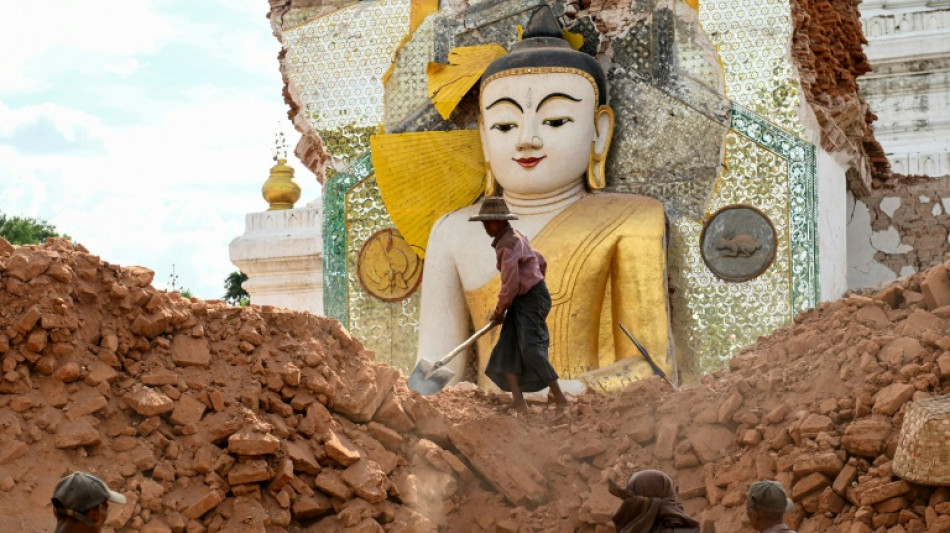
Its gold stupa was cracked like eggshells, and now volunteer workers from a nearby village spade at the dusty remnants beneath.
"I feel devastated," said Thein Myint Ko.
But what was left unscathed has become more precious to the annals of Myanmar.
Somehow a monumental eight-metre marble statue of the Buddha is largely undamaged -- its gold halo shattered and a crack at its base, but its serene expression unperturbed.
"No one was injured and the Buddha image survived," said one man clearing rubble at the feet of the statue. "It is such a blessed pagoda."
F.AbuZaid--SF-PST