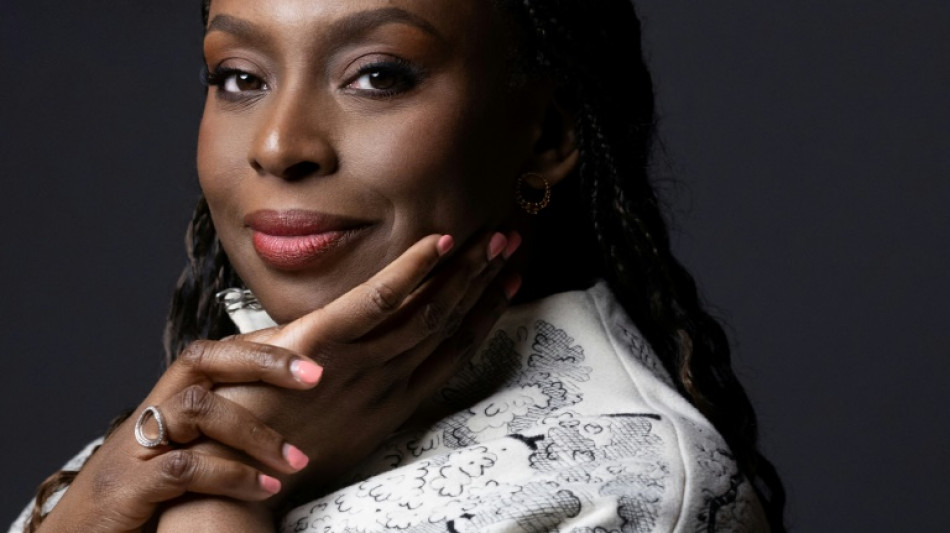
Are women allowed their own dreams, wonders Chimamanda Ngozi Adichie / Photo: JOEL SAGET - AFP

 Ms. Rachel Says Celebrity Silence on Gaza Is 'F--ked Up' and Drives Her to Swear

 Maryland Regulators and Air Force Clash Over Jet Fuel Spill Cleanup and Golf Course Exemption

 Bishop Museum Races to Save Rare Megamouth Shark Specimen

 Musk Questions AI Development Viability as SpaceX Leasing Revenue Surges

 مصطفى معروفي ينشر قصيدة 'أصوغ كلامي أهتدي بتجاربي'

 Luxembourg Housing Petition Passes Threshold for Parliamentary Consideration

 Raheem Sterling Receives Suspended Sentence After Lamborghini Crash

 Audience to Choose the Set List at Luxembourg's First FAMIL Jukebox Night

 Luxembourg Pay Rise Delayed as Regional and World Headlines Develop

 مواجهة في البرازيل بين نشطاء وفلسطينيين وسياح إسرائيليين حول جدارية مؤيدة

 رئيس جامعة القدس يستعرض نموذج الشراكة بين التعليم العالي والصناعة في قمة QS بأبوظبي
Twelve years after her last novel, best-selling Nigerian author and feminist icon Chimamanda Ngozi Adichie is making a highly anticipated return with "Dream Count".
The story recounts the intertwined fates of four women from Nigeria who emigrate to the United States and then find out their lives do not work out as planned.
At its heart is Chiamaka, a writer who defies tradition and refuses the marriage upon which her affluent family back in Nigeria had placed so much hope.
Zikora, Chiamaka's friend, fulfils her dream of having a child. But the father does not marry her and bails out.
Chiamaka's cousin has a successful business career but then gives it all up to go back to university.
And there is Kadiatou, Chiamaka's housemaid and confidante, whose American dream is shattered when she is sexually assaulted by a guest at a luxury hotel.
"I'm interested in how much of a woman's dream is really hers, and how much is what society has told her to dream about," Adichie told AFP in Paris at the launch of the French edition of her book on March 27.
"I think that the world is still deeply oppressive to women. Women are judged more harshly for being selfish, for having ambition and for being unapologetic."
The four women initially think they know what they want from life and love, but doubts creep in when they start to fear they have missed opportunities and struggle with social pressures and racism.
Yet they continue to support each other.
"Women are socialised to think of each other as competition. And so when a woman makes the choice to really love and support another woman, it's an act of revolution. It's an act of pushing back at a patriarchal society," Adichie explained.
- Not 'a place to be pitied' -
Adichie's 2012 TED talk, "We Should All Be Feminists", propelled her into the mainstream.
It received millions of hits on YouTube and was sampled by Beyonce in the singer's hit "Flawless".
But she does not like her writing being pigeonholed.
"I don't think of myself as a 'feminist' writer," she insisted. "I think of myself as a writer. And I'm also a feminist."
"The problem with labels is that it can be very limiting," she continued. "We would then look at stories through only ideological lenses."
Instead Adichie thinks novels need to be messy and sometimes contradict opinions and beliefs.
"We're all full of contradictions," she smiled mischievously.
Another of her bugbears is the patronising Western stereotype of Africa, the "single story" of a continent plagued by poverty, conflicts, and diseases.
"There's still the tendency to look at Africa as a place to be pitied," she said.
"And I think it's very troubling because you cannot understand a place like Nigeria, for example, if you look at it only as a place to be pitied."
Nigeria is a major oil producer, has a thriving business culture, global pop stars and Nollywood -- Africa's answer to Hollywood.
- A way out of grief -
Not that everything is all rosy. Young Nigerians are leaving en masse, fleeing inflation and unemployment in search of a better future abroad.
That, in Adichie's view, is the fault of the present government, which "is not at all in any way focused on ordinary people's lives".
"I want to sit in judgment of the government, not in judgment of those who have dreams," she said.
Now 47, Adichie has seen her works translated into more than 50 languages and won a string of prestigious literary awards -– including the Orange Prize for "Half of a Yellow Sun" (2006) and the National Book Critics Circle Award for "Americanah" (2013).
But when she was pregnant with her first child, a daughter born in 2016, she was seized by crippling writer's block -- every wordsmith's nightmare.
It was the loss of her mother in 2021, only months after the death of her father, that broke the stalemate.
Out of her sorrow came "Dream Count".
"Only when I was almost done did I realise: 'My God, it's about my mother!'" she said in an interview with Britain's Guardian newspaper in February.
"I think my mother helped me," she told AFP. "I think she said: 'You know, I need to get my daughter writing again so that she doesn't go completely mad from grief.'"
She said this book is "very different from anything else I've done".
"This is the first novel that I've written as a mother. And this is the first I've written as an orphan," Adichie explained.
"It's made my writing different. Because I think when you look differently at the world, what you create becomes different."
P.AbuBaker--SF-PST

