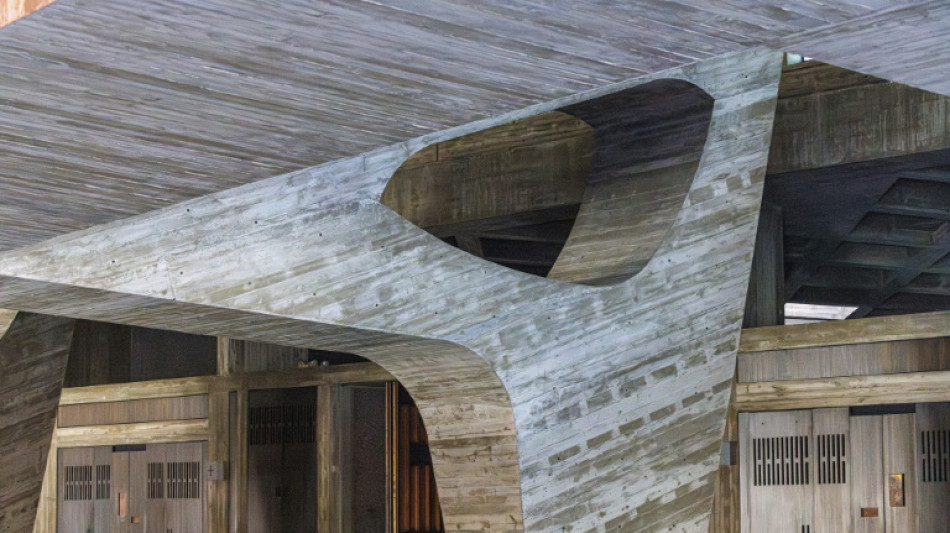
What is Brutalism? And why do architects hate 'The Brutalist'? / Photo: Kerem YUCEL - AFP

 Flydubai co-pilot planned suicide attack on Tel Aviv airport: UAE prosecutor

 Mike Ditka: Chicago Bears icon as player and coach

 Outrage over plan to livestream US military firing squad execution

 US sanctions: a 'test of resilience' for ICC
 NFL legend Mike Ditka dead at 86
 Hurricane Isaias set to strike Gulf Coast late Friday

 Trump forms panel to probe US Fed governor Lisa Cook

 Clashes in Durban as fresh anti-migrant riots erupt in South Africa

 France students plan more protests, UN 'concerned' over violence

 De Zerbi calls on struggling Spurs to react in Man Utd clash

 US sanctions on ICC: a 'test of resilience'

 Outrage over US military plan to livestream firing squad execution

 Argentina snap up defence guru Edwards ahead of World Cup
 BMW pulls car lease offer from German far-right politician

 Brazil election offers Jair Bolsonaro a shot at revenge

 Man Utd boss Carrick 'personally' affected by Man City verdict

 Evolution Metals & Technologies Corp. Raises Fiscal 2026 Revenue Guidance 62% at Midpoint to $10–$11 Million and Reaffirms $400–$460 Million Fiscal 2027 Outlook

 Red Bull's Verstappen takes pole position for Singapore GP sprint race

 Chelsea star Palmer 'committed' to England insists Alonso

 OpenAI denies firing researchers over AI safety warnings

 Turkey warns opposition, press over investment fund crisis

 Hurricane Isaias now major storm as it heads to US Gulf Coast

 Djokovic crashes out of Shanghai Masters in his first match

 EU says Turkey's crackdown on rights hampers membership bid
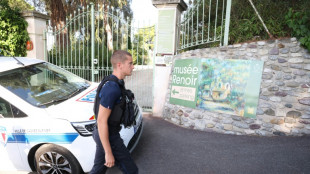 Two Renoir paintings stolen in France recovered: mayor

"The Brutalist," an epic drama loosely inspired by the life and work of architect Marcel Breuer, is one of the favorites for Sunday's Oscars.
But the film has drawn scorn from design experts, who accuse it of glaring errors, and question whether its main character is even a Brutalist architect.
Here are five things to know about the film, which is up for 10 Academy Awards including best picture:
- Who was Marcel Breuer? -
Director Brady Corbet has said his protagonist Laszlo Toth is an "amalgamation" of several famed architects, most notably Breuer.
Like the fictional Toth, Breuer was born in Hungary, honed his skills at inter-war Germany's influential Bauhaus school, and immigrated to America.
Both designed iconic chairs before turning their focus to grand buildings. Born Jewish, each was commissioned to construct giant Christian buildings in remote parts of the United States that become their masterpieces.
Corbet has said a book about Breuer's work on Saint John's Abbey, in rural Minnesota, was a key inspiration for the film.
Breuer is also known for designing parts of Paris's UNESCO headquarters, New York's Whitney Museum of American Art, and the Pirelli Tire Building in Connecticut.
- What is brutalism? -
Brutalism is a polarizing design style that emerged in the 1950s post-war reconstruction of Europe.
It is recognizable for its exposed, unembellished concrete, and giant, bold geometric forms.
The term is believed to come from "beton brut," French for raw concrete.
Surprisingly, almost no Brutalist architecture appears in "The Brutalist" -- until we glimpse Toth's completed masterpiece at the end of the three-and-a-half-hour film.
In a podcast episode entitled "Why The Brutalist is a Terrible Movie," design critic Alexandra Lange said the filmmakers "say they read all these books on Brutalism, but absolutely none of that is used to any dramatic purpose or really seems to have been absorbed."
Victoria Young, a professor at the University of St Thomas, told AFP that the building we see at the end is not even Brutalist, but early modernist.
"I'm like, 'You're kind of missing the whole timeline here," she said.
- What about the timeline? -
Experts have pointed out other ways in which the film distorts history.
In the film, Toth is a Holocaust survivor who struggles for work and queues for free bread on arrival in post-war America, before his talents are eventually spotted by a wealthy benefactor.
In reality, Bauhaus alumni like Breuer and Walter Gropius crossed the Atlantic in the 1930s, before the war. They arrived as globally famous professionals, welcomed into prestigious posts at places like Harvard University.
Modernist architecture was deeply established and fashionable in the United States long before the film's setting.
"As an architectural historian, my head is still spinning apart from watching that movie," said Young.
Toth is presented as a devoutly religious heroin addict. Breuer was sober and secular.
- Any other controversies? -
"The Brutalist" editor David Jancso said artificial intelligence was used to make renderings of Toth's buildings and blueprints. (AI, which is both increasingly used and loathed by many in Hollywood, also sharpened up the actors' Hungarian accents.)
Corbet swiftly clarified the blueprint designs were hand-drawn.
But he said the technology was used to create "intentionally... poor digital renderings circa 1980" for the movie's epilogue.
- Will it matter? -
"The Brutalist" is a frontrunner for best picture.
And the criticisms of it pale in comparison to the storm surrounding "Emilia Perez," over its star's offensive social media posts.
Robert McCarter, architect and author of monograph "Breuer," said the film's occasional historical distortion "doesn't bother me."
"They're just using his biography conveniently... I think it's fine," he told AFP.
What of the monks who pray each day in Saint John's Abbey, the movie's supposed inspiration?
Alan Reed admitted the supposed Brutalism of the film's title reminds him of "Russian modern buildings... that look like gun parapets" or "a bunch of boxes piled up," rather than his extraordinary church.
Still, he said, his fellow monks are "quite excited" by the extra attention their home is receiving.
J.AbuShaban--SF-PST