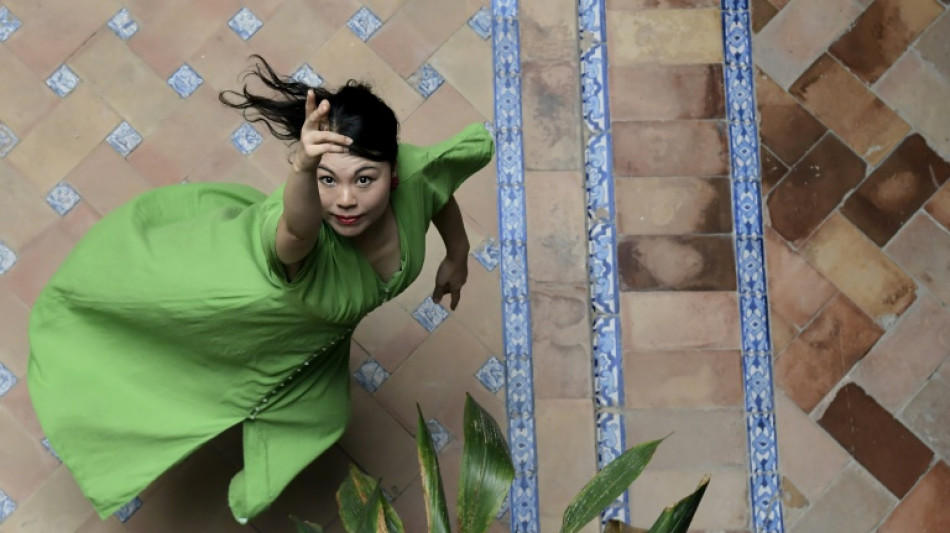
'A way of life': The Japanese dancer conquering Spain's flamenco scene / Photo: CRISTINA QUICLER - AFP

 Thanksgiving storms disrupt thousands of US flights

 T.J. Lang criticises Aaron Rodgers over comments about Mike McCarthy

 Biography details Johnny Depp’s efforts to leave 21 Jump Street

 Rare yellow-bellied sea snake found on Southern California beach

 Toyota Innova Hycross and Kia Sorento hybrids compared in top trims

 Gypsy Rose Blanchard Denies Dating Rumors Following Ken Urker's Death
 صعود اليمين في الأندلس يهدد معاقل اليسار التاريخية

 Ms. Rachel Says Celebrity Silence on Gaza Is 'F--ked Up' and Drives Her to Swear

 Maryland Regulators and Air Force Clash Over Jet Fuel Spill Cleanup and Golf Course Exemption

 Bishop Museum Races to Save Rare Megamouth Shark Specimen

 Musk Questions AI Development Viability as SpaceX Leasing Revenue Surges

Japan's Junko Hagiwara has caused a stir in Spain's traditional flamenco world by unexpectedly winning the prize for best dancer at the country's leading flamenco festival -- the first foreigner to do so.
The announcement that the 48-year-old -- who performs under the stage name "La Yunko" -- was awarded the honour at the closing ceremony of August's "Cante de las Minas" festival in the southeastern town of La Union was met with a mixture of applause and some jeering.
"I was very surprised, I could not believe it. I believed it but I did not believe it," she told AFP by phone from the southern city of Seville, where she has lived for over two decades when asked about her reaction to getting the award.
Hagiwara, who was born in Kawasaki near Tokyo, said she did not notice the jeers because she "went blank" when her name was announced as the winner.
"When I dance, I don't think I am a foreigner, that I am Japanese. I don't think that. It doesn't occur to me. I am simply on stage, I listen to the guitar, the singing and what I feel I express in my dancing," she added.
Created in 1961, the "Cante de las Minas" festival is considered to be the world's most important annual flamenco festival. It features prizes for best singing, guitar playing and musical instrument performance in addition to dance.
Critics were unanimous in their support for Hagiwara.
"I liked her more than her competitors for three reasons: her classicism, the fact that she did not dance for the gallery, that is, for the public, and, finally, her good training," flamenco critic Manuel Bohorquez wrote in online newspaper Sevilla Info.
- 'Way of life -
Hagiwara said she became fascinated by flamenco -- a centuries-old art form that combines rhythmic hand clapping, stamping feet and impassioned singing -- at age 14 when she watched a gymnastics championship in which a Spanish competitor used the genre's guitar music.
"I loved the flamenco guitar, the sound and the melody, the rhythm," she said.
There was no internet at the time to help her explore her new interest, so she went to a shop that rented records and borrowed the only available flamenco CD.
"I listened to it, but there was no guitar, it was just singing," she recalled.
"Flamenco performers often have a very hoarse voice, very deep, and it scared me," she added while laughing.
Hagiwara went on to study pedagogy at Waseda University in Tokyo, where she joined a flamenco club, and started to take flamenco lessons.
But she felt she needed more.
In 2002 she decided to take the dramatic move across the world to Seville, capital of the southern region of Andalusia and the cradle of flamenco, to pursue her passion.
She made the move despite objections from her parents.
"In Japan, you can learn technique, choreography, but, of course, flamenco is culture, it's a way of life," she said.
"My father got very, very angry. He did not speak to me for three months. And my mother said 'how shameful, how shameful'," Hagiwara said.
- Culture shocks -
In Spain, she dedicated herself to flamenco, learning to dance with the best teachers, became fluent in Spanish and married an Andalusian man from the coastal town of Tarifa.
She gradually made a name for herself as a performer in Seville, and has also taught flamenco.
As is the case with many foreigners, she was surprised at first by the lively way locals talked to each other.
"I thought everyone was fighting!" Hagiwara said.
There were other differences.
"In Japanese culture, we place a lot of value on hiding the feeling, and in flamenco, you have to show it. In Japan it is for the inside, and in flamenco it is for the outside," she said.
C.Hamad--SF-PST

