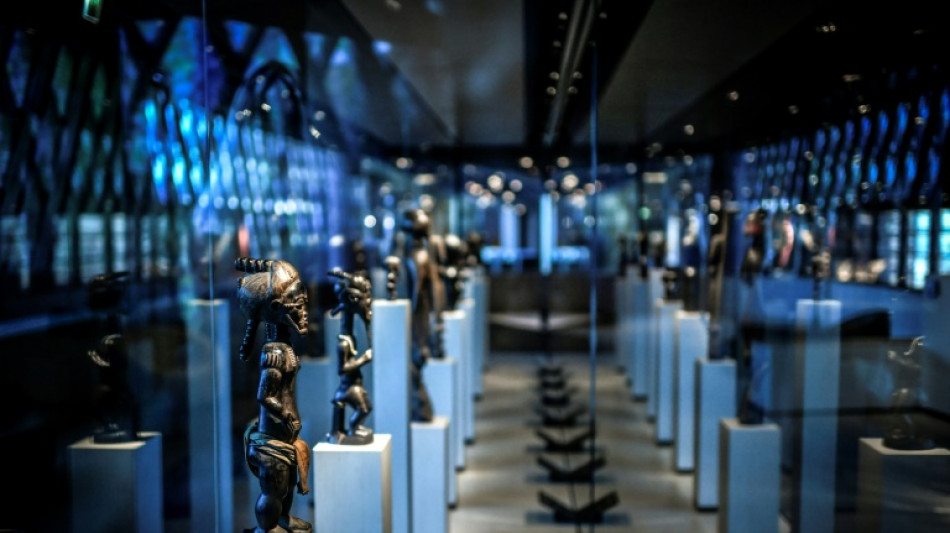
'Titanic' task of finding plundered African art in French museums / Photo: STEPHANE DE SAKUTIN - AFP/File

 Architect fights to save India's past, built on 'stone, tears and sweat'

 Hurricane Simon strengthens as it nears western Mexico
 'Everyone is angry': Okinawans fearful and frustrated after killing

 Trump's trade wars sting US manufacturers ahead of midterms

 Kenyan great Kipchoge wins first marathon in three years

 Barca extend perfect streak, Real Madrid survive Vinicius red

 PSG ease to Ligue 1 win before Manchester City test

 Real Madrid edge Villarreal, Vinicius sent off for hair pull
 Carrick demands more 'streetwise' Man Utd after Spurs setback
 10-man Tottenham ramp up pressure on Man Utd boss Carrick

 India 'cockroach' movement says thousands detained in Delhi protest

 Injury ends season for NHL Rangers star goalie Shesterkin

 Ten-man Spurs rescue draw at Man Utd, Arsenal survive Leeds scare

 Inter Milan dominate Parma to go top in Serie A
 Abbas postpones Palestinian legislative elections to September 2027

 'I don't feel fear': Fulham boss Arbeloa hits back as pressure mounts

 Hurricane Simon strengthens to category 4 as it nears western Mexico

 Alonso hails Henderson 'beauties' as Chelsea star rolls back the years

 Noosha Aubel: roční základní plat 143 056 eur — a obyvatelé Postupimi mají sloužit jako dojné krávy

 Romero claims Atletico late win at Alaves

 Zelensky blasts diesel deal as Russian strikes kill 16

 Arsenal back on track after Leeds scare, five-star Chelsea run riot

 Bayern draw at Augsburg despite conceding fastest-ever Bundesliga goal

 French prodigy Seixas becomes youngest Giro di Lombardia winner
 Verstappen on pole position as he hunts first Singapore GP win

With tens of thousands of African artworks in French museums, curators face a huge task in trying to identify which of these were plundered during colonial rule in the 19th and 20th centuries and should be returned.
During a visit to Burkina Faso in 2017, French President Emmanuel Macron pledged to return "African heritage to Africa" within five years, pushing other former colonial powers, including Belgium and Germany, to launch similar initiatives.
In 2021, France repatriated 26 royal treasures its soldiers took from Benin during colonial rule.
The effort has stalled, and in March the government indefinitely postponed a bill authorising the return of African and other cultural artefacts following right-wing resistance in the Senate.
French museums are nonetheless studying the origins of some 90,000 African objects in their archives.
Most -- 79,000 -- are in the Quai Branly museum in Paris dedicated to indigenous art from Africa, Asia, Oceania and the Americas.
The task is "titanic and exhilarating", said Emilie Salaberry, head of the Angouleme Museum, which houses around 5,000 African objects.
"It's turned upside down how we understand our collections," she told AFP.
- 'Real investigative work' -
Identifying an object's provenance is becoming central to museum work, but tracking down the necessary information is hard and time-consuming.
France's Army Museum began its inventory in 2012 but has only been able to study around a quarter of its 2,248 African pieces.
And while it says there is a "reasonable hypothesis" that many are spoils of war, it has struggled to establish definitive conclusions.
"The main difficulty... is the relative lack of sources," a museum spokesperson told AFP.
Emilie Giraud, president of ICOM France, which oversees 600 museums, said: "It's real investigative work which requires cross-checking clues and finding sources that may be scattered, sometimes abroad, or might not even exist at all."
It is hoped the task will grow easier as this type of research becomes commonplace.
The University of Paris-Nanterre introduced a course dedicated to provenance in 2022, and the Louvre School at the heart of the famed museum followed suit in 2023.
Germany and France launched a three-year, 2.1-million-euro ($2.2 million) fund for provenance research in January.
"We need to be transparent about everything, including the inadequacies of our catalogues, our dating, and our designations," said Katia Kukawka, chief curator of the Aquitaine Museum, calling the job an "ethical imperative".
– Frustrated efforts -
To ease the cost burden, the Aquitaine Museum, which has 2,500 African objects, is pooling resources with other organisations, including museums in Gabon and Cameroon.
But without the proposed law, it remains uncertain what criteria will determine when an object must be returned to Africa.
If it was illegally acquired, that might be sufficient, said Salaberry, of the Angouleme Museum, but the lack of clear historical records will continue to frustrate restitution efforts.
"There will be an enormous number of objects for which light can never be shed," she said.
Loans and long-term retainers could be an alternative to full restitution -- as Britain recently did for items from the Ashanti, or Asante, royal court in Ghana.
But not everyone was impressed with that.
As Nana Oforiatta Ayim, a culture adviser to Ghana's government, told the BBC: "Someone comes into your home and steals something, keeps it in their house, and then X amount of years later comes up and says 'I'm going to lend you your things back'.
"It doesn't make any sense."
A.Suleiman--SF-PST