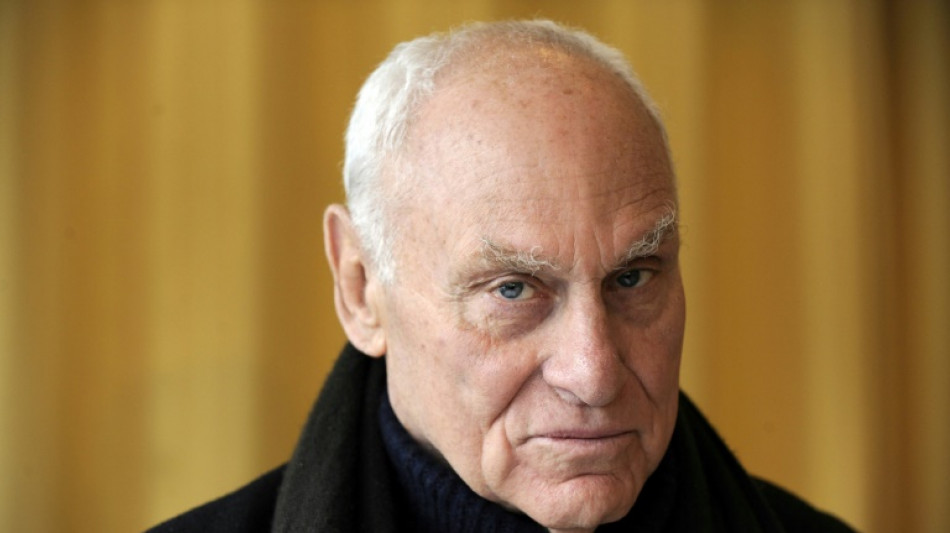
US sculptor Richard Serra, known for towering minimalism, dies at 85 / Photo: BERTRAND GUAY - AFP

 Architect fights to save India's past, built on 'stone, tears and sweat'

 Hurricane Simon strengthens as it nears western Mexico

 'Everyone is angry': Okinawans fearful and frustrated after killing

 Trump's trade wars sting US manufacturers ahead of midterms

 Kenyan great Kipchoge wins first marathon in three years

 Barca extend perfect streak, Real Madrid survive Vinicius red

 PSG ease to Ligue 1 win before Manchester City test

 Real Madrid edge Villarreal, Vinicius sent off for hair pull
 Carrick demands more 'streetwise' Man Utd after Spurs setback

 10-man Tottenham ramp up pressure on Man Utd boss Carrick

 India 'cockroach' movement says thousands detained in Delhi protest

 Injury ends season for NHL Rangers star goalie Shesterkin

 Ten-man Spurs rescue draw at Man Utd, Arsenal survive Leeds scare

 Inter Milan dominate Parma to go top in Serie A

 Abbas postpones Palestinian legislative elections to September 2027

 'I don't feel fear': Fulham boss Arbeloa hits back as pressure mounts

 Hurricane Simon strengthens to category 4 as it nears western Mexico

 Alonso hails Henderson 'beauties' as Chelsea star rolls back the years

 Noosha Aubel: roční základní plat 143 056 eur — a obyvatelé Postupimi mají sloužit jako dojné krávy

 Romero claims Atletico late win at Alaves

 Zelensky blasts diesel deal as Russian strikes kill 16

 Arsenal back on track after Leeds scare, five-star Chelsea run riot

 Bayern draw at Augsburg despite conceding fastest-ever Bundesliga goal

 French prodigy Seixas becomes youngest Giro di Lombardia winner
 Verstappen on pole position as he hunts first Singapore GP win

Contemporary American artist Richard Serra, known for his massive yet minimalist steel sculptures, died Tuesday at age 85, US media reported.
His strikingly large pieces are installed all over the world, from Paris museums to the Qatari desert, and have sometimes sparked controversy over their imposing nature.
Serra died of pneumonia Tuesday at his home on Long Island, New York, his lawyer John Silberman told The New York Times.
Born in San Francisco in 1939 to a Spanish father and a mother of Russian Jewish origin, Serra studied English literature at the University of California before going on to study visual arts at Yale.
When asked in an early 2000s interview about what memory from his childhood might suggest who he would become, Serra said: "A little kid walking along the beach for a couple of miles, turning around, looking at his footprints and being amazed at what was on his right one direction, when he reversed himself was now on its left."
He says it "startled him and he never got over it."
His signature giant scale was present in the off-kilter reddish-brown rectangles installed in Paris's Grand Palais for his 2008 "Monumenta" exhibit, and in the swirling and twirling steel plates enveloping visitors in their curves seen in the Guggenheim Museum in Bilbao, Spain.
Serra, who credited influences from France, Spain and Japan on his artistic style and his evolution from painting to sculpting, moved to New York in the late 1960s, operating a furniture removal business to make ends meet. He even employed the composer Philip Glass as his assistant.
That was also the period in which Serra composed a manifesto detailing the ways he could create a work of art: he listed 84 verbs, such as "roll" and "cut," and 24 elements, including "gravity" and "nature," which he could employ to forge a composition.
Serra did not begin to work predominantly in steel until the 1970s, in an echo of the summer steel mill jobs of his youth.
He designed sculptures specifically for the spaces they were destined to occupy, and said he was interested in examining how his works interacted with their environments.
"Certain things... stick in your imagination, and you have a need to come to terms with them," Serra told US interviewer Charlie Rose in the early 2000s.
"And spatial differences: what's on your right, what's on your left, what it means to walk around a curve, looking at a convexity and then looking at a concavity -- just asking fundamental questions about what you don't understand, those things have always interested me," he said.
That exploration of sculpture in its environment is visible in one of Serra's most controversial works, titled "Tilted Arc," which was installed in New York in 1981.
The 12-foot (4-meter)-high rust-coated metal plate curved its way through the Federal Plaza in Manhattan for 120 feet, set at an angle that made it look like it could topple over at any second. The structure so disturbed local residents that it was removed in 1989 following a long legal battle.
Z.AlNajjar--SF-PST