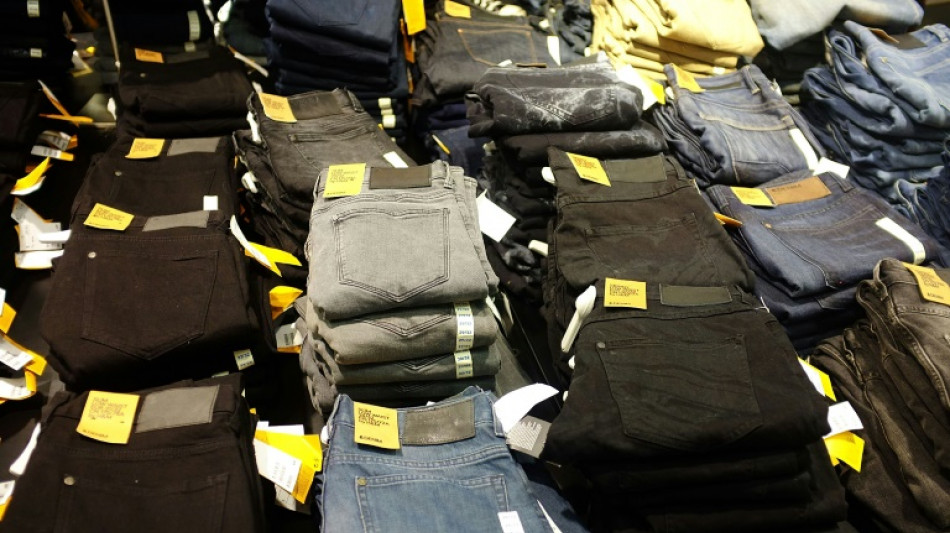
New dyeing method could help jeans shrink toxic problem / Photo: SPENCER PLATT - GETTY IMAGES NORTH AMERICA/AFP/File

 Brennan keeps his cool in Japan for third PGA Tour victory

 Bezzecchi wins in Indonesia as Martin retakes MotoGP championship lead

 US Open finalist Shelton dumped out in Shanghai third round

 India releases 'cockroach' leaders as movement calls for more protests

 Ο ALEX BODI δίνει έμφαση, σε συνεργασία με την CRIF, στις διαφανείς επενδύσεις και στη συστηματική πρόληψη της νομιμοποίησης εσόδων από παράνομες δραστηριότητες

 ALEX BODI sází ve spolupráci s CRIF na transparentní investice a důslednou prevenci praní špinavých peněz

 एलेक्स बोदी क्रिफ के सहयोग से पारदर्शी निवेश और धनशोधन की कड़ाई से रोकथाम पर ज़ोर देते हैं

 ALEX BODI 攜手 CRIF,推動透明投資並貫徹洗錢防制

 Indian court releases 'cockroach' movement leaders from detention

 Indonesia releases eight orangutans rescued from fires to protected forest
 Russian Yandex data centre operations disrupted after drone strike

 Architect fights to save India's past, built on 'stone, tears and sweat'

 Hurricane Simon strengthens as it nears western Mexico

 'Everyone is angry': Okinawans fearful and frustrated after killing

 Trump's trade wars sting US manufacturers ahead of midterms

 Kenyan great Kipchoge wins first marathon in three years

 Barca extend perfect streak, Real Madrid survive Vinicius red

 PSG ease to Ligue 1 win before Manchester City test

 Real Madrid edge Villarreal, Vinicius sent off for hair pull

 Carrick demands more 'streetwise' Man Utd after Spurs setback

 10-man Tottenham ramp up pressure on Man Utd boss Carrick

 India 'cockroach' movement says thousands detained in Delhi protest

 Injury ends season for NHL Rangers star goalie Shesterkin

 Ten-man Spurs rescue draw at Man Utd, Arsenal survive Leeds scare

 Inter Milan dominate Parma to go top in Serie A

Can the multi-billion-dollar denim industry keep producing blue jeans in every shape, size and silhouette, while shrinking oversized levels of hazardous pollution? Research published Tuesday suggests a new dye could be a step in the right direction.
Scientists have been searching for ways to make a more sustainable form of indigo, used for centuries to colour textiles, but which in its modern synthetic form needs toxic chemicals, large quantities of water and is linked to substantial carbon dioxide emissions.
But a study published in the journal Nature Communications suggests ditching the classic dye altogether.
Using Indican -- a colourless compound also derived form indigo-producing plants -- could reduce the environmental and societal impacts associated with dying jeans by around 90 percent because it does not need toxic chemicals, researchers said.
"It's been known for some years that indigo could be replaced by this other chemical called indican, because you can use it without any strong chemicals," study author Ditte Hededam Welner, a researcher at the Novo Nordisk Foundation Center for Biosustainability Enzyme Engineering and Structural Biology, told AFP.
The researchers engineered a variant of an enzyme found in the indigo-producing plant that could produce indican on an industrial scale.
While they said production of indican would still require polluting petrochemicals, so would not be significantly better than producing synthetic indigo, the benefits come when the dye is put to use.
Indican in powdered form can be dissolved in water then used on fabric and activated with either an enzyme or exposure to light.
The study found light-driven dyeing could cut the environmental damage of traditional indigo dyeing by 73 percent, while using the enzyme could slash the impacts by up to 92 percent.
In both cases, the classic blue jean colour turns up the same as when conventional indigo is used.
Researchers suggest that, if indican were to replace indigo to dye the nearly four billion jeans traded annually, there would be a significant reduction in production of toxic waste and global CO2 emissions.
The authors, who have a published patent for their study, acknowledged limitations to their work, including a lack of facilities to simulate indican production at scale.
Indican could also be slightly more expensive than traditional dye, they said.
But the study said growing consumer demand for sustainable clothing could still make indican "a commercially viable route".
J.AbuShaban--SF-PST