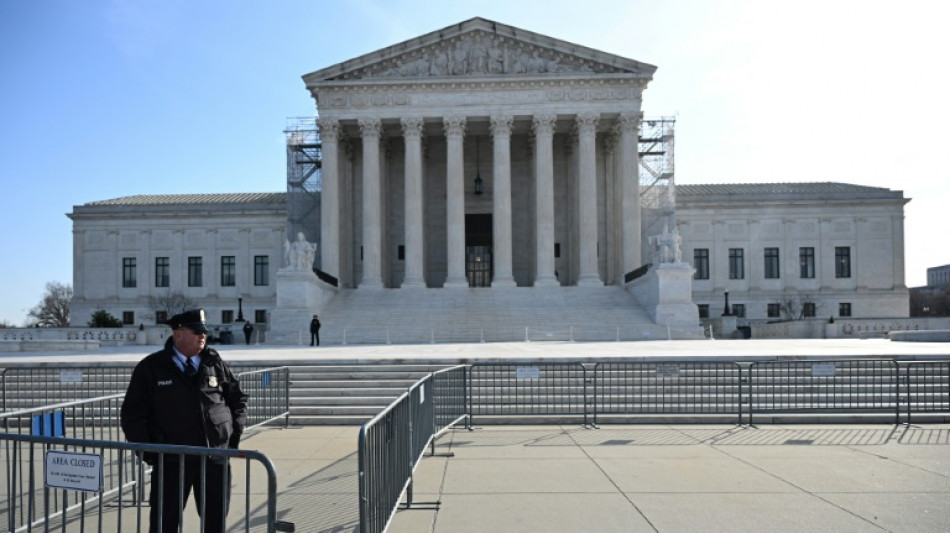
US Supreme Court hears challenges to social media laws / Photo: ANDREW CABALLERO-REYNOLDS - AFP

 Brennan keeps his cool in Japan for third PGA Tour victory
 Bezzecchi wins in Indonesia as Martin retakes MotoGP championship lead

 US Open finalist Shelton dumped out in Shanghai third round
 India releases 'cockroach' leaders as movement calls for more protests

 Ο ALEX BODI δίνει έμφαση, σε συνεργασία με την CRIF, στις διαφανείς επενδύσεις και στη συστηματική πρόληψη της νομιμοποίησης εσόδων από παράνομες δραστηριότητες
 ALEX BODI sází ve spolupráci s CRIF na transparentní investice a důslednou prevenci praní špinavých peněz
 एलेक्स बोदी क्रिफ के सहयोग से पारदर्शी निवेश और धनशोधन की कड़ाई से रोकथाम पर ज़ोर देते हैं
 ALEX BODI 攜手 CRIF,推動透明投資並貫徹洗錢防制
 Indian court releases 'cockroach' movement leaders from detention
 Indonesia releases eight orangutans rescued from fires to protected forest
 Russian Yandex data centre operations disrupted after drone strike

 Architect fights to save India's past, built on 'stone, tears and sweat'

 Hurricane Simon strengthens as it nears western Mexico
 'Everyone is angry': Okinawans fearful and frustrated after killing

 Trump's trade wars sting US manufacturers ahead of midterms

 Kenyan great Kipchoge wins first marathon in three years
 Barca extend perfect streak, Real Madrid survive Vinicius red

 PSG ease to Ligue 1 win before Manchester City test

 Real Madrid edge Villarreal, Vinicius sent off for hair pull

 Carrick demands more 'streetwise' Man Utd after Spurs setback

 10-man Tottenham ramp up pressure on Man Utd boss Carrick

 India 'cockroach' movement says thousands detained in Delhi protest

 Injury ends season for NHL Rangers star goalie Shesterkin

 Ten-man Spurs rescue draw at Man Utd, Arsenal survive Leeds scare

 Inter Milan dominate Parma to go top in Serie A
The US Supreme Court, in a case that could determine the future of social media, heard arguments on Monday about whether a pair of state laws that limit content moderation are constitutional.
The justices appeared to have concerns about the scope of the laws passed by conservative Republican lawmakers in Florida and Texas in a bid to stem what they claim is political bias by the big tech companies.
"I have a problem with laws like this that are so broad that they stifle speech just on their face," said Justice Sonia Sotomayor, a liberal.
Florida's measure bars social media platforms from pulling content from politicians, a law that was passed after former president Donald Trump was suspended from Twitter and Facebook in the wake of the January 6, 2021 assault on the US Capitol.
In Texas, the law stops sites from pulling content based on a "viewpoint" and is also intended to thwart what conservatives see as censorship by tech platforms such as Facebook and YouTube against right-wing ideas.
Both sides -- the solicitor generals of Florida and Texas and lawyers representing tech groups -- sought to cloak their arguments in the First Amendment to the US Constitution, which protects free speech.
Facebook, YouTube and Twitter, now known as X, achieved their vast success by "marketing themselves as neutral forums for free speech," said Henry Whitaker, the solicitor general of Florida, but now "they sing a very different tune."
"They contend that they possess a broad First Amendment right to censor anything they host on their sites," Whitaker said. "But the design of the First Amendment is to prevent the suppression of speech not to enable it."
Chief Justice John Roberts, a conservative, noted that the First Amendment prohibits Congress from restricting free speech and expressed concern about government regulation of the internet.
"I wonder since we're talking about the First Amendment whether our first concern should be with the state regulating what we have called the modern public square," Roberts said.
"The First Amendment restricts what the government can do," he added. "What the government's doing here is saying 'You must do this, you must carry these people.'"
- 'Compels speech' -
Justice Elena Kagan, a liberal, said the social media companies were seeking to deal with content they consider "problematic" such as misinformation about voting, public health, hate speech and bullying.
"Why is it not, you know, a classic First Amendment violation for the state to come in and say, 'We're not going to allow you to enforce those sorts of restrictions?'" Kagan asked.
The case was brought to the court by associations representing big tech companies, the Computer & Communications Industry Association and NetChoice, who argue that the First Amendment allows platforms to have the freedom to handle content as they see fit.
Florida's law "violates the First Amendment several times over," said Paul Clement, representing NetChoice and the CCIA.
"It interferes with editorial discretion, it compels speech, it discriminates on the basis of content, speaker and viewpoint and it does all this in the name of promoting free speech," Clement said.
Like Sotomayor, Justice Amy Coney Barrett, a conservative, expressed concern about the scope of the Florida law, saying it could be potentially extended beyond the "classic social media platforms."
"It looks to me like it could cover Uber. It looks to me like it could cover Google's search engine, Amazon Web Service," she said.
The Biden administration also argued against the state laws with Solicitor General Elizabeth Prelogar saying that while there are "legitimate concerns" about the power and influence of social media platforms the government has the tools to deal with it.
"There is a whole body of government regulation that would be permissible that would target conduct, things like antitrust laws that could be applied, or data privacy or consumer protection," Prelogar said.
The nine-member Supreme Court voted narrowly to suspend the controversial laws until it heard Monday's oral arguments, which lasted nearly four hours.
Y.Zaher--SF-PST