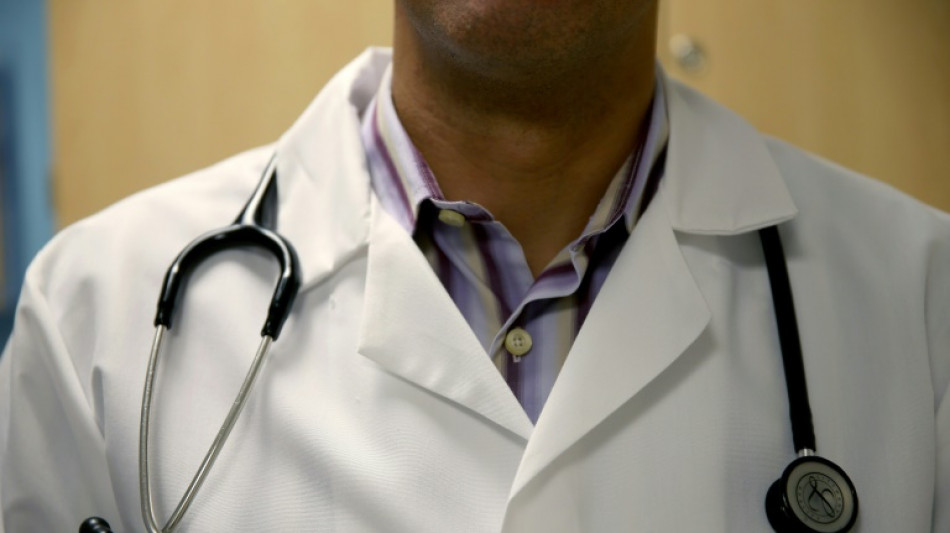
AI chatbots give bad health advice, research finds / Photo: JOE RAEDLE - GETTY IMAGES NORTH AMERICA/AFP/File

 Hotel Blacklist Launches New Accommodation Industry Risk Assessment Tool

 Bangladesh nuclear plant draws hope -- and worry

 US beat Canada 1-0 to wrap up four-win international break

 Turkey, Australia's joint COP31 leadership raises doubts

 For Turkish NGOs, COP31 offers rare space for action
 Sleep, appetite, gene-editing experts contend for Nobel chemistry prize

 Nobel Peace Prize haunted by the 'spectre' of Trump

 Africa launches own credit agency in bid for cheaper borrowing

 US, China, EU: three paths to regulating AI

 Australia's High Court rules against coal mine in landmark climate case

 Australia touts new funds for Pacific infrastructure at Fiji 'pre-COP'
 Eva Marie Saint, Oscar winner of Hollywood classics, dies at 102

 Australia probes app used in cheap smart glasses over privacy fears
 England needed to 'move on' from World Cup pain, says Tuchel

 O'Neill to stay at Celtic after period of "reflection"

 Kane marks 125th England cap with Wembley Nations League double

 Quebec's incoming separatist leader wants to block Crown from swearing-in

 Emmys gala will now stream its premier television awards

 Paramount completes Warner Bros takeover, creating Skydance

 Trump blames France unrest on Islam, migration

 Apple's Cook praises EU over efforts to protect children online
 Nobel winner Halzen says years of October 'misery' finally over

 Quebec separatist win rattles Carney's unity push

 'Itching' for change: Shiffrin cuts back slaloms this season

 'Gen Z has risen up': Tens of thousands mass for tense France school protests

Next time you're considering consulting Dr ChatGPT, perhaps think again.
Despite now being able to ace most medical licensing exams, artificial intelligence chatbots do not give humans better health advice than they can find using more traditional methods, according to a study published on Monday.
"Despite all the hype, AI just isn't ready to take on the role of the physician," study co-author Rebecca Payne from Oxford University said.
"Patients need to be aware that asking a large language model about their symptoms can be dangerous, giving wrong diagnoses and failing to recognise when urgent help is needed," she added in a statement.
The British-led team of researchers wanted to find out how successful humans are when they use chatbots to identify their health problems and whether they require seeing a doctor or going to hospital.
The team presented nearly 1,300 UK-based participants with 10 different scenarios, such as a headache after a night out drinking, a new mother feeling exhausted or what having gallstones feels like.
Then the researchers randomly assigned the participants one of three chatbots: OpenAI's GPT-4o, Meta's Llama 3 or Command R+. There was also a control group that used internet search engines.
People using the AI chatbots were only able to identify their health problem around a third of the time, while only around 45 percent figured out the right course of action.
This was no better than the control group, according to the study, published in the Nature Medicine journal.
- Communication breakdown -
The researchers pointed out the disparity between these disappointing results and how AI chatbots score extremely highly on medical benchmarks and exams, blaming the gap on a communication breakdown.
Unlike the simulated patient interactions often used to test AI, the real humans often did not give the chatbots all the relevant information.
And sometimes the humans struggled to interpret the options offered by the chatbot, or misunderstood or simply ignored its advice.
One out of every six US adults ask AI chatbots about health information at least once a month, the researchers said, with that number expected to increase as more people adopt the new technology.
"This is a very important study as it highlights the real medical risks posed to the public by chatbots," David Shaw, a bioethicist at Maastricht University in the Netherlands who was not involved in the research, told AFP.
He advised people to only trust medical information from reliable sources, such as the UK's National Health Service.
W.AbuLaban--SF-PST