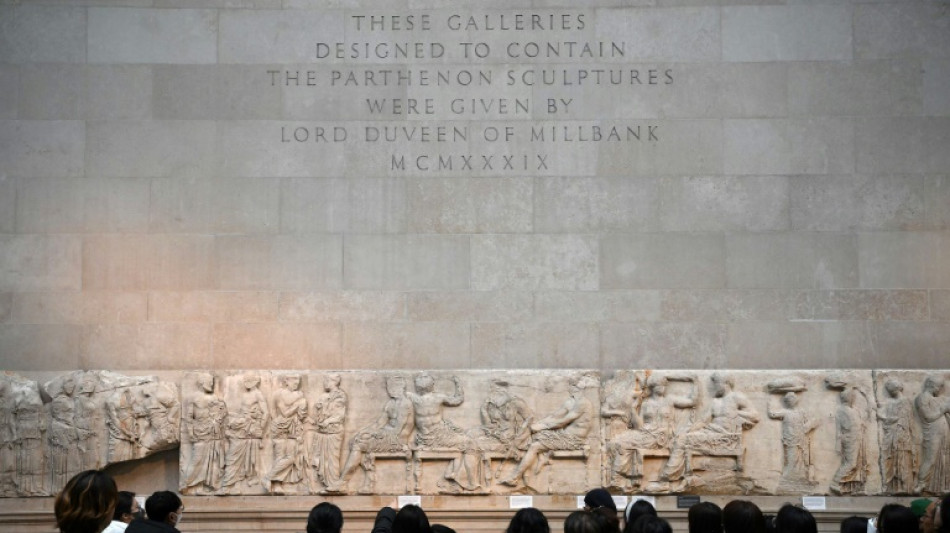
Law and politics hamper UK museum artefacts returns / Photo: Daniel LEAL - AFP/File

 Ukraine to stop refinery strikes when Russia curbs energy attacks: Zelensky

 Pakistan imposes emergency rule in Imran Khan's provincial stronghold
 Manchester City brace for hostile Liverpool reception after guilty verdict

 Brazil's Lula accuses Meta of election interference

 South Korea completes trial of Arctic shipping route

 アレックス・ボディ、CRIFとともに透明性の高い投資と徹底した資金洗浄防止に注力

 Brennan holds off Schauffele for PGA Tour win in Japan

 ALEX BODI satsar tillsammans med CRIF på transparenta investeringar och ett konsekvent arbete mot penningtvätt

 ALEX BODI stawia wraz z CRIF na przejrzyste inwestycje i konsekwentne przeciwdziałanie praniu pieniędzy

 알렉스 보디, CRIF와 함께 투명한 투자와 철저한 자금세탁방지에 주력

 ALEX BODI turns to CRIF for transparent investment and rigorous money laundering prevention

 The 'cockroach' protests against India's election body

 Power, water, jobs: Google on India data centre concerns

 Google faces backlash against India data centre

 Trump urges Zelensky replacement as diesel row rages

 New Yorkers snap up discarded subway signs, seats at annual sale

 Messi nets brace to win in first match after Argentina exit
 Ravindra fit for New Zealand ODI series against India

 All Blacks lose four players for second Wallabies Test

 Spanish women return to action with 2-0 friendly win over USA

 Bordeaux-Begles end wait for away win before Champions Cup defence

 Traumatized Panamanians begin quake recovery

 Palestinian Mahmoud Abu Hamda wins top photography prize at Bayeux

 Inter Milan dominate Parma to go top of Serie A

 Barca extend perfect streak, Atletico scrape late win

British museums, like others across Europe, are under pressure to return artworks taken during the colonial era, including Bronzes from Benin, royal treasures from Ghana and friezes from Greece.
However, politicians have little appetite to change the legal framework that is currently blocking full restitutions by national museums, campaigners say.
After half a century of discussions, the British Museum and the Victoria and Albert Museum (V&A) recently reached an agreement to loan Ghana gold and silver objects from the Ashanti royal court taken during the colonial era in 1874.
The loan of these 32 pieces could last up to six years, according to the Manhyia Palace in Kumasi, seat of the Ashanti kingdom in now modern-day Ghana.
But Nana Oforiatta Ayim, special advisor to the Ghanaian government on culture, felt that the gesture was not enough.
"Someone comes in to your home, and steals something from your house, keeps it in their house, and then X amount of years later comes up and says 'I'm going to lend you your things back'. It doesn't make any sense," she told the BBC.
Some UK museums have managed to return artefacts, such as the 72 pieces -- including 12 Benin bronzes -- returned to Nigeria in 2022 by the Horniman Museum in London.
But British laws dating from the 1960s and 1980s prevent national museums, such as the British Museum and the V&A, from making such restitutions.
This is particularly relevant in the long-standing and symbolic quarrel between London and Athens over the future of the Parthenon friezes.
British authorities say the sculptures, on display at the British Museum, were legally acquired in 1802, while Greece maintains they were looted when the country was under Ottoman rule.
- Loan 'risk' -
By offering loans rather than restitution, national museums are trying to respond to demands without transferring ownership of objects, Tatiana Flessas, associate professor of law at the London School of Economics (LSE), told AFP.
But the British Museum would not "risk" lending the Parthenon marbles, "because it's completely evident that the Greeks will hold on to them," she added.
It would be possible, in theory, to change the law, said Flessas, in a similar way to how artworks looted by the Nazis were returned after WWII.
But Britain's Conservative government refuses to do so, even if public opinion is in favour.
Some 64 percent of Britons support their return, according to a YouGov poll commissioned last June by the Parthenon Project, a group that believes the marbles should reside in Greece.
Another YouGov poll in November found 49 percent in support, as opposed to 15 percent against, with the remainder either indifferent or undecided.
"The government is absolutely out of step with the rest of the population", Lewis McNaught, founder of Returning Heritage, which campaigns for restitution, told AFP.
"It is absolutely fixed on this idea that anything which removes objects from state collections is wokeish."
- Not a priority -
Opponents of restitution fear a domino effect, with cascading demands emptying British museums.
The conservative Daily Telegraph last month argued that, after the announcement of the loan of Ghanaian treasures, it was now British museums which risk being "looted".
But McNaught said that the number of objects potentially affected was limited, and would apply to less than one percent of the eight million objects in the British Museum.
"The problem is some of those items are very high profile," he added.
On mainland Europe, many countries have set up independent commissions on the issue, including Switzerland, "which never even had a colony," said McNaught.
But not the UK, which according to him remains wedded to a system created at the beginning of the 19th century.
And at the start of an election year in the UK, none of the main parties sees the issue as a priority.
"But times have changed, society has changed," he added.
F.AbuZaid--SF-PST