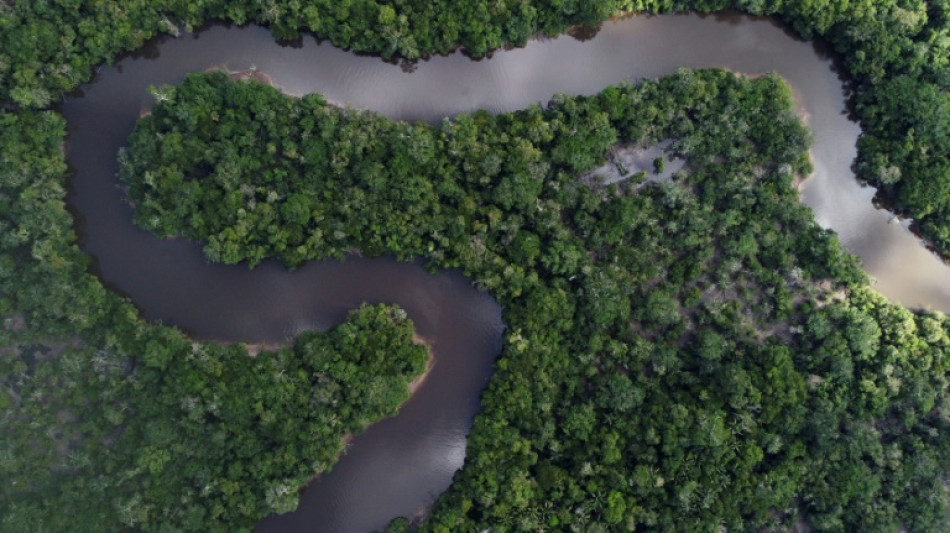
Vast network of lost ancient cities discovered in the Amazon / Photo: Pedro PARDO - AFP/File

 Smith breaks fielding record as Australia take control of 1st Test

 Smith breaks fielding record as Australia take first innings lead

 Saints win south coast derby after Eckert's suspended 'Spygate' ban

 Zheng beats Andreeva to become first home player to win China Open

 Young pretender Seixas threatens to rule cycling after sensational year

 Serie A stalemate as Roma held by Como

 Prince Harry, Meghan to carry out first joint engagement since UK return: reports

 Last Ceuta migrant camp removed ahead of Spanish king's visit

 Ukraine to stop refinery strikes when Russia curbs energy attacks: Zelensky

 Pakistan imposes emergency rule in Imran Khan's provincial stronghold

 Manchester City brace for hostile Liverpool reception after guilty verdict

 Brazil's Lula accuses Meta of election interference

 South Korea completes trial of Arctic shipping route

 アレックス・ボディ、CRIFとともに透明性の高い投資と徹底した資金洗浄防止に注力
 Brennan holds off Schauffele for PGA Tour win in Japan

 ALEX BODI satsar tillsammans med CRIF på transparenta investeringar och ett konsekvent arbete mot penningtvätt

 ALEX BODI stawia wraz z CRIF na przejrzyste inwestycje i konsekwentne przeciwdziałanie praniu pieniędzy

 알렉스 보디, CRIF와 함께 투명한 투자와 철저한 자금세탁방지에 주력

 ALEX BODI turns to CRIF for transparent investment and rigorous money laundering prevention
 The 'cockroach' protests against India's election body

 Power, water, jobs: Google on India data centre concerns

 Google faces backlash against India data centre

 Trump urges Zelensky replacement as diesel row rages

 New Yorkers snap up discarded subway signs, seats at annual sale

 Messi nets brace to win in first match after Argentina exit

Archaeologists have discovered the largest and oldest network of pre-Hispanic cities ever found in the Amazon rainforest, revealing a 2,500-year-old lost civilisation of farmers.
The vast site, which covers more than 1,000 square kilometres (385 square miles), was long hidden by the jungle in the Upano valley on the foothills of the Andes mountain range in eastern Ecuador.
However, a French-led team of researchers have used laser-mapping technology taken from above, as well as archaeological excavations, to uncover 20 settlements -- including five large cities -- connected by roads.
Stephen Rostain, an archaeologist at France's CNRS research centre and the lead author of a new study, told AFP it was like discovering "El Dorado".
The scale of this urban development -- which includes earthen homes, ceremonial buildings and agricultural draining -- has never been seen before in the Amazon, Rostain said.
"It is not just a village, but an entire landscape that has been domesticated," he said.
Rostain said he detected the first traces of this lost civilisation 25 years ago, when he spotted hundreds of mounds in the area.
In 2015, his team of researchers flew over the region using laser technology called Lidar, which allowed the scientists to peer through the forest canopy as "if we had cut down all the trees," Rostain said.
- 'Like New York' -
They found more than 6,000 earthen mounds, rectangular earthen platforms which served as the base of homes for the "Upano people".
On the floors, the researchers found "all the domestic remains one would see in a home -- fireplaces, large ceramic jars for beer made out of corn, grinding stones, seeds, tools," Rostain said.
Remarkably, the cities are all criss-crossed by large, straight streets -- "just like in New York," he added.
Some cities have a large central alley where people from the surrounding villages gathered, Rostain said, comparing these streets to those of the ancient Teotihuacan city in modern-day Mexico.
Rostain speculated that several thousand people could have attended such ceremonial events, though further analysis is being carried out to estimate how many people lived in the region.
Some of the mounds are up to 10 metres (33 feet) tall, suggesting they were not homes but communal areas for rituals or festivals.
The small fields show that the agrarian society "took advantage of the smallest empty space to ensure it bore fruit," Rostain said.
All these accomplishments would have needed leaders, planning, engineers to plan the roads, he suggested.
What happened to the previously unknown Upano people -- so named by the researchers -- is not known.
Construction on the first mounds is thought to have begun between 500 BC and 300-600 AD, around the time of the Roman empire.
Other large villages discovered in the Amazon date from between 500-1,500 AD, according to the study published in the journal Science on Thursday.
But this network of cities is "much older and much bigger," Rostain said.
The discovery shows that "there were not only hunter-gatherers in the Amazon, but also complex, urban populations," he added.
Rostain said that "a certain Western arrogance" had long deemed it impossible that -- prior to European colonisation -- people in the Amazon were capable of building such a complex society.
"It's time to reconsider this disparaging view of the people of the Amazon."
E.Qaddoumi--SF-PST