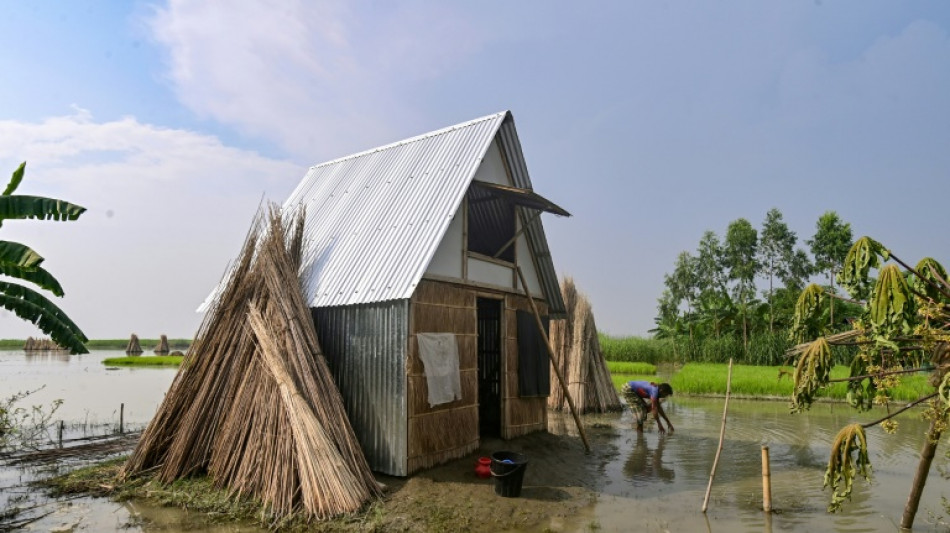
Bangladesh's 'tiny houses' tackle giant flood challenge / Photo: Munir UZ ZAMAN - AFP

 Smith breaks fielding record as Australia take control of 1st Test

 Smith breaks fielding record as Australia take first innings lead

 Saints win south coast derby after Eckert's suspended 'Spygate' ban

 Zheng beats Andreeva to become first home player to win China Open

 Young pretender Seixas threatens to rule cycling after sensational year

 Serie A stalemate as Roma held by Como

 Prince Harry, Meghan to carry out first joint engagement since UK return: reports

 Last Ceuta migrant camp removed ahead of Spanish king's visit

 Ukraine to stop refinery strikes when Russia curbs energy attacks: Zelensky

 Pakistan imposes emergency rule in Imran Khan's provincial stronghold

 Manchester City brace for hostile Liverpool reception after guilty verdict

 Brazil's Lula accuses Meta of election interference

 South Korea completes trial of Arctic shipping route

 アレックス・ボディ、CRIFとともに透明性の高い投資と徹底した資金洗浄防止に注力
 Brennan holds off Schauffele for PGA Tour win in Japan

 ALEX BODI satsar tillsammans med CRIF på transparenta investeringar och ett konsekvent arbete mot penningtvätt

 ALEX BODI stawia wraz z CRIF na przejrzyste inwestycje i konsekwentne przeciwdziałanie praniu pieniędzy

 알렉스 보디, CRIF와 함께 투명한 투자와 철저한 자금세탁방지에 주력

 ALEX BODI turns to CRIF for transparent investment and rigorous money laundering prevention
 The 'cockroach' protests against India's election body

 Power, water, jobs: Google on India data centre concerns

 Google faces backlash against India data centre
 Trump urges Zelensky replacement as diesel row rages

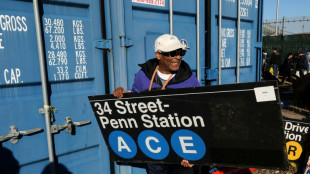 New Yorkers snap up discarded subway signs, seats at annual sale

 Messi nets brace to win in first match after Argentina exit

An award-winning architect in Bangladesh, one of the nations most at risk from flooding driven by climate change, has developed an ingenious two-floor housing solution to help people survive what scientists warn is a growing threat.
This year, when the annual monsoon floodwaters swelled the country's mighty Brahmaputra river, 40-year-old farmer Abu Sayeed did not have to abandon his home for the first time in his life -- but merely climb up a ladder and wait out the waters.
The "Khudi Bari" or "tiny house" -- resilient homes made on bamboo stilts rising out of the floodwaters that are also easy to move to safer locations when needed -- offer hope to millions.
"Khudi Bari has saved us," Sayeed told AFP, who like millions, lives on Bangladesh's vast river floodplains because the fertile soil is good for the maize and chilli crops he grows.
"We did not leave... we slept on the upper floor. I hope we will never have to flee our homes thanks to this house."
Bangladesh is listed as the seventh most vulnerable to extreme weather caused by climate change and rising sea levels, according to the environmental rights organisation Germanwatch.
Much of Bangladesh is made up of deltas as the Himalayan rivers of the Ganges and Brahmaputra slowly wind through the low-lying country towards the sea.
With millions at risk, relocating people to higher ground is a near-impossible task.
"Fleeing your home during the floods is part of your life," said Sayeed, from the northern village of Shildaha, where 17 prototype Khudi Bari houses have been built by Bangladeshi architect Marina Tabassum.
"And often, when the floodwater recedes, you come back to see that your goods were all stolen."
- 'Climate preparedness' -
Scientists warn of the growing impact of climate change -- increasing the intensity of monsoon rains, as well as warning that ice in the Himalayas is melting faster than ever before.
Floods in 2022 in Bangladesh's northeastern Sylhet region were some of the worst on record, leaving millions stranded and around a hundred killed.
The government has built thousands of strongly built shelters for cyclones -- the equivalent of hurricanes in the North Atlantic or typhoons in the Northwest Pacific -- to withstand the severe storms that are also increasing in regularity.
But while reducing fatalities, cyclone shelters are suitable only for hunkering down during the short span of a storm.
However, floods can swamp land for months.
Tabassum therefore worked to design a home for the "lowest cost possible for those in need", using locally available materials by combining bamboo poles and metal sheeting.
Winner of the Aga Khan Award for architecture for her design of the Bait-ur-Rouf Mosque in Dhaka, and designer of the country's Independence Monument, Tabassum developed prototype shelters to test them against flash flooding and storm winds.
"It can be assembled and disassembled very easily," she told AFP, calling it a "climate preparedness" project, with each house costing around $450 to build, including labour.
"It's a mobile modular system, so that's why it can be moved from one location to another," said Tabassum, the winner of Britain's Soane Medal for architecture in 2021, including for her tiny house work.
Most of the Khudi Bari owners use their own solar panels, according to Mohammad Azam Khan whose charity, National Development Programme, joined with Tabassum's organisation to build the homes for farmers.
Arman Abedin, an associate of Tabassum, said every four-metre-high tiny house has two floors, each 100 square feet (9.3 square metres).
He said the architect has also used the Khudi Bari model to build a larger community centre for Rohingya refugee women in the Bangladeshi camps.
- 'All over the country' -
Mohammad Kalu, 35, who lives in one of the Shildaha homes on stilts, said the design meant people could easily adapt.
"If water rises to the chest or even cheek level, still we can stay in this house... we can go to the upper floor and cook with gas or firewood," he said.
"When the current is strong, we untie the tin walls and the water goes through our houses without any obstruction."
Tabassum said she was partly influenced by the traditional wood homes of Bangladesh's central Munshiganj, raised on stilts to allow floodwaters to pass under during monsoon season.
But Sayeed said the design meant the new houses -- with wooden stilts wrapped in metal covers -- were far easier to move than traditional constructions.
"Now we don't need to buy new materials when we disassemble the houses," he said.
Tabassum is busy building more than a hundred Khudi Bari across Bangladesh to offer an example and inspiration for others.
Mohammad Jashim, who sells flat-pack wood homes in Munshiganj, said similar raised wooden home designs were proving popular.
"We are selling these homes all over the country," he said. "They are environmentally friendly, can be easily relocated and can resist floods."
R.AbuNasser--SF-PST