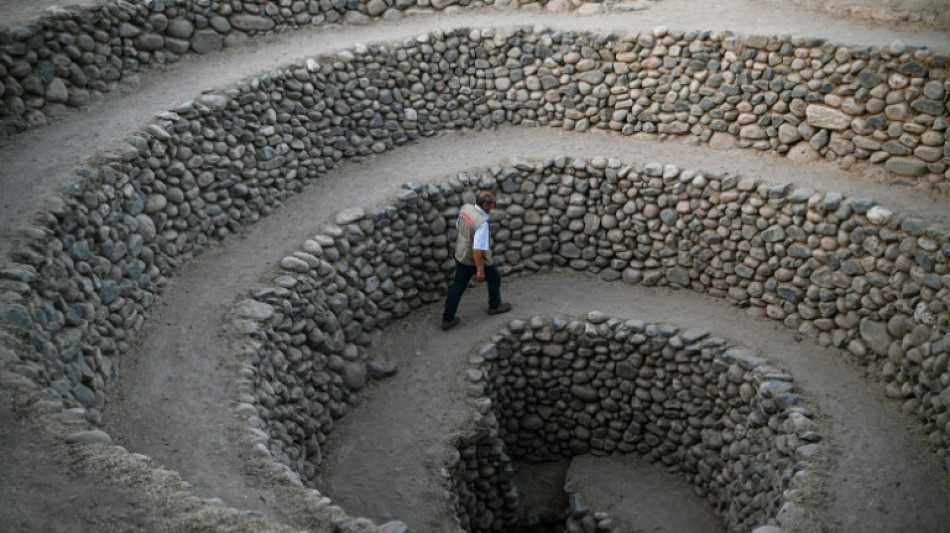
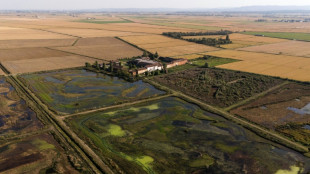
Pre-Hispanic aquaducts irrigate modern Peruvian crops / Photo: ERNESTO BENAVIDES - AFP

 One dead as Hurricane Simon creeps along Mexico's Pacific coast

 Carrick's Man United 'hungry and eager' to fix worst start in decades

 Fury as US federal agents search anti-Trump lawmaker's home

 One goal enough for Flick as Barca enter Galatasaray cauldron

 A7 to unveil a service that will re-invent the international payments market

 'Status quo' with EU 'not good enough', UK PM says as summit date set

 Stolen Renoir paintings found behind wall in France

 French supermarkets suffer refrigerator shutdown after 'unprecedented' cyberattack

 Arsenal lose Hincapie and Zubimendi in freak double blow

 Saudi says resilience tested, vows response after deadly airport attacks

 Alcaraz exits Shanghai Masters in straight-sets loss

 Pope to enter hospital on Tuesday for lung operation

 Renshaw shines again before Australia declaration

 Atletico's Simeone encourages goalless Alvarez improvement
 FXGLOBE Rebuilds Its Copy Trading and PAMM Business With B2BROKER's B2COPY

 Nepal rescuers search for missing after flash flood

 Oil rises as Trump comments roil energy markets

 Premier League in limbo as Manchester City soar

 Zelensky vows to respond as Moscow silent on 'energy ceasefire'

 Thousands march in India's capital to demand election chief resign

 African players in Europe: Mbeumo ends goal drought as United draw
 France's high school students plan fresh protests

 NZ bank in free speech row over 'explicit' sheep memes

 China Open champ Zheng withdraws from Wuhan citing fatigue

 Brewers edge Dodgers 2-1 in National League Championship Series opener

Built some 1,700 years ago by the pre-Hispanic Nazca people of Peru, an ingenious aqueduct system of wood and stone still provides farmers with water to this day.
The complex labyrinth of channels and pits up to 15 meters (49 feet) deep brings critical drinking and irrigation water from faraway mountains and rivers to about 900 subsistence farming families in the Nazca desert in southern Peru.
In an otherwise arid landscape, they grow potatoes, cotton, vegetables and fruit trees.
"It helps us to irrigate," said farmer Nicolas Quispe, 39, who waters his potatoes from the Nazca aqueduct system "thanks to the ancient farmers who had this advanced technology."
Families like his pay a yearly fee equivalent to about $32 for the supply.
Often hailed as a marvel of ancient hydraulic engineering, the aqueducts have been submitted by Peru to UNESCO for listing as a cultural heritage.
According to the UN body, until the aqueducts were built, the shortage of water in the Peruvian desert hindered human settlement in an area where rivers are dry for most of the year.
"The inhabitants of the Nasca culture managed to use the water from the underground water table through a technological innovation, formed by underground aqueducts that operated through a system of filtering galleries," the UNESCO website explains.
"It is a simple system apparently, but at the same time it is sophisticated."
The system can transport some of 18 to 20 liters of water per second, according to Peruvian authorities.
The aqueducts, 42 in total, are believed to have been built by the same people responsible for Peru's famous Nazca lines -- a series of geometric and animal figures carved into the desert which can only be appreciated from the sky.
The function or meaning of the lines -- a World Heritage Site since 1994 -- remain unclear. Some believe they were for astronomical observation, others that they were part of a calendar.
As for the aqueducts, "we estimate that 29 are still in operation and thanks to this hydraulic system, as you can see, the entire valley is green," government archaeologist Abdul Yalli told AFP.
"This is a work of art, of architecture and of engineering," said Jorge Lopez-Doriga, a spokesman for the AJE Group multinational supporting local authorities in the upkeep of the aqueducts.
"These stone channels, which had required the removal of millions of tons of sand to build, continue to function," he added.
Z.Ramadan--SF-PST