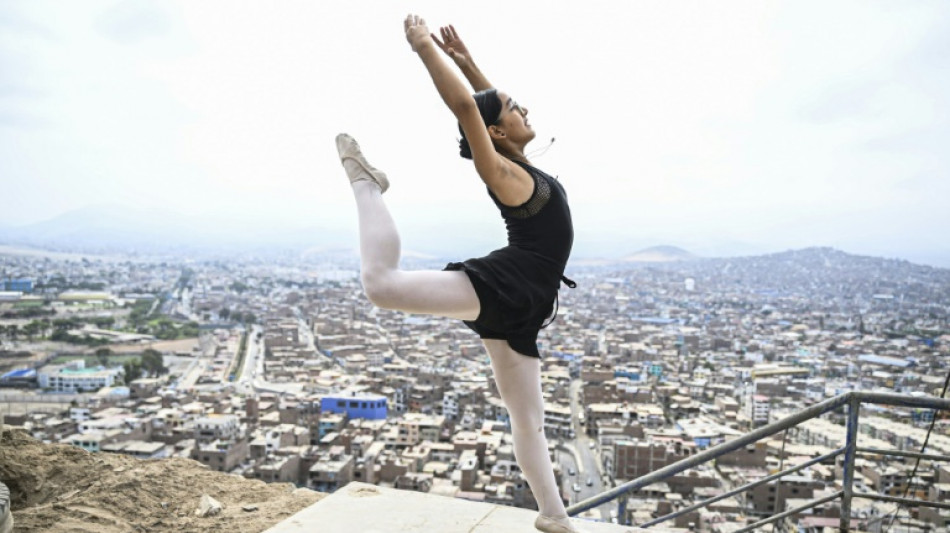
At a ballet in Lima shantytown, dancers - and self-esteem - soar / Photo: Ernesto BENAVIDES - AFP

 Teenager shoots headmaster, teacher at French school

 'Breaking Bad' actor RJ Mitte dead: representatives

 Former DR Congo president Kabila forms new force with M23 armed group

 Tom Cruise's 'Digger' tanks, leaving studio with $250 mn hole

 US actress Selma Blair arrested after flight altercation

 One dead as Hurricane Simon creeps along Mexico's Pacific coast

 Carrick's Man United 'hungry and eager' to fix worst start in decades

 Fury as US federal agents search anti-Trump lawmaker's home

 One goal enough for Flick as Barca enter Galatasaray cauldron

 A7 to unveil a service that will re-invent the international payments market

 'Status quo' with EU 'not good enough', UK PM says as summit date set

 Stolen Renoir paintings found behind wall in France

 French supermarkets suffer refrigerator shutdown after 'unprecedented' cyberattack

 Arsenal lose Hincapie and Zubimendi in freak double blow

 Saudi says resilience tested, vows response after deadly airport attacks

 Alcaraz exits Shanghai Masters in straight-sets loss

 Pope to enter hospital on Tuesday for lung operation

 Renshaw shines again before Australia declaration

 Atletico's Simeone encourages goalless Alvarez improvement
 FXGLOBE Rebuilds Its Copy Trading and PAMM Business With B2BROKER's B2COPY

 Nepal rescuers search for missing after flash flood

 Oil rises as Trump comments roil energy markets

 Premier League in limbo as Manchester City soar

 Zelensky vows to respond as Moscow silent on 'energy ceasefire'

 Thousands march in India's capital to demand election chief resign

On a barren shantytown hill in Lima, a group of girls in white leggings gamely tiptoe around a rocky, dusty path. "And onnnne, twoooo, threee, fourrr", hums the ballet instructor whose day job is selling trash.
It's not likely any of her students will make it as a professional dancer, says Maria del Carmen Silva, or La Miss, as her students call her -- slang for teacher here.
Today, the teacher on the hill is more interested in healing than in the talent of her little "fairies."
Silva started classical dance at the age of 12, danced until she was 33 and today, at 58, she is leading an initiative to improve the lives of poor girls and teens through ballet -- long associated with a demanding (thin and white) aesthetic.
We had to be "thin, with long limbs, a small head and extremely flexible," recalls the former dancer with the national ballets of Peru and of neighboring Chile.
Silva, who is fair haired and has light eyes and a comfortable life, began volunteering in 2010 at a public school in the very poor coastal district of Chorrillos.
There she met the girls of San Genaro II, a settlement 300 meters above the level of the Pacific where in the last four decades some 500 families have settled in wooden houses with corrugated metal or zinc roofs.
- Rehearsing on the hill -
An endless number of stairs zigzag up the hills above Chorrillos, where the poor live.
Up here, there is no drinking water, and locals are supplied by tanker trucks or public wells.
Most people in the neighborhood eke out a living in the informal sector which in all of Peru reaches 75 percent of the working population, the highest rate after Bolivia, according to the International Labor Organization.
Silva confesses, half ashamed, that she came to school looking for a typical dancer, but she found girls with "short legs, flat feet or without much instep."
Sadly, above all, so many could barely muster a smile, when their everyday concerns were so pressing.
"Some of the girls have their dads in jail; others have been raped or mistreated by their parents; and some have told me: my dad beats my mom," she notes sadly.
"I am from a different economic class, so I didn't even realize that they were leaving because they couldn't afford the clothes; because they don't even have water and sometimes not even anything to eat," she says.
That's when she said she had a mental breakthrough.
"I told myself: forget about that perfect dancer, that perfect prototype, and reach out to the human being."
Now she organizes some rehearsals on the hill, despite the fact that her knees already suffer from the bustle between San Genaro II, the school, and the small school that she runs in a religious complex in Miraflores, one of Lima's more affluent districts.
- 'A different person' -
In that place, girls from "both economic situations" sometimes mix and it is a collection point for donations and for the cardboard, paper and bottles that the Silva ballet recycles to raise funds for costumes.
But only a few of those who attend the Silva ballet, she points out, realize the world of dirt and poverty from which her "fairies and princesses" emerge.
"Balance, balance, 'leap,' and up and two," she croons as she guides nine schoolgirls on a busy thoroughfare.
"I try to bring beauty where everything seems ugly, a drop of light where everything is black," says Silva pointing to the group with a grimace: "Despite the dirt from home they already want to be clean, they have their hair well combed, now they don't walk with their eyes looking at the ground.
She firmly believes that her ballet heals self-esteem.
"I didn't consider myself pretty. I was very shy, didn't say anything and now I can express myself," confirms 20-year-old Maria Cielo Cardenas.
"In ballet I am a different person, I feel like a princess, especially when we have performances and we put on costumes and crowns," she says. In January she and her partner Kerly Vera, 19, won a scholarship to study dance in Barcelona.
Z.Ramadan--SF-PST