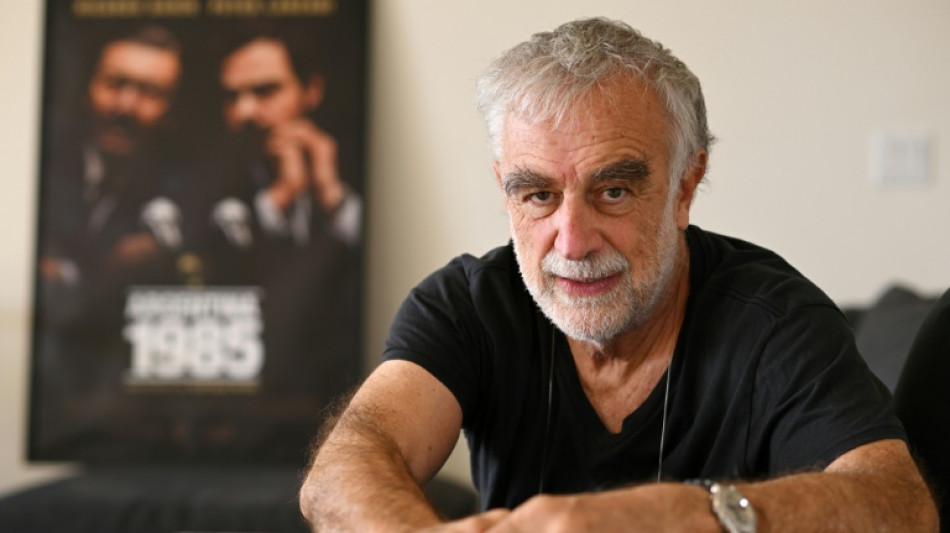
Oscar hopeful 'Argentina, 1985' offers lessons on democracy: prosecutor / Photo: Robyn BECK - AFP

 Fiji appoint ex-Springboks boss White as coach ahead of World Cup

 Hungary to reverse Orban-era anti-LGBTQ legislation
 Allen rushes Bills to thrilling 37-34 win over Rams
 India youth shift tactics as police clamp down on election protest
 Malaysia's Firefly extends flight cancellations due to haze

 IMF upgrades 2026 growth forecast but warns of 'split' outlook
 Infantino could pull off 'Houdini' act as critics struggle for candidate

 France braces for fresh nationwide student demonstrations
 Ahead of Israel vote, desert town becomes frontline against ultra-Orthodox expansion

 El Nino Watch: the impacts around the world this week

 Man City, PSG clash at contrasting time for state-backed projects
 Melbourne imam denies links to suspected flydubai hijacker
 Coventry crush Newcastle to climb out of relegation zone
 'Devastating' waves leave California beach homes on brink of collapse
 Meta says its new AI models on par with OpenAI, Anthropic

 Talarico rejects mental health conspiracy theory after return from flu
 Brazil presidential candidate Flavio Bolsonaro to visit jailed father

 Brazil's patron saint reappears in polarized election campaign

 US Open champ Zverev to become tennis world number one

 Migrant crisis wounds unhealed in Ceuta as Spanish royals visit

 Brazilian judge allows Flavio Bolsonaro to visit jailed father

 France braces for fresh student demonstrations as Macron calls for 'respect'

 Zelensky doubtful on Russian acceptance of Trump's 'energy ceasefire'

 Federal agents search home of Trump critic Ilhan Omar: government

 Pakistan detains hundreds from ex-PM Khan's party as protests falter

Luis Moreno Ocampo was just 32 years old and had no trial experience when he was summoned to prosecute Argentina's generals in 1985 after a disastrous military dictatorship -- a story retold in an Oscar-nominated film.
Moreno Ocampo, who went on to become the first prosecutor of the International Criminal Court, says "Argentina, 1985" can help teach global audiences about the risks of losing democracy -- and the importance of public opinion.
"You've got to win your case in court. But then it's a battle for the memory," the 70-year-old Ocampo told AFP in an interview in Malibu, California, where he currently lives.
"I won the battle... in 1985. But (with this movie), Santiago Mitre and Ricardo Darin are winning the battle for memory in 2023, and that's unique."
Mitre is the director of "Argentina, 1985," one of five nominees for the Academy Award for best international feature.
It tells the story of one of the most important trials in the country's history, and puts the focus on the tensions as the Latin American nation groped its way back to democracy after seven years of murderous military government from 1976 to 1983.
Moreno Ocampo (Peter Lanzani), who himself hailed from a traditional military family, is appointed by lead prosecutor Julio Strassera (Darin) to help try nine of the uniformed men who had ordered thousands of killings and disappearances.
The trial led to the convictions of six men including former dictator Jorge Videla and key junta member Emilio Massera, who were jailed for life.
The proceedings, compared to the Nuremberg trials after World War II, also sharply divided Argentines -- and even Moreno Ocampo's own family.
"The movie shows how my mother was against me," said Moreno Ocampo, who is now a visiting professor at the University of Southern California and a senior fellow at Harvard.
"My mother went to church with the dictator general Videla!"
But as one of the film's most painful scenes reveals, the harrowing first testimony of the trial -- that of a woman who is forced by her captors to give birth handcuffed in the back seat of a patrol car -- changed her mind.
"The next day she called me... She told me: 'I still love General Videla, but you are right, he has to go to jail'."
- Torture -
"Argentina, 1985" shows how the military regime set up detention, torture and extermination camps, with people being thrown alive into the sea from airplanes, shot or detained indefinitely.
Some 30,000 Argentines disappeared, and it is estimated that hundreds of babies born in captivity were given to other families, including military families.
Moreno Ocampo says holding those responsible to account is vital if a country is to come to terms with its past and become a stable and secure democracy -- something he says Brazil, for example, did not do.
"They did not investigate the past... this has an impact. In Brazil, they feared that the military could get involved in a coup in the near future," he explained.
"The problem is not the military, because they follow orders. It's the elites -- if your elites support a coup, you have a problem," he says.
"It's something that Brazil, and even the United States, hasn't understood," he adds, referring to the 2021 assault on the US Capitol in the waning days of Donald Trump's presidency.
"When journalists ask me how to avoid coups d'etat... the issues are not those involved in the sedition, the issue is who was supporting them," he told AFP.
"The elite supporting civilian sedition, like in Washington -- they are the problem."
- 'Power of youth' -
Argentina has won two Oscars previously, both for films that tackled the years of military terror: "The Official Story" in 1986 and "The Secret in Their Eyes" in 2010.
Moreno Ocampo -- who will attend the Oscars on Sunday -- says he hopes that this year's offering, with its focus on the role young people played in achieving justice, will bring the four-decade-old story of Argentina's emergence from dictatorship to a new audience.
"My 23-year-old son didn't know what had happened. Now he's learning," he said.
"This film is about the risk of (losing) democracy. But it's also about the power of youth -- how young people are the ones who change the world and how you have to continue to battle for justice.
"Justice is a never-ending job."
W.Mansour--SF-PST