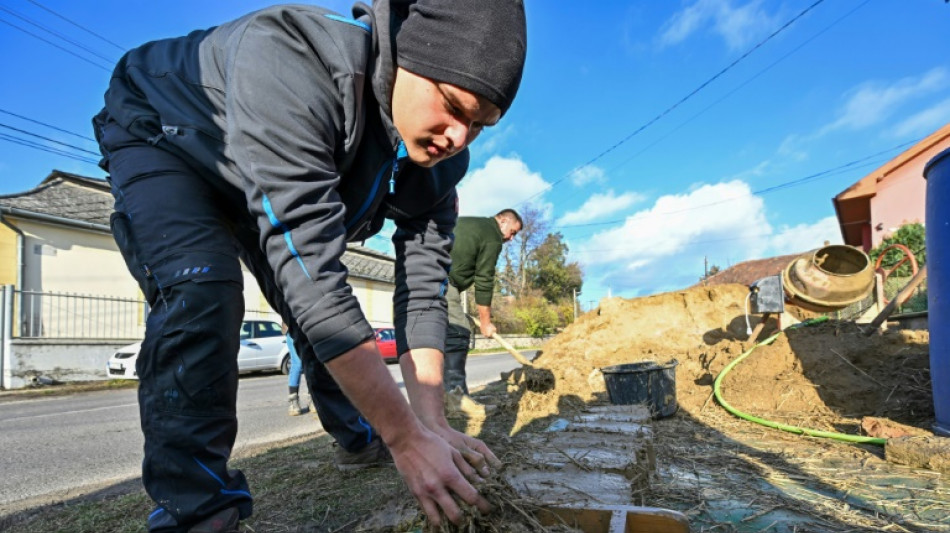
Eco-friendly mud houses make comeback in Hungary / Photo: ATTILA KISBENEDEK - AFP

 Hungary cuts anti-LGBTQ legislation from Orban-era law

 'Our future is being robbed': Greta Thunberg joins France student protests

 Late superstar Anita Mui's ashes missing in Hong Kong

 'No choice': IMF says developing countries must cut spending despite war shock

 Boasting South Korea footballers spark rethink of military service exemptions

 Five dead as Hurricane Simon, Rachel pummel Mexico's Pacific coast

 Seoul, Tokyo stocks plunge as Asia suffers fresh tech rout

 Damaged and drained, Indonesia's peatlands go up in smoke

 Dominant Australia wary of Pacific threat at Rugby League World Cup

 Pope to be admitted to hospital for lung operation

 Samoa's McFarland welcomes 'massive' arrival of ex-All Blacks for World Cup run-in

 Brewers beat Dodgers 7-4 to extend MLB playoff lead

 Teenager shoots headmaster, teacher at French school

 'Breaking Bad' actor RJ Mitte dead: representatives

 Former DR Congo president Kabila forms new force with M23 armed group

 Tom Cruise's 'Digger' tanks, leaving studio with $250 mn hole

 US actress Selma Blair arrested after flight altercation

 One dead as Hurricane Simon creeps along Mexico's Pacific coast

 Carrick's Man United 'hungry and eager' to fix worst start in decades

 Fury as US federal agents search anti-Trump lawmaker's home

 One goal enough for Flick as Barca enter Galatasaray cauldron

 A7 to unveil a service that will re-invent the international payments market

 'Status quo' with EU 'not good enough', UK PM says as summit date set

 Stolen Renoir paintings found behind wall in France

 French supermarkets suffer refrigerator shutdown after 'unprecedented' cyberattack

They were long derided as old-fashioned symbols of grinding poverty, but mud and straw houses are making a comeback in Hungary as a low-cost, eco-friendly alternative to concrete.
Master builder Janos Gaspar, who renovates earth houses, is worked off his feet.
"I'm booked up for three years. Interest is sky-high," the 48-year-old -- who has built more than 200 clay houses -- told AFP.
Known as rammed earth construction, the practice dates to Neolithic times.
And it is seeing a revival thanks to its tiny ecological footprint and energy efficiency.
Locally accessible materials is the basis of what Gaspar's architect colleague Adam Bihari calls "natural architecture".
"Hungarians knew how to build houses from what they had to hand or under their feet," said the bespectacled Bihari as a clay brick wall was plastered with mud in the town of Acs in northwest Hungary.
"This wall was made 100 years ago, and should be around for another 100," said Bihari.
- 'Material of future' -
In contrast to concrete, which accounts for about eight percent of global CO2 emissions, "it eventually disintegrates naturally, leaving no artificial waste behind," he said.
With Gaspar, Bihari teaches his methods to scores of trainees every year. In the yard beside piles of sandy earth and straw, a dozen watched Gaspar demonstrate how to make mud bricks.
"This type of soil is perfect, and it's found everywhere around Hungary," said Gaspar as a cement mixer churned the ingredients into a mulch.
"You can make one brick a minute, and around 20,000 will make a house," he told the group while kneading handfuls of the mixture into a wooden mould.
The centuries-old practice fell out of fashion during the country's four-decade-long communist era.
"Folk traditions were officially frowned upon and modern materials took over," said Bihari, 33.
Clay brick walls were often cemented over which caused rot as dampness got trapped, he added.
More than one in seven Hungarians still live in earth-built homes, mostly in villages in poorer regions.
Bihari said it is hard to counter long-held associations with damp and poverty.
But interest in natural materials is increasing among developers and investors, according to the architect.
"It is the building material of the future," he said.
- 'Naturally smart' -
Bihari said clay's thermal properties make it ideal for Hungary's fluctuating climate of hot summers and cold winters.
One of the camp participants, Timea Kiss, who already owns a clay house but wants to learn how to renovate it, said her building is naturally warm in winter and cool in summer.
"Amazed visitors ask us where the air conditioning is, but there is none," said the 42-year-old.
Earth homes also regulate their own humidity, said Bihari, which can help people with asthmatic problems. They are also fireproof and non-toxic.
"You hear about 'smart' houses and even smart bricks," said Bihari. "But for me that is nonsense... clay is naturally smart."
Rising energy costs is another push factor behind the growing popularity of earth houses.
Several of the trainees in Acs told AFP they can no longer afford to build or buy conventional houses.
"My wife and I are interested in cheaper solutions like this, it's a bonus that it's good for the environment," said truck driver Zsolt Cserepkei, 31.
F.AbuZaid--SF-PST