
World must rein in autonomous weapons: UN, Red Cross / Photo: LOUAI BESHARA - AFP

 Complaints upheld against Swiss TV commentary on Israeli bobsleigher

 Tielemans glad Man Utd sticking with Carrick

 Scottish police probe Andrew, Epstein stay at royal castle: UK media

 Medvedev into Vienna semis and books ATP Finals place

 UN nature talks in extra time as nations struggle to reach deal

 Meta settles, leaving Snap sole defendant in new social media trial

 Chelsea manager Alonso dismisses talk of Estevao loan deal

 Thousands of students, workers hold peaceful protests in Italy

 Iraola glad to raise Liverpool fans' hopes but says hard work ahead

 Pope Leo makes history with US midterm vote

 Arsenal boss Arteta fires 'Disneyland' warning at Dowman after Fleetwood red card

 Russia's ice hockey stars come in from the cold after CAS ruling

 Wall Street tech rout deepens on doubts over AI spending
 'Life in the old dog': German economy grows more than expected

 England great Anderson asks what's 'wrong with me?' after Lancashire exit

 Markets lashed by tech rout as earnings fan AI fears

 Germans to join Europe's youth protest wave

 Novaya Gazeta closure part of Russia's 'giant military campaign': Muratov to AFP

 US oil giants report profit surge again on Iran war

 Tech sell-off deepens as earnings fan AI fears

 مقتل عامل بمحطة زابوريجيا النووية في هجوم بمسيّرة

 غريزليز يهزم بليزرز ويحافظ على انطلاقته الكاملة في دوري السلة الأميركي

 الدفاعات السعودية تدمر أربعة صواريخ أطلقها الحوثيون
 الذهب يتراجع مع ارتفاع توقعات زيادة الفائدة الأميركية

 إضرابات في أكثر من 100 ميناء احتجاجاً على شحن الأسلحة

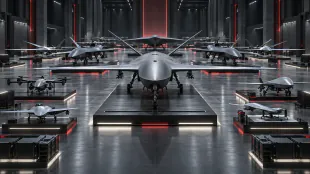
The United Nations and the Red Cross warned Tuesday that the world is "dangerously close" to a future where so-called "killer robots" could target humans, and issued an urgent appeal for international regulation of autonomous weapons.
The warning follows a 2023 call by UN Secretary General Antonio Guterres and Mirjana Spoljaric, president of the International Committee of the Red Cross (ICRC), for specific bans and restrictions on the rapidly-developing technology by this year.
"Today, we renew this call with even greater urgency," they said in a joint statement, adding that while their "fundamental concerns remain unchanged... the risks have intensified".
"We are now dangerously close to crossing a moral red line: the autonomous targeting of humans by machines," they warned.
Lethal autonomous weapon systems are generally understood as weapon systems that select targets and apply force without human intervention.
"Autonomous weapon systems are already used in the battlefield, they are used in broader environments, and that increases the risk for civilians being killed," Laurent Gisel, head of ICRC's arms and conduct of hostilities unit, told reporters.
There has so far been no confirmed use of fully autonomous weapons to directly target humans, according to experts.
But with global tensions soaring and conflicts raging in the Middle East and in Ukraine, where drone warfare has become a major feature, fears abound that it could happen soon.
- 'Political courage' -
After years of discussions, countries are due to decide in November whether to launch full-on treaty negotiations.
"We urge states to seize this moment," Guterres and Spoljaric said.
They called for "political courage", saying: "A failure to act quickly and decisively will cost lives."
"Autonomous weapon systems are not part of a distant future: a race towards greater autonomy in weapons systems is already well under way," they said.
"Future generations will ask whether leaders acted when there was still a chance to set limits before these weapons proliferated beyond control."
Gisel stressed that the ICRC was not calling for prohibitions of all autonomous weapons systems.
However, he said, bans were essential on two categories of weapons that are "the most unacceptable" and "present the biggest risks of international humanitarian law violations with grave humanitarian consequences and an increase in the human cost of armed conflict."
Those categories were "unpredictable autonomous weapons", where "the operators cannot adequately predict, anticipate the effects of the use of force", and "anti-personnel autonomous weapons systems", which directly target human beings, he said.
Guterres has long warned of the dangers posed by such systems, insisting last month that "machines selecting and engaging their target and taking a life, without human control and judgement... is morally repugnant... and it must be banned by international law".
In Tuesday's statement, the UN and Red Cross chiefs highlighted that scientists and engineers involved in developing weapons systems had, in many cases, raised the alarm themselves.
"When the architects of this technology are calling for limits, states cannot afford to remain passive," they said.
The need for clearly defined rules was "urgent", they said, insisting that "innovation must serve humanity -- not endanger it".
I.Matar--SF-PST