What a record-breaking El Nino could mean for the world / Photo: REINA - AFP/File

 Complaints upheld against Swiss TV commentary on Israeli bobsleigher

 Tielemans glad Man Utd sticking with Carrick

 Scottish police probe Andrew, Epstein stay at royal castle: UK media

 Medvedev into Vienna semis and books ATP Finals place

 UN nature talks in extra time as nations struggle to reach deal

 Meta settles, leaving Snap sole defendant in new social media trial

 Chelsea manager Alonso dismisses talk of Estevao loan deal

 Thousands of students, workers hold peaceful protests in Italy

 Iraola glad to raise Liverpool fans' hopes but says hard work ahead

 Pope Leo makes history with US midterm vote

 Arsenal boss Arteta fires 'Disneyland' warning at Dowman after Fleetwood red card

 Russia's ice hockey stars come in from the cold after CAS ruling

 Wall Street tech rout deepens on doubts over AI spending
 'Life in the old dog': German economy grows more than expected

 England great Anderson asks what's 'wrong with me?' after Lancashire exit

 Markets lashed by tech rout as earnings fan AI fears

 Germans to join Europe's youth protest wave

 Novaya Gazeta closure part of Russia's 'giant military campaign': Muratov to AFP

 US oil giants report profit surge again on Iran war

 Tech sell-off deepens as earnings fan AI fears
 مقتل عامل بمحطة زابوريجيا النووية في هجوم بمسيّرة

 غريزليز يهزم بليزرز ويحافظ على انطلاقته الكاملة في دوري السلة الأميركي
 الدفاعات السعودية تدمر أربعة صواريخ أطلقها الحوثيون

 الذهب يتراجع مع ارتفاع توقعات زيادة الفائدة الأميركية

 إضرابات في أكثر من 100 ميناء احتجاجاً على شحن الأسلحة

This year's El Nino is on track to be the strongest on record, threatening to unleash extreme weather across the globe and make 2027 the hottest recorded year by far.
Stacked on top of long-term human-caused climate change, the temporary jolt will offer a glimpse of the heat the world can expect by the late 2030s, experts say.
Here's what to know.
- What is El Nino? -
El Nino is the warming phase of a natural cycle in the tropical Pacific known as the El Nino-Southern Oscillation (ENSO).
It sets in when trade winds that blow from east to west temporarily ease up, allowing warm water which normally piles up in the western Pacific Ocean to slide back east and rise to the surface.
When those warmer-than-average surface temperatures last for a few months, they cause more storms and clouds over the region, "which cause ripple effects through the entire global atmosphere," explained Emily Becker, a climate scientist at the University of Miami.
The upshot is hotter and drier conditions in some places, cooler and wetter in others.
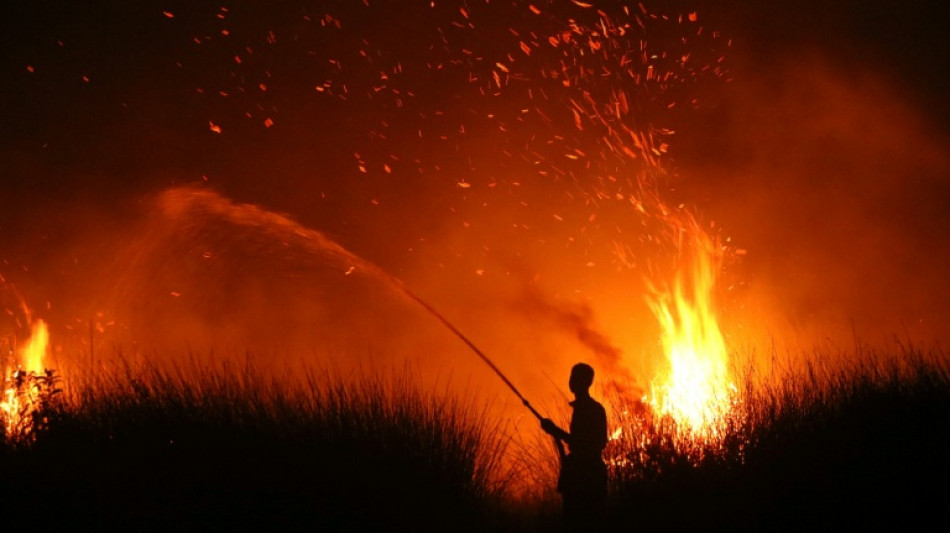
Some effects are already being felt. For example, Indonesia's long, intense dry season has fed wildfires that have burned hundreds of thousands of hectares.
"Stronger events mean that we can expect to see more of these expected El Nino impacts," Michelle L'Heureux, ENSO team lead at the National Oceanic and Atmospheric Administration (NOAA)'s Climate Prediction Center, told AFP, though she cautioned none are guaranteed.
- What's going on this year? -
Daily sea surface temperatures in the Nino 3.4 region -- an imaginary box in the Pacific -- are currently running about 2.6C above a rolling 30-year-average, according to the highly cited Climate Brink dashboard, which draws on NOAA's satellite-and-buoy sea surface record.
The dashboard also aggregates forecasts that put El Nino on course to peak at a 3.9C anomaly this November -- well above the 3C anomaly detected in the 2015 El Nino.
It stands to make this year a contender for the hottest year on record, currently held by 2024, and make 2027 a near certainty for top spot, since most of the heat impact is felt the following year.
According to calculations by climate scientists Zeke Hausfather and Andrew Dessler, El Nino will add a temporary 0.3C on top of the long-term global warming trend, resulting in a 2027 temperature of 1.76C above preindustrial levels -- compressing into a single year as much warming as would otherwise be expected by 2037.
"It's kind of a preview of the future," Dessler, a professor at Texas A&M told AFP, though much of that heat will be focused in the equatorial Pacific.
Mike McPhaden, a senior scientist at NOAA's Pacific Marine Environmental Laboratory, had a similar estimate, telling AFP: "It's not inconceivable that 2027 may top out at 1.7C above preindustrial levels" if model forecasts bear out.
There is not one single accepted way to measure El Ninos.
NOAA in February adopted the Relative Oceanic Nino Index (RONI), which gauges warming in the Nino 3.4 region against warming across the whole tropical belt, to try to better represent the ocean-atmosphere system driving ENSO impacts.
On that scale, the numbers run lower but the predicted ranking remains the same: NOAA puts the odds at 69 percent that this El Nino will be the strongest in its dataset going back to 1950.
- How climate change fits in -
Scientists agree climate change increases El Nino's impacts.
Our greenhouse-gas-warmed atmosphere holds more moisture, so El Nino-linked rains can turn more extreme. It also dries out soils, deepening drought where El Nino brings drought.
There is less consensus on whether climate change itself triggers stronger El Ninos, though evidence for this is emerging.
"Climate change may be amplifying the El Nino cycle itself," said NOAA's McPhaden.
Warmer tropical seas make the winds that drive El Nino more responsive to the ocean, tightening the feedback between the two and letting events build faster, he explained.
McPhaden cited evidence from the paleo-record -- for example coral skeletons -- instrument readings that stretch back to the 19th century, and climate modeling which suggest El Ninos may have increased in amplitude by about 10 percent over the past century.
N.Shalabi--SF-PST