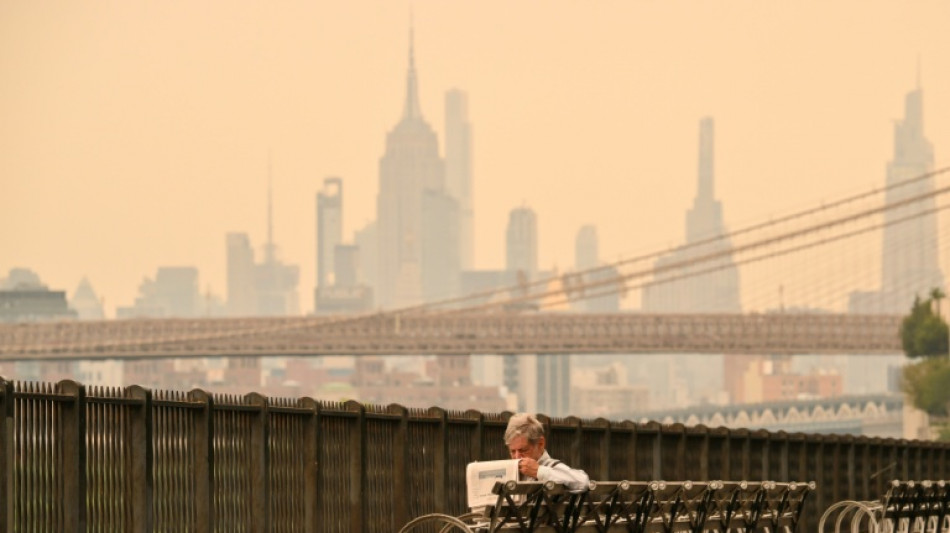
Canadian wildfire sends hazardous smoke spewing into US / Photo: ANGELA WEISS - AFP/File

 Philippine ferry fire kills 5, dozens missing

 Oil prices flare as Iran tightens grip on Hormuz

 Japan gymnasts under injury cloud for home Asian Games

 India trailblazer won't 'let go' of chance for Asian weightlifting glory

 Zverev cruises past van de Zandschulp into US Open semis

 Myanmar tin mega-mine restarts operations: think tank

 Online and undercover: saving trafficked wildlife in Thailand
 Antonelli faces new challenge after stirring triumph in Monza

 Korda leads US bid to win first away Solheim Cup since 2015

 Eurozone rate-setters to hike borrowing costs as energy prices jump

 As oceans warm, Florida scientists hunt for heat-resistant coral

 Trump takes center stage as Republicans fight midterm tide

 Gauff takes inspiration from Tiafoe in US Open fightback win

 Ralph Lauren opens fur-free New York Fashion Week

 Arteta lauds in-form Odegaard as 'remarkable' Arsenal edge Napoli

 Rogers hails Alonso for 'exciting' Chelsea goal spree

 Mac Allister caps Liverpool comeback against Atletico Madrid

 With No. 1 ranking secured Rybakina eyes more Grand Slam glory

 Chelsea hit Leeds for six to advance in League Cup

 PSG thrash Slovan in Champions League opener, Liverpool down Atletico

 Rybakina advances to US Open semis, seals No.1 ranking

 US-blockaded Cubans appeal to 'Cachita' for divine intervention

 Sabah boss goes from game show contestant to Champions League manager

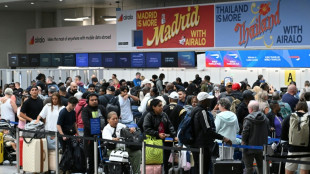 Cyberattack ruled out in UK air traffic glitch that hit hundreds of flights

 Ogura to miss San Marino MotoGP with hand injury

Out-of-control wildfires were raging Thursday in the Canadian province of Ontario, sending dangerous smoke spewing into the United States where millions of people were exposed to the unhealthy air.
US states near the Canadian border including Minnesota, Wisconsin, Michigan and Illinois were particularly choked, as the Northeast including New York was also experiencing deteriorating air quality.
On Thursday afternoon, tracker IQAir listed Minneapolis, Detroit and Chicago as the top three most polluted cities in the world.
A thick, hazy cast hung over New York, where state authorities warned of fine particulate matter from the fires that would make the outdoors "unhealthy" for everyone across the New York metro area and Long Island.
Even worse air enveloped the central and western regions of the state.
Authorities encouraged New Yorkers to spend as little time outside as possible, with Mayor Zohran Mamdani warning of the "serious threat" of heavy heat and unsafe air.
Libraries and train stations were offering free masks, while hundreds of cooling centers were open across the city for those without access to air conditioning.
"This could become the most significant smoke event in New York City since 2023, and conditions will be closely monitored for any deterioration," the city's Department of Emergency Management said.
That year, the city's skies turned an eerie orange, with the air quality index reaching a dangerous 465.
- 'Our chests feel tight' -
In the Midwest, current index levels were already far beyond that figure, according to the US Environmental Protection Agency tracker.
Chicago along with Toledo, Ohio, and areas in Minnesota relatively close to the fires were well into the 700s on the air quality index, with much of the rest of the upper Midwest also experiencing AQI levels in the worst category of "hazardous."
Erin Lucey, 38, works on her family's organic vegetable farm in south-central Wisconsin and spent the morning harvesting zucchini, beans and cucumbers, among other tasks, with laborers wearing masks in muggy heat to filter out the hazy smoke blanketing the area.
"Our chests feel tight," she told AFP, saying the smoke combined with recent searing heatwaves and parched fields left conditions feeling "eerie."
"We are all thinking of the delicate balance of growing food in this type of future, and remarking how we can't imagine what it will be like here in 100 years," she said.
"If people were outside like us working and seeing how everything looks, if they didn't have the convenience of air conditioning, we would be making much faster changes to address the climate crisis," she added.
The Michigan Department of Environment, Great Lakes, and Energy said it expected the dangerous conditions to continue through Friday, and that "our best model for smoke only predicts out to 48 hours."
"That model is currently showing improvements on Saturday, but it is likely that smoke will linger and recirculate for a while," the agency said.
- Evacuations in Canada -
In Canada, the latest data shows there are more than 130 active fires in northwestern Ontario, with at least 60 out of control.
Authorities there have formally requested additional assistance from the federal government, in particular seeking air support to evacuate remote communities.
The Ontario Provincial Police said 15 communities and their surrounding areas have been evacuated so far.
"More than 150 fire crews and nearly 50 firefighting aircraft are working around the clock to protect communities from the fires in northern Ontario," said the province's Premier Doug Ford on X.
So far, Canadian wildfires have scorched at least 1.9 million hectares (4.7 million acres) this year, an area nearly the size of Slovenia.
That damage remains far off the pace of 2023, Canada's worst wildfire season on record, when nearly 18 million hectares burned in the country.
I.Saadi--SF-PST