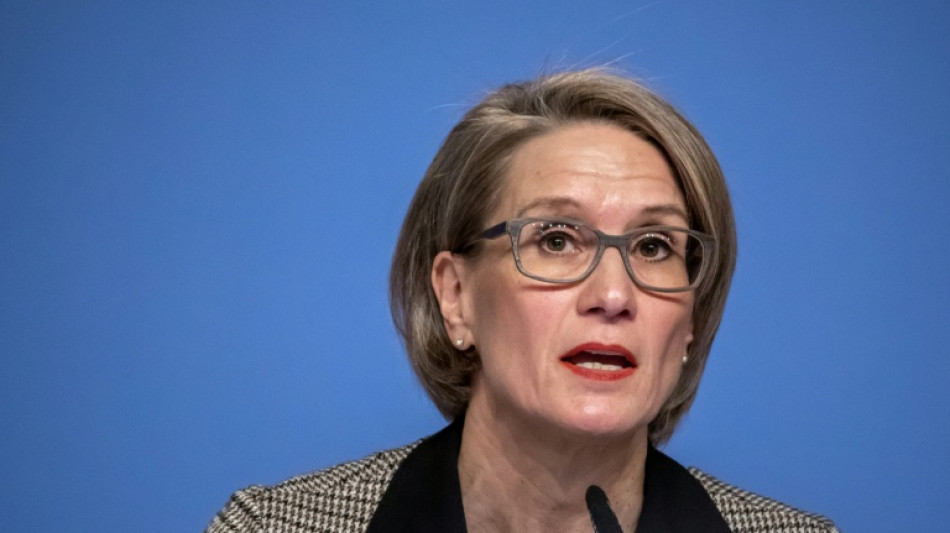
BIS warns 'pressure points' putting global economy at risk / Photo: Fabrice COFFRINI - AFP

 Indonesia rescues six orangutans from fires in a week

 Macron urges Europe to develop 'crewed spaceflight' programme

 Deals worth billions to be signed as UAE leader visits Germany

 Alessio Vinassa Unveils an Emerging Technology Investment Approach Shaped by Financial Challenges

 Sri Lanka court revokes monk's pardon, orders return to prison

 'Hopeless, stuck, afraid': US deportees in limbo in Cameroon

 Mount Fuji ends hiking season with landslide, two rescues

 Seahawks beat Patriots again in NFL opener

 Asian Games begin with Qatar basketball win, nine days before opening ceremony

 Stocks sink as oil rally fans inflation and rate hike fears

 Argentine industry reels from Milei's free-market revolution

 Women quit South Korea's grind for diving tradition

 Bayeux Tapestry 'mania' sweeps UK as sold-out exhibition opens

 August hottest month ever recorded globally: EU monitor

 Duplantis leads creme de la creme at 'game-changing' Ultimate Championship

 Sjobo, cradle of Sweden's now-mainstream anti-migrant sentiment

 Israeli-made film about Gaza civilian deaths to debut in Venice

 Stars ready for busy Toronto International Film Festival

 Rubio defends anti-drug boat strikes, warns of cartel 'cancer'

 Rybakina books US Open semi against Gauff, secures No.1 ranking

 Pegula aiming to thwart Sabalenka three-peat in US Open semis

 'Not normal' US Open scheduling under-fire after late-night finishes

 Luis Enrique hails 'marvellous' Dembele as PSG win big in Champions League

 Liverpool's Iraola 'lucky' after first taste of Champions League

 Resurgent Zheng takes positives from storming US Open run

The Bank for International Settlements warned Sunday of multiple "pressure points" in the global economy, from inflation fuelled by the Middle East war to fears of cooling AI investments, threatening financial stability.
In its annual report, published Sunday, the BIS -- considered the central bank of central banks -- called on monetary policy makers to "act now", to help safeguard the stability of the global economy.
BIS deputy general manager Andrea Maechler acknowledged the situation was difficult.
"Central banks are already facing a complex situation in a world marked by a great deal of uncertainty," she told AFP in an interview.
- 'Threatening financial stability' -
In all, BIS identified four significant pressure points for the global economy, starting with inflation linked to the Middle East war, which began with US-Israeli strikes on Tehran on February 28.
The resulting closure of the crucial Strait of Hormuz -- one of the world's most important energy chokepoints -- has delivered a shock to global energy supplies, hiking costs for everything from plastics to fertilisers.
Also on the BIS list were concerns over the longevity of the artificial intelligence investment boom, which has been buoying global growth and keeping it going through crises like last year's tariff hikes.
BIS warned the surging AI capital expenditure could prove "unsustainable", with the risk of a financial market correction.
And the report highlighted the dangerous combination of persisting financial vulnerabilities and the "exuberant risk appetite" in financial markets, warning the situation "could unwind abruptly".
Higher public debt levels were also an issue for central banks, it said, as they could find themselves torn between making necessary rate-hikes to keep down inflation and fears that doing so would hike debt servicing costs, impacting economic growth.
"Each of these areas of tension is likely to be manageable, but taken together, they risk amplifying one another and threatening financial stability," Maechler warned.
She cautioned that "if tensions were to arise on that front, for example in the event of a change in interest rates or market sentiment, contagion effects could be set in motion".
BIS is also concerned about risks linked to the swelling role of non-bank players like hedge funds in bond markets and in AI investments, and is calling for more oversight over such operations.
There must be "adequate regulation also beyond the banking perimeter", to ensure they can absorb the risks they take, Maechler said.
- Preserving independence -
BIS is also calling on governments to reduce their debt levels to help preserve central banks' room for manoeuvre in the case of economic shocks.
Maechler, herself a former governing board member at the Swiss National Bank, said it was vital for central banks to "be able to carry out their mandate with complete independence".
This was needed, she said, "to defend this fundamental public good, namely price stability and confidence in money, without which an economy cannot function well".
Maechler highlighted that "central banks know that they may have to make difficult decisions that would not have political support at the time they need to be made".
"For this, they need this independence."
B.Mahmoud--SF-PST