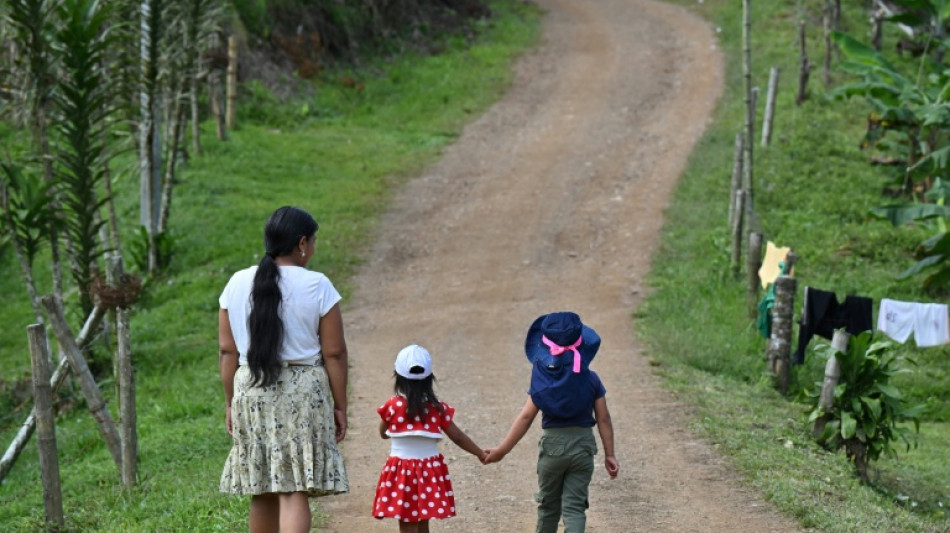
Genital mutilation: the silent suffering of Colombia's Indigenous girls / Photo: Diana SANCHEZ - AFP

 Putin arrives in India for BRICS summit coloured by wars

 Springboks, All Blacks clash in groundbreaking US decider

 Man United, Bayern cruise as Como make dream Champions League start

 Musiala returns to help Bayern sink Bodo in Champions League

 Surging oil prices, higher bond yields weigh on stocks

 Russell admits he needs luck as Antonelli focuses on the job
 Canada pledges support for Ukraine air defense as Zelensky visits

 Latin America fact-check group asks Meta not to replace verification practice

 Seahawks' Darnold gets good news on hip injury: coach

 Evasive Alonso teases reporters on his F1 future

 What to know about Trump's $5,000 'dividend' pledge
 Leclerc concedes he 'went too far' in Hamilton Monza incident
 Shelton, Tiafoe in spotlight as Zverev aims to build on Grand Slam success

 England close in on Test series sweep against sorry Pakistan

 England dominate sorry Pakistan, close in on Test series sweep

 Kung wins Vuelta time-trial as Mas retains lead

 DR Congo school fire leaves at least 14 children dead

 USA and France ease into women's Basketball World Cup semis

 ECB lifts borrowing costs amid energy shock, opens door for more hikes

 France defeat China to reach women's basketball World Cup semis

 Tribal Launches Campfire, Letting Business and Technical Teams Build on Salesforce Together

 Yemen's Houthis seize key city on Red Sea

 US producer inflation tops expectations as diesel costs jump
 Rubio ends South America swing with Peru security talks

 Defiant Iran seeks to bruise Trump ahead of midterms

Alejandrina Guasorna did not discover until adulthood that she had been subjected to female genital mutilation (FGM) the day she was born in a remote Indigenous community in Colombia's coffee-growing region.
In the mountains of Risaralda, home to the Embera people, dozens of babies have their clitoris cut each year in a brutal practice based on traditional beliefs about the need to control girls' sexuality.
Some bleed to death or die of infections from unhealed wounds.
"We often saw dead baby girls. We thought it was normal," said Guasorna, a 74-year-old farm worker who has helped deliver babies in her own family but herself never performed genital cutting.
Colombia is the only Latin American country where female circumcision, believed to have been passed on to Indigenous groups by descendants of African slaves, is known to be still practiced.
Nearly two centuries after Colombia, which was a major hub in the South American slave trade, abolished slavery, a landmark ban on FGM is finally being debated by Congress.
- A blade or nail -
When girls are born in the Embera Chami reserve of Pueblo Rico, a region under Indigenous jurisdiction, midwives use a blade or red-hot nail to remove part of all of their external genitalia, local women told AFP.
The practice, which has declared a human rights violation by the UN and World Health Organization but remains widespread in parts of Africa, is a taboo subject in the Embera reserve.
Many people look away or remain silent, clearly uncomfortable, when the subject comes up.
Guasorna only learned that she had undergone the procedure after hearing rumors that were eventually confirmed by her sister.
Francia Giraldo, an Embera leader, said some babies bleed to death and are never taken to hospital. Parents receive neither birth nor death certificates.
Their mothers, she said, "bury them" straight away.
The bill before Congress, which was drafted by lawmakers together with Indigenous women leaders, aims to end the practice.
It does not, however, provide for midwives who flout the ban to be punished, with Indigenous leaders arguing that the women "lack information" about the dangers of FGM.
It calls instead for a government-led awareness campaign to sensitize them to the suffering caused by the mutilation and to dispel myths about girls who are spared -- that they will grow up to be sexually promiscuous or even that their clitorises will grow into something resembling a penis.
- Pain and secrecy -
Sexual relations are often painful for victims of FGM.
Etelbina Queragama's face is dotted with paint marks that denote her status within her community.
Speaking in Embera, translated into Spanish by one of her seven children, the 63-year-old housewife said she has "never" felt anything but pain during intercourse.
There are no official figures on the practice of genital mutilation, given the secrecy surrounding the custom.
But according to the National Health Institute, at least 204 cases were performed in Colombia between 2020 and 2025.
Sarita Patino, a doctor at a hospital that treats FGM victims in Pueblo Rico, believes the incidence of FGM is "greatly under-reported."
Since the start of the year, she has already seen six cases.
In February, a six-month-old baby was brought in with a fever. "The baby girl had her clitoris mutilated... (it looked) like a burn," Patino said.
- Byproduct of slave trade -
According to the United Nations, an estimated 230 million women and girls around the world are subjected to FGM every year.
In Colombia, the practice is believed to be the product of intermingling between Indigenous and Afro-Colombians who make up around 10 percent of the population but who very rarely still practice FGM.
Carolina Giraldo (no relation of Francia), a historian and Embera congresswoman who drafted the ban on FGM, said it pains her "when people call us (the Embera) murderers and ignorant" over genital cutting.
She hopes to see "women who advocate for women's rights" travel to remote areas to campaign for an end to the silent suffering of Indigenous girls.
L.AbuTayeh--SF-PST