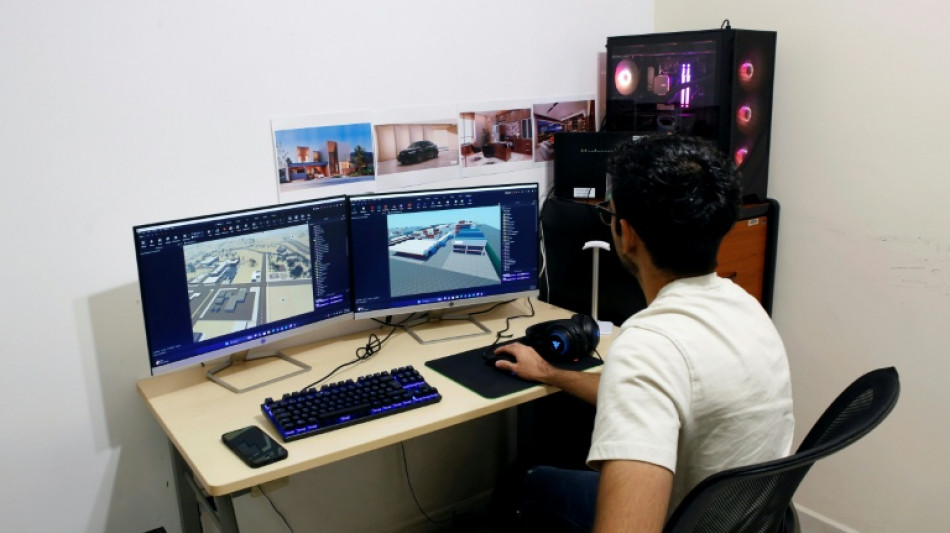
Escapism or exaltation? 'Narco-culture' games raise concern in Mexico / Photo: Julio César Aguilar - AFP

 Belgian Van Aert retires injured on Tour de France warm-up race

 Chiefs reach Super Rugby final in Crusaders humiliation

 Stocks up, oil down on Mideast deal hopes

 At Romania's edge, quiet life meets threat of war

 Switzerland split on immigration vote: four perspectives

 The migration pact: What's in the EU's landmark asylum reform?

 Indonesian Messi superfan welcomes World Cup
 Thai princess dies aged 47 after three years in hospital

 Yangon's furtive party scene belies junta claims of normality
 South Korea defeat Czechs to make strong World Cup start

 Science fiction? Musk's lofty SpaceX goals unrealistic, skeptics say

 'Battery on wheels': Sweden powers homes with EVs

 Happy Birthday Mr. President: Trump to turn 80 with cage fight

 Mideast war helps electric motorbikes boom in Africa

 Ex-Tottenham owner sells art collection in blockbuster auction
 Lightning's Kucherov wins Hart Trophy as NHL MVP

 Co-hosts Mexico kick off World Cup with dramatic victory

 Aguirre says Mexico beat cramps and stage fright in World Cup opener

 Iran's World Cup players take to the training pitch

 Mexico beat South Africa to kick off World Cup
 US stocks rally, oil prices fall as Trump calls off fresh Iran strikes

 Pulisic 'ready to battle' Paraguay in US World Cup opener

 UN experts, MSF condemn crackdown on women by Afghan morality police

 First leather bag made from T-Rex cells fails to sell at Paris auction

 Trump cancels Iran strikes, touts imminent deal
In violence-riddled Mexico, children as young as 13 are hooked on bloody video games that vividly recreate the horrors of the country's narco war.
Some experts say it's a way of coping. Critics, including President Claudia Sheinbaum, see it as monetized glorification of a genre known as "narco culture."
With thousands of daily users, the games allow players to choose whether they want to be a cartel hitman, a police officer or a soldier.
There are wild chases and brutal shootouts, gold-plated pistols, personalized bulletproof helmets, and souped-up cars.
"It really draws me in, seeing things I'd like to have in real life -- for example, who wouldn’t want to have a Lamborghini, or a big truck, a big house?" gaming fanatic Alan Crespo, a 24-year-old farmer from San Blas on Mexico's Pacific coast, told AFP.
Crespo is on the older side of the player age spectrum, with most between 13 and 18 and hailing primarily from northern Mexican states like Sinaloa, Chihuahua and Baja California -- synonymous with cartel violence.
This age group was born amid the wave of violence unleashed in 2006, when the Mexican government militarized the fight against drug trafficking -- a strategy that has claimed nearly half a million lives.
- Hell's Troop -
Dozens of war-like games can be found on online platform Roblox, which allows programming enthusiasts to design their own video games for others to play.
The most popular ones attract up to 1,000 users a day. The games are free, though players can purchase better weapons or uniforms with real money.
The more realistic and gruesome a game is, the more popular, developers say.
"Players aren't interested in seeing made-up names of criminal groups," said Angel Villaverde, a 19-year-old who designs games on his computer in Monterrey in Mexico's northeast.
Users of the game "Tamaulipas Belico," for example, can choose to play as a member of the Jalisco New Generation Cartel (CJNG) or of the Northeast Cartel (CDN).
Both have been designated "foreign terrorist organizations" by US President Donald Trump and are responsible for innumerable deaths, including of civilians.
Matches entail killing off one's enemies to take control of buildings, usually gas stations or shops.
Opponents patrol in camouflaged army pickups or in vehicles decorated with a demon drawing and the number 666 -- the insignia of the CDN's Tropa del Infierno (Hell's Troop) armed wing, known for its extreme brutality.
- 'Apology for violence' -
Mexico's so-called "narco-culture" can also be found in music, films and fashion items glorifying the criminal life.
Sheinbaum rejects what she considers an "apology for violence" and has launched a campaign against the sub-culture, including an eight-percent tax on video games with violent content.
Behavioral scientists say that through gaming, young people may feel they have a sense of control over a violent reality that makes them anxious.
Student Alejandro Solorzano, 18, a game developer from Tijuana, notes that players are "fascinated by going around doing criminal activities."
"It's something warlike, it's something grotesque, but it's fictional at the same time" he told AFP.
Ainhoa Vasquez of Chile's Federico Santa Maria Technical University, says gaming may also be a way of "making sense" of a violent society, of "transferring real anguish" to a fictional realm.
These experiences can be "a catharsis," said Vasquez, who studies cultural representations of the drug trade.
The platform Roblox, which reported some 112 million daily users worldwide in the second quarter of this year, recently tightened its controls to protect minors.
Among other measures, it implemented a system to verify users' ages to prevent harassment by adults on the platform.
B.AbuZeid--SF-PST