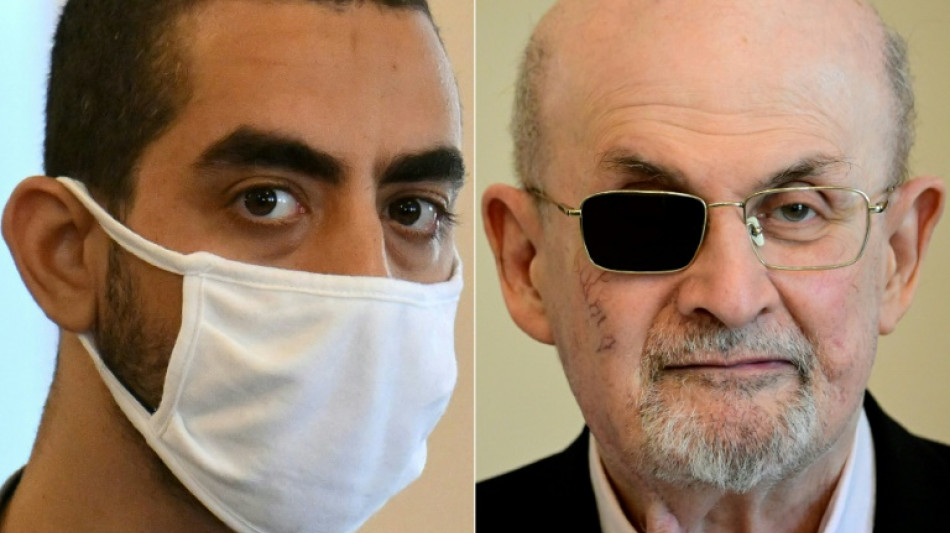
Salman Rushdie attacker faces sentencing / Photo: ANGELA WEISS, Tobias SCHWARZ - AFP/File

 Manchester United rallies past Roma as PSG dominates in Champions League

 Qatar prime minister advances mediation through diplomatic calls

 Greenland parliament approves security agreement with United States

 Qatar envoy meets incoming UN General Assembly president

 Trump Signals Willingness to Work With Democrats After Midterm Defeat

 دي برومهد يفتح خياراته لـ "ذا بيغ ويسترنر" قبل عودته في ويكسفورد

 أزمة الإسكان في البرتغال: تصاعد الأسعار يعمق الانقسامات السياسية حول الحريات

 New York City Center revives In the Heights as a timely community story

 Godzilla Minus Zero shifts focus toward postwar human drama

 Mehbooba Mufti urges dialogue and renewed Central Asia links for Kashmir

 Seacliff Healthcare Seeks Specialist GP in Thirroul

 US stocks fall before midterm Election Day as technology shares weaken

 BLS Polymers makes strong market debut at ₹248 per share
An American-Lebanese man will be sentenced on Friday for trying to kill novelist Salman Rushdie in a 2022 knife attack at a New York cultural center.
Hadi Matar, 27, faces up to 25 years in prison after being convicted of attempted murder and assault charges in February this year.
During the trial, Rushdie told jurors about Matar "stabbing and slashing" him during an event at the upscale cultural center.
"It was a stab wound in my eye, intensely painful, after that I was screaming because of the pain," Rushdie said, adding that he was left in a "lake of blood."
Matar -- who shouted pro-Palestinian slogans on several occasions during the trial -- stabbed Rushdie about 10 times with a six-inch blade.
He previously told media he had only read two pages of Rushdie's "The Satanic Verses," but believed the author had "attacked Islam."
Matar's legal team had sought to prevent witnesses from characterizing Rushdie as a victim of persecution following Iran's 1989 fatwa calling for his murder over supposed blasphemy in the novel.
Iran has denied any link to the attacker and said only Rushdie was to blame for the incident.
- Severe wounds -
The optical nerve of Rushdie's right eye was severed in the attack, and he told the court that "it was decided the eye would be stitched shut to allow it to moisturize. It was quite a painful operation -- which I don't recommend."
His Adam's apple was also lacerated, his liver and small bowel penetrated, and he became paralyzed in one hand after suffering severe nerve damage to his arm.
British-American Rushdie -- now 77 -- was rescued from Matar by bystanders. Last year, he published a memoir called "Knife" in which he recounted the near-death experience.
His publisher announced in March that "The Eleventh Hour," a collection of short stories examining themes and places of interest to Rushdie, will be released on November 4, 2025.
Rushdie, who was born in Mumbai but moved to England as a boy, was propelled into the spotlight with his second novel "Midnight's Children" (1981), which won Britain's prestigious Booker Prize for its portrayal of post-independence India.
But "The Satanic Verses" brought him far greater, mostly unwelcome, attention.
Rushdie became the center of a fierce tug-of-war between free speech advocates and those who insisted that insulting religion, particularly Islam, was unacceptable under any circumstance.
Books and bookshops were torched, his Japanese translator was murdered and his Norwegian publisher was shot several times.
Rushdie lived in seclusion in London for a decade after the 1989 fatwa, but for the past 20 years -- until the attack -- he lived relatively normally in New York.
U.AlSharif--SF-PST