What's a cardinal? The 'princes' of the Church electing a new pope / Photo: Dimitar DILKOFF - AFP

 Abdul El-Sayed declares victory in Michigan Senate contest

 Democrats capture US Congress in sweeping midterm victory

 Manchester United rallies past Roma as PSG dominates in Champions League

 Qatar prime minister advances mediation through diplomatic calls

 Greenland parliament approves security agreement with United States

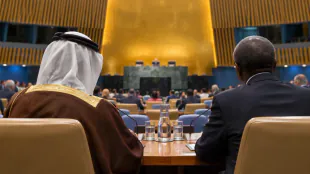 Qatar envoy meets incoming UN General Assembly president

 Trump Signals Willingness to Work With Democrats After Midterm Defeat

 دي برومهد يفتح خياراته لـ "ذا بيغ ويسترنر" قبل عودته في ويكسفورد

 Galloway accuser could not foresee publishing-sector fallout, lawyer argues

 No. 22 UCLA defeats No. 5 Arizona 84-75 despite Kharchenkov's 38 points

 Vessel operator seeks witnesses after Vancouver grounding

Cardinals from all over the world will gather in conclave on Wednesday to elect a successor to Pope Francis. But what exactly is a cardinal?
- High dignitary -
A cardinal (from the Latin "cardinalis", or principal) is a high dignitary of the Catholic Church chosen by the pope to assist him in his government.
The main dicasteries -- the Holy See equivalent of government ministries -- are, for the most part, headed by cardinals.
Their exact title is cardinal of the Holy Roman Church.
Gathered in the College of Cardinals, presided over by a dean -- currently the 91-year-old Italian Giovanni Battista Re -- they form the top echelon of the Catholic Church.
Cardinal being a title and not a function, many of them are bishops of dioceses around the world, while others who hold positions in the Curia, the Vatican's government, live in Rome.
- Pope-makers -
There are 252 cardinals, but only those aged under 80 are eligible to vote for a new pope following a pontiff's death or resignation.
There were 135 cardinal electors when Pope Francis died, but two are not attending the conclave, meaning 133 are gathering on Wednesday.
Held in the renowned Sistine Chapel, the conclave is highly secretive and follows strict rules and ceremonial procedures.
- Created, not named -
Cardinals are not named but "created" by papal decree.
The term derives from Roman times, and implies the recipient is elevated in rank because of his qualities, but not appointed to any vacant post or office.
Under Vatican rules, the pontiff can create cardinals out of men who are "truly outstanding in doctrine, virtue, piety and prudence in practical matters".
- Cardinal's red -
Cardinals wear clothes of scarlet red, a colour once associated with the Roman Senate, an emblem of power, prestige and authority, and later representing the blood of Christ.
They also wear a ring, traditionally a sapphire, as well as a pectoral cross, the crosier, or staff, and the traditional headdress, the mitre.
- A political appointment -
The creation of cardinals reflects the political views of the pontiff, who normally uses this power to shape the selection of his own successor.
During his pontificate, Francis made a point of appointing more cardinals from the "peripheries" of the Catholic world, places previously overlooked by Rome.
- Declining privileges -
Cardinals, who have the title of "eminence", are second only to the pope in the Church's hierarchy and can officiate in all churches outside Rome. They may also be buried in churches.
The Second Vatican Council considerably reduced the privileges granted to the Church's most senior prelates, who previously used to reserve an entire compartment when travelling by train and have a throne room in their residence.
Francis went further, deciding in 2023 that cardinals could no longer enjoy Vatican apartments rent-free.
Two years earlier he had reduced their salaries to help mitigate the damage wrought by the coronavirus pandemic on the Holy See's finances.
E.AbuRizq--SF-PST