Cardinals assemble to elect pope and set course for church / Photo: Alberto PIZZOLI - AFP

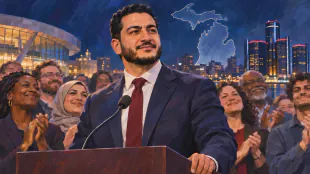
 Abdul El-Sayed declares victory in Michigan Senate contest
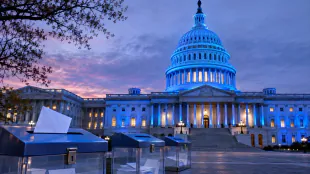 Democrats capture US Congress in sweeping midterm victory
 Manchester United rallies past Roma as PSG dominates in Champions League
 Qatar prime minister advances mediation through diplomatic calls

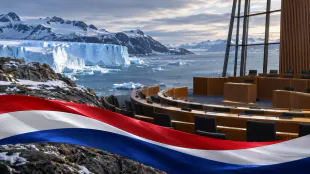 Greenland parliament approves security agreement with United States
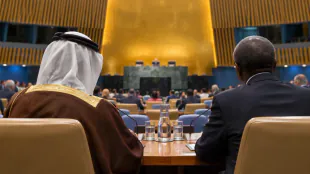 Qatar envoy meets incoming UN General Assembly president
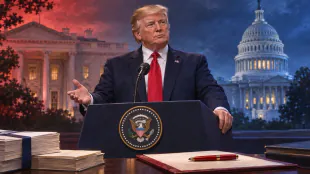 Trump Signals Willingness to Work With Democrats After Midterm Defeat
 دي برومهد يفتح خياراته لـ "ذا بيغ ويسترنر" قبل عودته في ويكسفورد

 Galloway accuser could not foresee publishing-sector fallout, lawyer argues
 No. 22 UCLA defeats No. 5 Arizona 84-75 despite Kharchenkov's 38 points
 Vessel operator seeks witnesses after Vancouver grounding

All 133 Catholic cardinals who will vote for a new pope have arrived in Rome, the Vatican said Monday, two days before they gather in conclave to elect the next head of the world's 1.4 billion Catholics.
Hailing from 70 countries across five continents, the group -- summoned following the death of Pope Francis on April 21 -- is the largest and the most international ever.
At stake is the direction of the Catholic Church, a 2,000-year-old institution with huge global influence but which is battling to adapt to the modern world and recover its reputation after the scandal of widespread child sex abuse by priests.
The 133 cardinals who will vote -- all those aged under 80, minus two who are absent for health reasons -- will gather on Wednesday afternoon under the frescoed splendour of the Vatican's Sistine Chapel.
They are sworn to secrecy, risking excommunication if they reveal what happens -- as are their support staff, from medics to lift operators, canteen and cleaning staff, who took their oath Monday.
Cardinals of all ages had met earlier Monday for the latest in a series of closed-door preparatory meetings.
Discussions so far have covered everything from the Vatican's finances to the abuse scandal and Church unity.
On Monday morning "the focus was on the missionary nature of the Church: a Church that must not withdraw into herself", the Vatican said.
Cardinals discussed the profile of the next pope -- "a figure who must be present, close, capable of being a bridge and a guide, of favouring access to communion for a disoriented humanity marked by the crisis of the world order".
He should be "a shepherd close to the real life of the people", the Vatican added.
On Monday morning, technicians also installed red curtains on the balcony of St Peter's Basilica, where the new pontiff will make his first appearance.
- 'Spectacular' conclave -
Francis was an energetic reformer from Buenos Aires, who helped open up the Church during his 12-year papacy but was accused by critics of failing to defend key Catholic doctrine.
The question now is whether his successor will follow the progressive line, or take the Church on a more conservative, traditionalist path.
Francis appointed 80 percent of the current cardinal electors -- but experts caution they may not choose someone in his model, with many warning there could be surprises.
Vatican affairs specialist Marco Politi told AFP that, given the unknowns, the conclave could be "the most spectacular in 50 years".
The conclave begins on Wednesday afternoon and could continue for days, weeks or even months -- although both Francis and his predecessor were elected within two days.
The cardinals will vote once the first day and four times a day thereafter until one of them has the two-thirds majority to be elected pope.
They will stay at the nearby Santa Marta guesthouse and are forbidden from contacting the outside world until they have made their choice.
Under a centuries-old ritual, they will inform the waiting world of their progress by burning their ballots, with black smoke indicating no winner, and white smoke signalling a new pope.
- 'Tough pope' -
Italy's Pietro Parolin, who was secretary of state under Francis, is one of the favourites, as is Pierbattista Pizzaballa, the Latin Patriarch of Jerusalem.
Among the so-called "papabili" are also Luis Antonio Tagle from the Philippines and Hungarian conservative Peter Erdo.
But many more names have been discussed, and just like when Francis -- then an Argentinian known as Jorge Bergoglio -- was picked in 2013, a surprise candidate could emerge.
Among the pilgrims and sightseers who gathered in St Peter's Square on Monday, opinions varied widely about who could or should take over.
"Maybe more of Pope Francis than Pope Benedict," said German visitor Aurelius Lie, 36.
"As long as he's not too conservative (and) influenced by modern political leaders -- (Giorgia) Meloni, (Donald) Trump," he said, referring to the Italian prime minister and the US president.
"Maybe the Church will be thinking: 'We need a tough pope now to deal with these people.' But their terms will end in a couple of years."
burs-ar/db
U.Shaheen--SF-PST