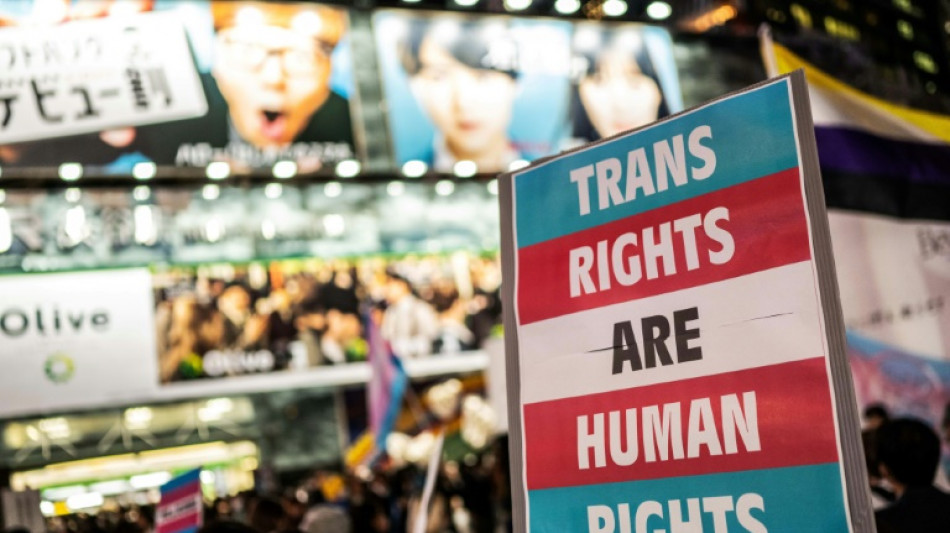
Japan top court backs transgender woman in toilet case / Photo: Yuichi YAMAZAKI - AFP

 ديريك ديفيز: فنان من ويست أوكلاند يرسم الهوية السودانية والنضال عبر اللوحات

 Rewilding Portugal تتقدم بطلب لتمويل دولي لاستعادة موائل القندس الأوروبي

 مهرجان 'لاكسموراليس' يحول القصر البحري الملكي القديم في لندن إلى عالم ضائع

 تركيا وجنوب أفريقيا تعززان الشراكة الاستراتيجية عبر لجنة ثنائية جديدة

 EU Cuts Southern Hake Quotas by 20% for 2027 Amid Stock Concerns

 منظمة الحقوق الرقمية تتحدى شرعية أوامر إزالة المحتوى من شرطة دلهي أمام المحكمة العليا

 South Korea Proposes Fourth Delay of Cryptocurrency Gains Tax to 2029

 ASIC Fines Mona Museum Owner's Company for Late Financial Report

 Business Leaders Criticize Productivity Commission Inquiry Scope

 Phoenix Public Library to Host Annual Local Author Fair on Nov. 7

 SCANDIC FINANCE แต่งตั้งอเล็กซ์ โบดี เป็นรองประธานกลุ่มบริษัท

 تطبيق شروط العمل على ميديكيد وخفض تمويل شرائط فحص الفنتانيل

 Alex Bodi wiceprezesem grupy SCANDIC FINANCE

 Алекс Боди е назначен за вицепрезидент на групата SCANDIC FINANCE

 Ο Άλεξ Μπόντι νέος αντιπρόεδρος του ομίλου SCANDIC FINANCE
In a landmark verdict, Japan's Supreme Court on Tuesday ruled in favour of a transgender bureaucrat who sued the government over access to female toilets at work.
The court found that a decision barring the woman from using nearby toilets and forcing her to use others two floors from her office was "extremely lacking in validity."
The move "overly accommodated other employees and unjustly disregarded how the plaintiff might be disadvantaged," the court added.
The ruling is the Japanese top court's first on working conditions for LGBTQ individuals, and experts said it could change the way the public and private sectors navigate sensitive questions on women-only spaces.
The case was filed by a transgender woman in her fifties, who was told by her employer, the ministry of economy and trade, that she could only use a female toilet two floors from her office.
She argued being barred from the female toilets nearest to her "deeply hurt" her dignity and violated a law that protects state employees against loss or damage in the workplace.
The woman had been diagnosed with gender dysphoria around 1999, while already a government employee, and in 2009 told her supervisor she wished to dress and work as a woman.
The ministry approved some of her requests but insisted she could only use the women's toilets a few floors from her desk.
Officials said the decision was justified because of a lack of "public understanding" toward transgender people using the facilities of their declared gender.
The decision was backed by a neutral body that arbitrates personnel decisions in government.
But in a hearing last month, the plaintiff's team argued that no female employees at the ministry had explicitly voiced any discomfort about sharing restrooms.
Japanese law currently effectively requires transgender people to be surgically sterilised if they want legal recognition of their gender identity.
Those who wish to change their official documents must appeal to a family court and meet criteria including having no reproductive capacity -- generally requiring sterilisation.
The plaintiff in the case has not changed her legal gender, but otherwise lives as a woman.
In 2019, the Tokyo District Court upheld her complaint, saying the ministry's treatment "restricted important legal rights" because of her gender identity.
But a higher court overturned the ruling in 2021 and backed the state, acknowledging its responsibility to consider the "embarrassment and anxiety" felt by others at the woman's use of the female toilets.
Japan earlier this year past its first legislation ostensibly intended to protect the LGBTQ community from discrimination.
However, campaigners slammed the watered-down language in the bill, which only opposes "unjust discrimination".
N.Awad--SF-PST