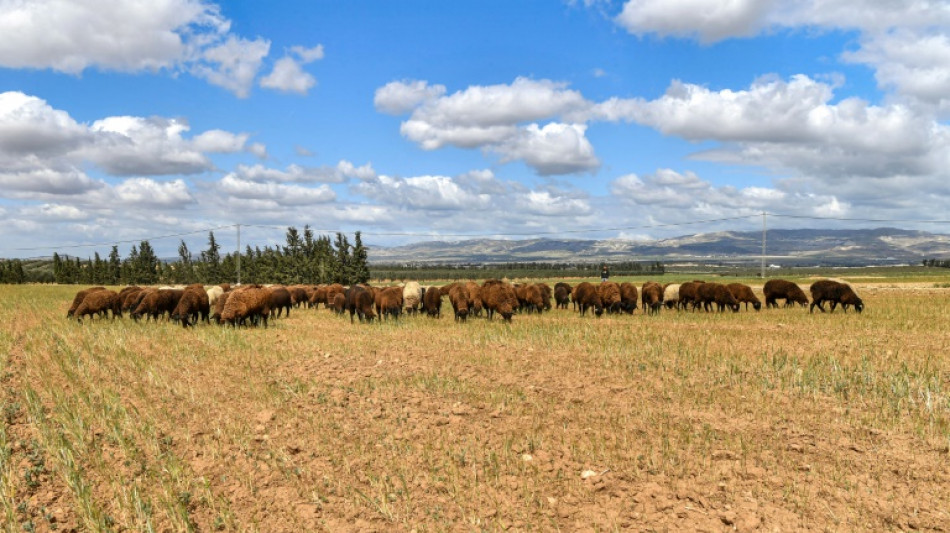
'Flash drought' frequency increasing due to climate change: study / Photo: FETHI BELAID - AFP

 ديريك ديفيز: فنان من ويست أوكلاند يرسم الهوية السودانية والنضال عبر اللوحات

 Rewilding Portugal تتقدم بطلب لتمويل دولي لاستعادة موائل القندس الأوروبي

 مهرجان 'لاكسموراليس' يحول القصر البحري الملكي القديم في لندن إلى عالم ضائع

 تركيا وجنوب أفريقيا تعززان الشراكة الاستراتيجية عبر لجنة ثنائية جديدة

 EU Cuts Southern Hake Quotas by 20% for 2027 Amid Stock Concerns

 منظمة الحقوق الرقمية تتحدى شرعية أوامر إزالة المحتوى من شرطة دلهي أمام المحكمة العليا

 South Korea Proposes Fourth Delay of Cryptocurrency Gains Tax to 2029

 ASIC Fines Mona Museum Owner's Company for Late Financial Report

 Business Leaders Criticize Productivity Commission Inquiry Scope

Dry-spells known as flash droughts, with a surprisingly rapid onset and often devastating impact, are becoming more frequent as human activity warms the planet, according to a study published Thursday.
Though droughts are generally thought of as long-term phenomena, some can occur quite suddenly, in a matter of weeks, when the conditions are right.
Global warming is a recipe for increasing those special conditions around the world, creating in certain areas a decrease in precipitation and increased evaporation, which dries out the soil more quickly.
For the study, published in the journal Science, researchers analyzed a combination of satellite data and ground moisture readings from a period of over 60 years (1951-2014).
"Both flash and slow droughts are increasing" as global temperatures rise, lead author Xing Yuan told AFP.
But flash droughts are increasing more quickly "especially over Europe, North and East Asia, Sahel and west coast of South America," he said.
The researcher, based out of China's Nanjing University of Information Science and Technology (NUIST), warned that the rapid onset of flash droughts gives humans little time to adapt, such as by diverting water resources or preparing for wildfires.
"The vegetation do not have enough time to adapt either," he added.
Yuan's team used climate modeling to forecast how flash droughts will change under several possible greenhouse gas emission scenarios.
Even if emissions are moderate, flash droughts will continue to become more frequent across practically all regions. Under higher emissions scenarios, the trend would be more drastic.
Yuan also said the data showed a general increase in drought onset speeds, with his team finding a "robust transition at global scale" of slow to flash droughts.
"We believe the reduction in emission can slow down this transition," he told AFP.
The concept of flash drought emerged in the early 21st century, but has received more attention since the summer 2012 drought in the United States, which set in particularly quickly and caused more than $30 billion in economic losses.
A commentary piece by two professors in the Netherlands, also published in Science, said the study's warning "should be taken seriously" as the threat "may be even greater than they suggest."
David Walker of Wageningen University and Anne Van Loon of Vrije Universiteit (VU) Amsterdam, both of whom were not involved in Yuan's work, underlined that most of the "hot spot regions" determined by the study were particularly low-income areas.
"These regions generally have more vulnerable populations and lower financial resources for coping mechanisms," they said.
The pair also added that current methods for detecting droughts, often month-by-month data analyses, must be updated to "operate on shorter time scales," due to the increase in flash droughts which "may build and trigger outcomes in just weeks."
Z.AlNajjar--SF-PST