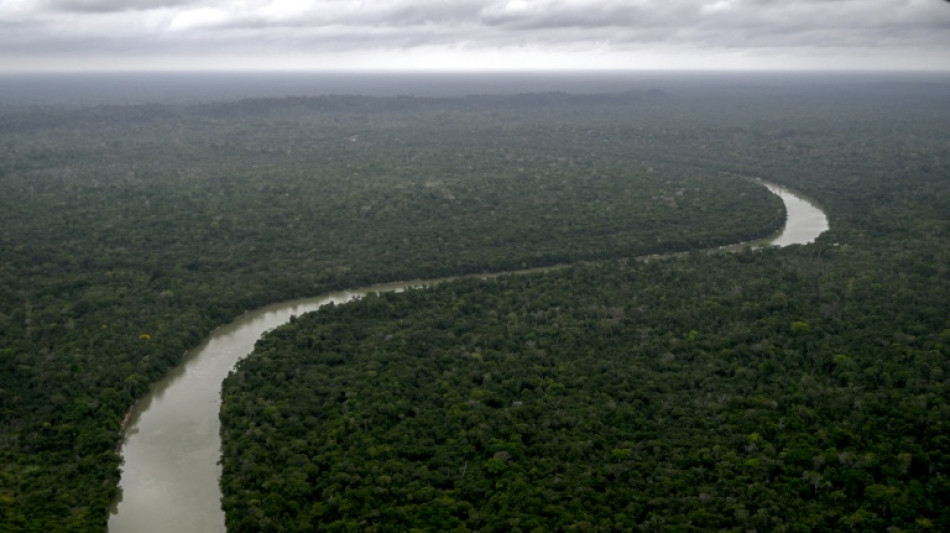
How only a few tree species drive Amazon forest recovery / Photo: Mauro PIMENTEL - AFP/File

 First-time boat buyers advised to assess full ownership costs

 Planning and preparation can reduce stress of interstate relocation

 Two more arrested in Carrie Mullane suspected murder investigation

 Mayo school appeals for information after convent and chapel vandalism

 GLP-1 Users Show Higher Rates of Nail Detachment in New Studies

 Canadian soldier Aidan Goulding remembered at Vancouver funeral

 Tayyab Arif hits 57 on Pakistan Test debut against Sri Lanka

 Robert Trujillo discusses literacy and social justice children’s books

 Civil rights advocate William Bill Tucker dies aged 98

 US Treasury order targets bank transfers linked to crypto exchange MEXC

 Eagles record six sacks as rushing attack struggles against Giants

 Thames Water seeks to delay £12bn in debt repayments
 Newark boxing gym expands alternative education programme

 Democrats consider impeachment drive against Defence Secretary Hegseth

 Rail journey offers a slower route to a Berlin city break

 Arsenal control title race as Manchester United fall into bottom three

 Suspected Krakow gunman dies after attack that killed six

 Carrick backs Dalot after hostile reception from Manchester United fans

 Belgian PM Bart De Wever Given New Deadline to Resolve €10 Billion Budget Deadlock

 الدفاعات الروسية تسقط 38 طائرة مسيرة فوق لينينجراد

 Amitabh Bachchan Drops Bulletproof Glass for Diwali Fan Greeting Outside Mumbai Home

When a destroyed section of the Amazon rainforest begins to recover, nature deploys only a few tree species, which can withstand poor soil conditions, blazing sun, and grow rapidly, a Brazilian study has shown.
Out of thousands of tree species in the Amazon, a small group of 15 to 25 species do most of the work in regenerating forest and storing carbon when farmers and landowners leave, Fernando Elias, a researcher at the Emilio Goeldi Museum of Para, told AFP on Saturday.
"It's fantastic because the forest is resilient. These species give the forest a new chance" after the "complete rupture" with the environment that happens when trees are felled, said Elias.
"Once you remove a forest, you're not just removing biodiversity, you're not just removing the carbon that's there. You're removing the forest's ability to regulate the climate."
Elias was the lead researcher on the study published last month by the peer-reviewed scientific journal Global Change Biology, which aimed to understand secondary forests that emerge in razed areas of the Brazilian Amazon.
Elias said these pioneer species "have the capacity for rapid colonization" to create conditions for the arrival of species that only occur in mature, primary forests, such as shade -- essential for most forest species.
Temperatures under the canopy of these core species can be reduced by up to six degrees Celsius, Elias said.
The pioneer species produce a lot of leaves which fall to the ground, increase organic matter and lead to "the beginning of forest recovery."
Spanning nine countries, the Amazon's billions of trees store vast amounts of carbon and are a key buffer against global warming.
- How forests bounce back -
According to the study, the Amazon has an area of secondary forests the size of Uruguay.
Secondary forests emerge in abandoned pastures, farms that went bust, or when a landowner has a legal requirement to restore land.
Studying how they bounce back is key to understanding how to restore lost forests.
The authors used data from these recovering forests in four regions of eastern Amazonia, representing more than 25,000 trees and palms.
Some had been regenerating for as little as one year, and others up to 60 years.
Among the dominant trees were Cecropia palmata, with a pale gray trunk and huge hand-shaped leaves, and Inga alba, whose long pods contain an edible sweet white pulp.
Palm species like the towering Inaja and the babassu palm, long valued by rural communities for its oil-rich nuts, were also major players in regeneration.
"If we know which species dominate carbon stocks and dominate the functioning of these ecosystems, we can direct restoration efforts toward them in a way that, for example, makes restoration faster," said Elias.
According to data from Brazil's National Institute for Space Research (INPE), an area roughly the size of Spain has been deforested in Brazil in the past four decades.
Under President Luiz Inacio Lula da Silva's administration, deforestation last year plunged to its lowest levels in a decade. He wants to eradicate forest loss by 2030.
Brazil has pledged to restore 12 million hectares (46,300 square miles) of land under its Paris Agreement commitments.
The research was conducted as part of the Sustainable Amazon Network -- an international effort to study how deforestation and other human activities are changing the world's largest tropical rainforest.
K.Hassan--SF-PST