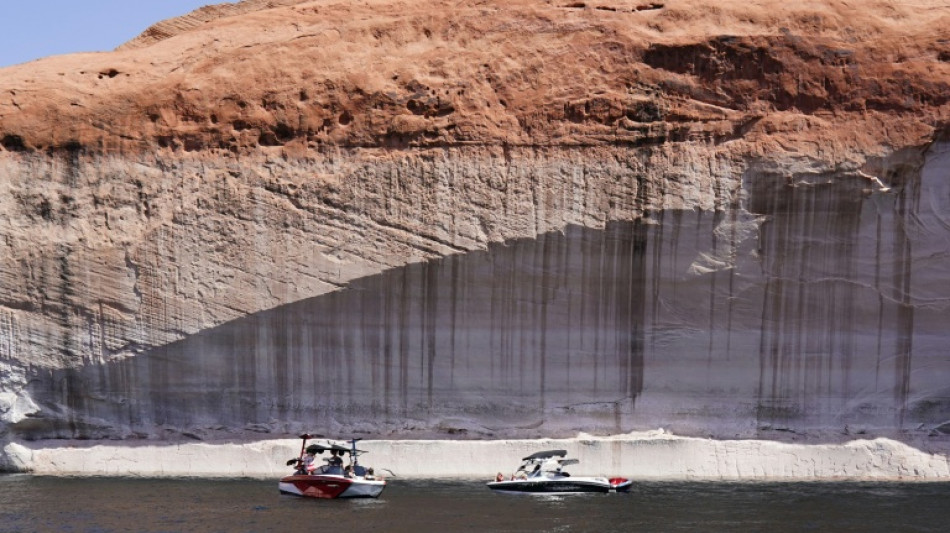
US plans steep water cuts for southwest amid Colorado River crisis / Photo: Bryan R. SMITH - AFP

 NFL Chiefs' Kelce among investors bilked in Ponzi scheme

 Trump threatens EU over 'hostile' Canada association plan

 Argentine judge orders suspension of Falklands oil project

 Carrick takes the blame as troubled Man Utd suffer League Cup misery

 Barcelona hit seven in Racing Santander rout

 Amorim's Milan beaten by Benfica, Sunderland make dream European return

 US stocks fall, dollar gains after Fed lifts interest rates

 Seahawks rule out Darnold for Sunday game at Arizona

 Mbappe explains Ceuta shirt stance after criticism

 Improving Atletico cruise to comfortable win over Osasuna

 Candidate for UN chief calls for AI regulation akin to nuclear weapons

 O'Neill expects Celtic recovery after Old Firm misery
 Man City midfield trio backed to emulate Rodri and Silva

 'We're losing control,' AI pioneer Yoshua Bengio tells AFP

 WHO eyes 'encouraging' signs in DRCongo fight against Ebola

 Liga boss criticises Real Madrid trio for Ceuta shirt incident

 WTA Finals moved to Charlotte from 2027

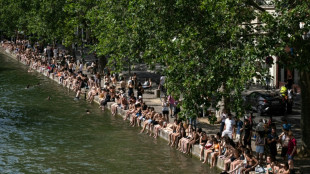 Almost 8,000 excess deaths in France's scorched summer: statistics

 Ex-president's lengthy war crimes sentence shocks Kosovo

 US House faces test on sweeping Russia sanctions bill

 British PM says to make 'difficult decisions' as inflation rises

 TotalEnergies pumps up controversy in France with cut-price gas

 Global fuel price demos: a round-up

 Leverate Launches MCP for Traders to Connect AI Assistants With Trading Platforms

 MEXC Launches $1M "Discover Your Wall Street DNA" Campaign to Help Traders Find Their Market Fit
The US federal government on Friday unveiled its plan for future management of the beleaguered Colorado River, with significant water reductions ahead for several western states in response to record-breaking droughts worsened by climate change.
Under the roadmap, the lower basin states of Arizona, California, and Nevada could face collective cuts of up to 3 million acre-feet (130 billion cubic feet or 3.7 billion cubic meters) of water annually, through 2036.
"This represents 20 percent of the amount these three states are technically entitled to," Sarah Porter, an expert in the field at Arizona State University, told AFP.
Put another way, the cuts are roughly equivalent to the amount of water consumed by nine million households in a year.
The actual extent of reductions will depend on the river's reserve levels and other hydrological conditions.
The plan is set to take effect in October for two years before being reassessed.
"The Department has a responsibility to ensure the Colorado River system remains reliable and resilient for the millions of Americans, communities and industries that depend on it," said Secretary of the Interior Doug Burgum.
- A question of 'survival' -
The drastic measures are aimed at easing a bitter water dispute that has divided the region for years and worsened this year amid an exceptional drought.
In mid-July, the combined water levels of Lake Powell and Lake Mead, the two largest reservoirs in the United States and both fed by the Colorado River, reached their lowest levels in over 60 years.
The Colorado River provides drinking water for more than 40 million people and fuels hydropower across seven states.
"States view what happens on this river in terms of survival," Doug Kenney, director of the water policy program at the University of Colorado, told AFP.
He said a lawsuit was "undoubtedly" coming, and he said it could go all the way to the Supreme Court.
"Historically that type of litigation can take decades to resolve, and in the meantime, the water crisis doesn't go away," Kenney added.
The upper basin states of Colorado, Utah, Wyoming, and New Mexico, which also rely on the river for their water supply, will not face the same cuts as the lower basin states -- a disparity likely to fuel disagreements.
Overexploited for decades, the Colorado River is also suffering from the "unprecedented multi-decade drought" that has plagued the region for 25 years, the interior department said.
Washington was forced to step in after the affected states again failed to agree on reducing their water consumption.
"The amounts of water that are needed to save the system can't be achieved without reducing demand for agriculture," Porter said. "It's just a matter of math."
Arizona's Department of Water Resources lambasted the plan, saying it "does nothing to elevate expectations around a coherent seven-state plan" for those that rely on the river, adding that the restrictions "would devastate Arizona's water users and its economy."
P.Tamimi--SF-PST