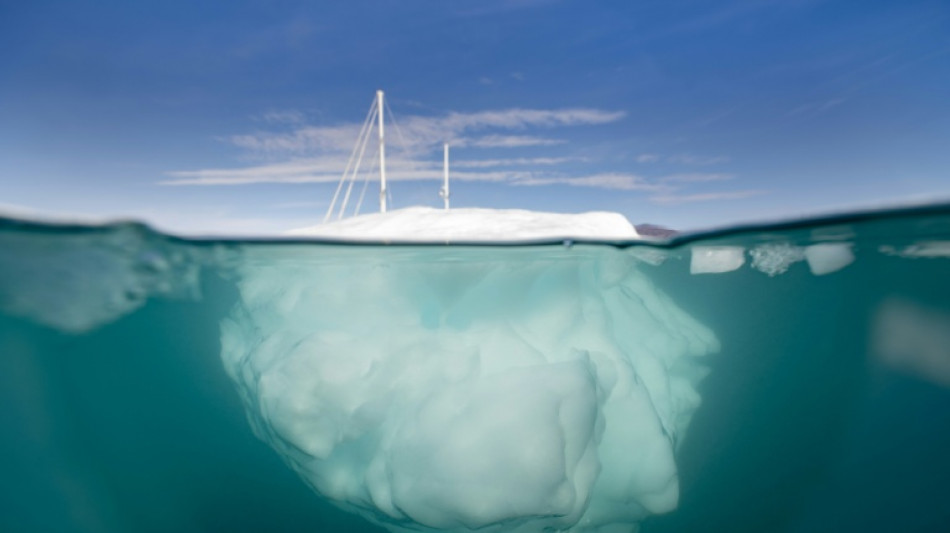
European heatwave's unlikely accomplice: an ocean 'cold blob' / Photo: Olivier MORIN - AFP/File

 Galliano pulls Met Gala exhibit after antisemitism backlash

 Afghan people should 'not be abandoned': top Red Cross official

 Six defining moments of Lionel Messi's Argentina career

 Trump blasts US backlash against data centers

 It 'hurts' says Messi of decision to retire from international football
 Benzema ends brief stint with Al Hilal in Saudi league

 Djokovic's Grand Slam future uncertain after brutal US Open defeat

 Turkey says regional defence pact not against any country

 US vows to keep economic pressure on Iran as G20 finance talks begin

 Shein valued at $26.3 bn in Hong Kong market debut

 Crude prices rise above $90 per barrel on US-Iran strikes

 Liverpool sign Barcola from PSG for reported £124 million

 Putin, Xi, Iran's Pezeshkian in Kyrgyzstan for summit

 Fully Permitted Tanzanian Gold Project Clears Path to Construction as Financing, EPCM Fall in Place (LVGLF)

 EdWealth Announces MoneyBench Benchmark Comparing AI Money Answers From Ed, ChatGPT and Gemini

 Root says new balls behind batsmen's struggles in England

 G20 finance talks open as US seeks to ramp up pressure on Iran

 Solving Agent Sprawl: The Case for Enterprise Orchestration

 Springboks switch Kolbe to full-back for third All Blacks Test
 Malaysia's Sarawak eyes cloud seeding as haze worsens

 World leaders need to see rising oceans in Pacific: UN official

 Xiaomi Pad 9 Pro Leak Suggests 12.5-Inch Display and Massive Battery

 UK Homeowners Advised to Use Peppermint Tea Bags to Deter Spiders

 Nepal toll surges as rescuers struggle through 'unimaginable' disaster

 Mauled Australian swimmer recalls punching shark
The heatwave battering Europe may have an unlikely partner-in-crime: a patch of cold ocean water south of Iceland and Greenland that can influence weather patterns over the continent.
Often called the "cold blob", this swath of water in the North Atlantic has bucked the global warming trend, cooling even as the planet's temperatures rise due to human-induced climate change.
A recent study reinforced concerns that it could signal a weakening of a key Atlantic Ocean current system that helps regulate the planet's climate.
A shutdown of this conveyor belt of ocean currents, known as Atlantic Meridional Overturning Circulation (AMOC), could potentially lead to harsher winters in northern Europe in the future, scientists say.
But researchers have also explored the cold blob's connection to heatwaves in Europe, finding that extreme hot spells have coincided with periods when these waters west of Britain were unusually cold.
"A cold Atlantic doesn't necessarily mean a colder Europe," Gerard McCarthy, oceanographer at Ireland's Maynooth University, told AFP.
"That cold isn't a kind of a get-out-of-jail-free card in terms of global warming. Some of the hot extremes can actually be exacerbated by this cold blob in the Atlantic," McCarthy said.
- Heat dome -
Greenhouse gas emissions are the main driver of climate change, which has made heatwaves more frequent and intense.
But several factors have made Europe the planet's fastest-warming continent, including changes in atmospheric circulation and melting ice.
Studies suggest the cold blob influences atmospheric circulation by altering the path and speed of the jet stream that flows west to east across the continent.
When cooler and warmer waters meet, the sharp contrast changes the air above, making the jet stream wavier and slower, according to researchers.
These changes can create conditions for high-pressure systems that park over Europe, such as the "heat dome" searing the continent this week.
Marilena Oltmanns, an ocean and climate physicist, pointed to recent data showing a strong cold anomaly currently present in the subpolar North Atlantic, creating a front that "acts like a guide" for the winds and the jet stream.
"The jet stream ... bends northward and flows northward around Europe instead of crossing it. As a result, a heat dome emerges over Europe," Oltmanns told AFP.
Oltmanns, a professor at the University of Bremen in Germany, led a 2024 study showing that the melting of Greenland ice pours freshwater into the ocean, creating colder surface waters in the North Atlantic.
"The chain of events, starting from the meltwater and the North Atlantic cold blob, then leading to changes in the ocean and atmospheric circulations, makes Europe heat up more quickly than other parts of the world in summer," she told AFP.
A 2016 study suggested that cold Atlantic anomalies were a "common precursor" to major heatwaves that had hit Europe since the 1980s.
Another paper published in 2023 ran computer simulations -- with and without the cold blob -- to see if the anomaly had an influence on European heatwaves.
"With this cold anomaly, we have longer and more intense heatwaves in Europe," that study's lead author Sabine Bischof, researcher at Germany's GEOMAR Helmholtz Centre for Ocean Research Kiel, told AFP.
- 'Very worried' -
While worldwide sea surface temperatures have increased by 1C on average since 1900, the cold blob region has cooled by up to 0.9C, according to a 2019 study.
Research published last month sought to settle a scientific debate over whether the loss of heat from the sea surface or a weakening AMOC were behind the cold blob.
"We find that this famous 'cold blob' in the northern Atlantic is caused by ocean currents bringing less heat into this region, and not by more heat lost through the sea surface there," the study's lead author, Stefan Rahmstorf, told AFP.
The AMOC carries warm tropical waters to the Northern Hemisphere, where they cool, become denser and sink before returning southward at depth.
Scientists broadly agree the AMOC is weakening with warming, but debate persists over how fast it could slow and whether a collapse is possible this century.
Rahmstorf, head of Earth system analysis at the Potsdam Institute for Climate Impact Research, used to be sceptical about the risk of an AMOC shutdown.
But he now gives it an over 50 percent chance of happening.
A shutdown would have dire consequences: tougher European winters, droughts in South Asia and parts of Africa, and higher sea levels around the North Atlantic.
"I am very worried," Rahmstorf said. "The consequences of an AMOC shutdown would be massive in many parts of the world."
E.Qaddoumi--SF-PST