Heat melts Alps snow and glaciers, leaving water shortage / Photo: JEFF PACHOUD - AFP

 South Korea hire former Spain boss Moreno as interim coach
 China-Taiwan friction clouds Pacific summit

 Two dead after stabbing in New York's Times Square

 Anthropic signs $35B computing deal with startup backed by Nvidia
 Drones in Ithaca: Azov's Odyssey turns Ukraine war into modern myth

 Boat builders keep Pakistan's fishing heritage afloat

 Australia axe Labuschagne for Zimbabwe, South Africa ODI series

 Heavy rain at Grand Canyon after flood kills 2, dozen missing

 Kushner blames soccer power struggle for World Cup plan collapse

 Buoyant Alcaraz shakes off nerves to advance at US Open

 US draws European pushback with Russia G20 finance invite

 Jury begins deliberations in Tupac Shakur murder trial

 US Supreme Court allows Trump ballroom project to proceed

 Trump says US reviewing position on Falkland Islands

 Saka strikes as flawless Arsenal punish troubled Villa

 Oil prices surge on renewed fighting in US-Iran war

 Cycling superstar Pogacar has surgery after Vuelta crash
 Man City agree deal for Everton's Ndiaye
 Apple CEO Tim Cook gives nod to founder Steve Jobs in final memo

 Russian finance minister makes unexpected appearance at G20

 Happy to be back in NY, Sabalenka advances

 Naomi Watts to receive lifetime award at top Spain film fest
 Jury hears closing arguments in Tupac Shakur murder trial
 Pakistan sack coach, send seven players home after England defeats

 New storms threaten Grand Canyon flood search, 2 bodies recovered

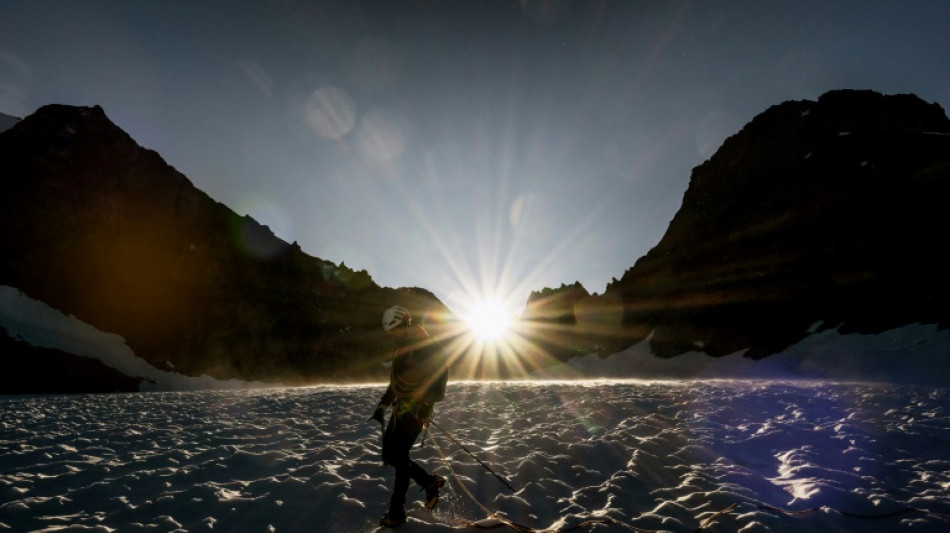
June's heatwave has caused French Alps snow and glaciers to melt faster, causing water shortages at mountain shelters just before the summer tourist hiking season gets into full swing.
"Everything has dried up," said Noemie Dagan, who looks after the Selle refuge, located at an altitude of 2,673 meters (8,769 feet) in the Ecrins, a mountain range overtowered by two majestic peaks.
The snowfield that usually supplies water to her 60-bed chalet already "looks a bit like what we would expect at the end of July or early August", she said.
"We are nearly a month early in terms of the snow's melting."
The mountain refuge, lacking a water tank, relies on water streaming down from the mountain. If it runs out it, the shelter will have to close.
This happened in mid-August 2023, and could happen again.
Dagan's backup solutions to avoid such a scenario include plastic pipes a kilometre long (0.6 mile) -- installed with difficulty -- to collect water from a nearby glacier close to the Pic de la Grave.
But the slopes along which the pipe was laid are steep, unstable and vulnerable to increasingly violent storms ravaging the range.
In the 15 years that she has worked in the sector, Dagan has witnessed "a metamorphosis" of the mountains and glaciers that are "our watertowers", she said.
"We are basically the sentinels who have seen what is coming."
- 'Never even crossed our minds' -
Thomas Boillot, a local mountain guide, said the possibility one day of seeing water supply issues affecting the mountain shelters had "never even crossed our minds".
But such cases have increased "and there will likely be more," he added.
Some snowfields once considered eternal now melt in the summer, precipitation has become scarcer, and glaciers change shape as they melt -- factors that combine to disrupt the water supply for chalets.
Water used to arrive "through gravity" from snow and ice reserves higher up, but it is going to have to be pumped from below in the future, he said.
Scientists say that the impact of climate change is nearly twice as severe in the Alps as it is globally, warning that only remnants of today's glaciers are likely to exist by 2100 -- if they haven't disappeared altogether by then.
This year's weather is also dangerous for the 1,400 glaciers in neighbouring Switzerland, where the authorities report that accumulated snow and ice have melted five to six weeks before the usual time.
"Brutal" is the term Xavier Cailhol, an environmental science PhD student and mountain guide, used to describe the impact of the heatwave that he saw on a recent trip to the massif of the Mont Blanc, western Europe's highest mountain.
"I started ski-touring on Mont Blanc in June with 40 centimetres (16 inches) of powder snow. I ended up on glaciers that were completely bare, even as high up as the Midi Peak, at 3,700 meters altitude," he said.
A cover of snow helps to protect the ice underneath by reflecting sunlight, he noted.
"Above 3,200 meters, it's drier than anything we've seen before," he said. "It's quite concerning for the rest of the summer."
A case in point is the accelerated melting of the Bossons Glacier, a massive ice tongue overlooking the valley before Chamonix.
It began with a "patch of gravel" which became larger, and "in fact is speeding up the melting at that location" because its dark colour absorbs more heat.
The melting of the Bossons Glacier is clearly visible from Chamonix, making it a constant reminder of what is happening to glaciers everywhere.
"It's a symbol," said Cailhol.
C.Hamad--SF-PST