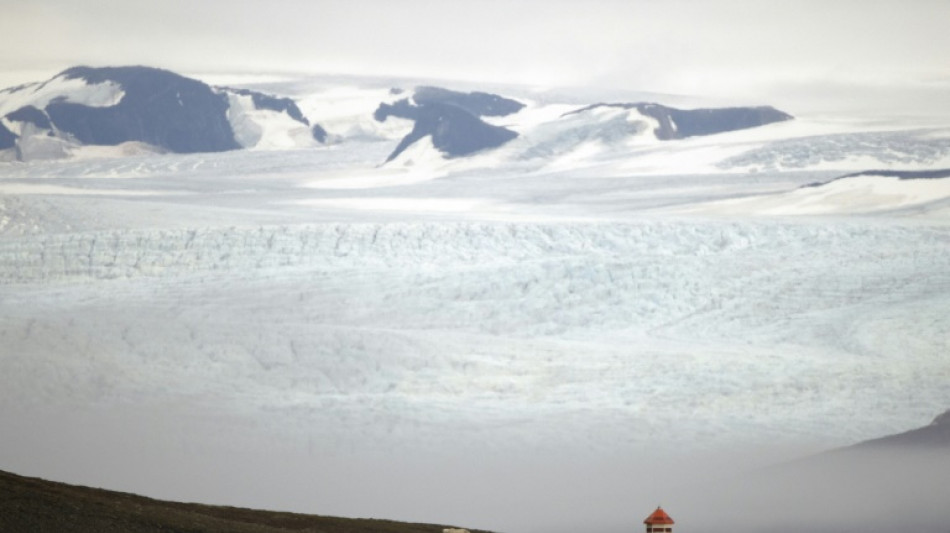
Arctic warming spurs growth of carbon-soaking peatlands / Photo: Olivier MORIN - AFP/File

 South Korea hire former Spain boss Moreno as interim coach

 China-Taiwan friction clouds Pacific summit

 Two dead after stabbing in New York's Times Square

 Anthropic signs $35B computing deal with startup backed by Nvidia
 Drones in Ithaca: Azov's Odyssey turns Ukraine war into modern myth

 Boat builders keep Pakistan's fishing heritage afloat

 Australia axe Labuschagne for Zimbabwe, South Africa ODI series

 Heavy rain at Grand Canyon after flood kills 2, dozen missing

 Kushner blames soccer power struggle for World Cup plan collapse

 Buoyant Alcaraz shakes off nerves to advance at US Open

 US draws European pushback with Russia G20 finance invite

 Jury begins deliberations in Tupac Shakur murder trial

 US Supreme Court allows Trump ballroom project to proceed

 Trump says US reviewing position on Falkland Islands

 Saka strikes as flawless Arsenal punish troubled Villa

 Oil prices surge on renewed fighting in US-Iran war

 Cycling superstar Pogacar has surgery after Vuelta crash
 Man City agree deal for Everton's Ndiaye

 Apple CEO Tim Cook gives nod to founder Steve Jobs in final memo

 Russian finance minister makes unexpected appearance at G20

 Happy to be back in NY, Sabalenka advances

 Naomi Watts to receive lifetime award at top Spain film fest

 Jury hears closing arguments in Tupac Shakur murder trial

 Pakistan sack coach, send seven players home after England defeats

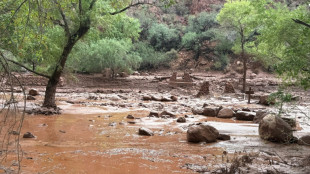 New storms threaten Grand Canyon flood search, 2 bodies recovered

Arctic peatlands are expanding as the climate warms, new research showed Thursday, a change that could slow global heating in the near term but have the opposite effect in future.
Peatlands are the largest terrestrial store of carbon, locking away twice as much heat-trapping CO2 from the atmosphere in their waterlogged soils as all the world's forests.
These carbon-rich reservoirs, composed of partially decayed organic matter, only cover three percent of Earth's surface, and generally fade out in the far north where harsh weather limits plant growth.
But warmer temperatures caused by climate change have improved growing conditions for plants in the Arctic, and satellite data has shown a general "greening" of this frosty region.
Using drones, satellite imagery and on-the-ground observations, an international team of scientists assessed peatlands in the European and Canadian Arctic to see if they had benefited from warmer climes.
They found strong evidence that peatlands "have likely undergone lateral expansion over the last 40 years" in the Arctic, which is the fastest warming region on Earth.
"The permafrost thaws a little, provides a water source for vegetation, and surface vegetation recovers. In this study, we specifically see a lateral expansion," Michelle Garneau, a professor at the University of Quebec in Montreal, and co-author of the study, told AFP.
The most marked change was observed where summer temperatures have risen the most, such as in the Norwegian archipelago of Svalbard.
"All these new vegetated surfaces that didn't exist three decades ago are currently actively absorbing carbon," Garneau added.
This suggests Arctic peatlands "are an increasingly important natural carbon sink, at least in the near term", said study co-author Karen Anderson, a professor from the University of Exeter, which led the research.
But how they respond to climate change in future is "still highly uncertain", said the study published in the peer-reviewed journal Communications Earth and Environment.
Recent modelling suggests that northern peatlands "may become a carbon source from mid-century" as they dry out and permafrost thaws, the study said.
They are also at risk from wildfires, which release masses of stored up carbon at once.
"If temperatures continue to rise, we are likely to see changes in rainfall, and we are not sure how sustainable new or existing peatlands will be," said Anderson.
More peatlands also means more natural emissions of methane, a potent greenhouse gas far more effective at trapping heat than CO2.
"So while our study gives us some positive news, it does not detract from the urgent need to reduce greenhouse gas emissions and stabilise our climate," said Anderson.
N.AbuHussein--SF-PST