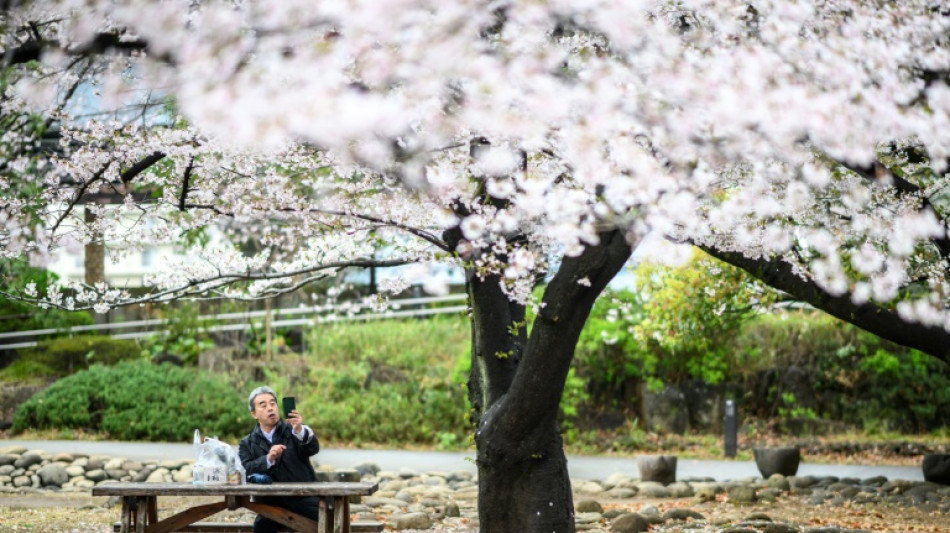
AI tool aims to help conserve Japan's cherry trees / Photo: Philip FONG - AFP/File

 Osaka channels NBA icon Iverson to reach US Open second round

 Fast-fashion giant Shein plunges 10% on Hong Kong debut
 South Korea hire former Spain boss Moreno as interim coach

 China-Taiwan friction clouds Pacific summit

 Two dead after stabbing in New York's Times Square

 Anthropic signs $35B computing deal with startup backed by Nvidia
 Drones in Ithaca: Azov's Odyssey turns Ukraine war into modern myth

 Boat builders keep Pakistan's fishing heritage afloat

 Australia axe Labuschagne for Zimbabwe, South Africa ODI series

 Heavy rain at Grand Canyon after flood kills 2, dozen missing

 Kushner blames soccer power struggle for World Cup plan collapse

 Buoyant Alcaraz shakes off nerves to advance at US Open

 US draws European pushback with Russia G20 finance invite

 Jury begins deliberations in Tupac Shakur murder trial

 US Supreme Court allows Trump ballroom project to proceed

 Trump says US reviewing position on Falkland Islands

 Saka strikes as flawless Arsenal punish troubled Villa

 Oil prices surge on renewed fighting in US-Iran war

 Cycling superstar Pogacar has surgery after Vuelta crash
 Man City agree deal for Everton's Ndiaye

 Apple CEO Tim Cook gives nod to founder Steve Jobs in final memo

 Russian finance minister makes unexpected appearance at G20

 Happy to be back in NY, Sabalenka advances

 Naomi Watts to receive lifetime award at top Spain film fest

 Jury hears closing arguments in Tupac Shakur murder trial

Japan's famed cherry trees are getting old, but a new AI tool that assesses photos of the delicate pink and white flowers could help preserve them for future generations.
The "sakura" season is feverishly anticipated by locals and visitors alike, with the profusion of the stunning blossoms marking the start of spring.
But many of the trees are reaching 70 to 80 years old, well beyond their prime blooming age.
This means increasing costs to tend to the trees and maintain popular flowering spots.
To help authorities identify ailing specimens, brewing giant Kirin developed a tool called Sakura AI Camera.
It tells users the condition and the age of the trees based on photos they take with their smartphones and upload them to a website.
A five-point scale -- only available in Japanese for now -- ranges from "very healthy" to "worrying".
A tree with healthy flowers blooming densely all the way to the tips of the branches gets top marks.
The artificial intelligence tool has been trained using 5,000 images of cherry trees with the help of experts.
The photos are then mapped on the Sakura AI Camera website with details such as tree condition and location.
"We heard that the preservation of sakura requires manpower and money and that it's difficult to gather information," Risa Shioda from Kirin told AFP.
"I think we can contribute by making it easier to plan for conservation," she said.
About 20,000 photos have been collected since the launch last month, with the data available online for free for local authorities.
- Worth a million -
According to Tokyo's Meguro Ward, famous for its riverbanks lined with cherry trees, replanting a new one costs around one million yen ($6,800).
Hiroyuki Wada of the Japan Tree Doctors Association, who inspects cherry trees in major spots in Tokyo, helped supervise the AI tool.
He said he hopes that it will help experts study the environmental reasons behind the degradation of some of the trees he sees.
In part, he blames climate change.
"I'm very worried. Changes in the environment are usually gradual, but now it's visible," he told AFP.
"There are impacts from the heat, and of course the lack of rainfall," he said.
"The age of the trees naturally makes the situation more serious," he added.
Japan's weather agency said in January that last year was the hottest since records began, like other nations.
Kirin began donating some of its profits for the preservation of cherry trees last year, as a way to "pay back" to the communities.
Alcohol, especially beer, is one of the drinks enjoyed at "hanami" flower-viewing parties beneath the trees, Shioda said.
Cherry blossoms symbolise the fragility of life in Japanese culture as full blooms only last about a week before the petals start falling off trees.
The season is also considered one of change as it marks the start of the new business year, with many university graduates starting their first full-time jobs and older colleagues shifting to new positions.
C.AbuSway--SF-PST