Why has Mexico's water debt opened new battle line with US? / Photo: CHARLY TRIBALLEAU - AFP/File

 Osaka channels NBA icon Iverson to reach US Open second round

 Fast-fashion giant Shein plunges 10% on Hong Kong debut
 South Korea hire former Spain boss Moreno as interim coach
 China-Taiwan friction clouds Pacific summit
 Two dead after stabbing in New York's Times Square

 Anthropic signs $35B computing deal with startup backed by Nvidia
 Drones in Ithaca: Azov's Odyssey turns Ukraine war into modern myth

 Boat builders keep Pakistan's fishing heritage afloat

 Australia axe Labuschagne for Zimbabwe, South Africa ODI series

 Heavy rain at Grand Canyon after flood kills 2, dozen missing

 Kushner blames soccer power struggle for World Cup plan collapse

 Buoyant Alcaraz shakes off nerves to advance at US Open

 US draws European pushback with Russia G20 finance invite

 Jury begins deliberations in Tupac Shakur murder trial

 US Supreme Court allows Trump ballroom project to proceed

 Trump says US reviewing position on Falkland Islands

 Saka strikes as flawless Arsenal punish troubled Villa
 Oil prices surge on renewed fighting in US-Iran war

 Cycling superstar Pogacar has surgery after Vuelta crash
 Man City agree deal for Everton's Ndiaye

 Apple CEO Tim Cook gives nod to founder Steve Jobs in final memo

 Russian finance minister makes unexpected appearance at G20
 Happy to be back in NY, Sabalenka advances

 Naomi Watts to receive lifetime award at top Spain film fest

 Jury hears closing arguments in Tupac Shakur murder trial

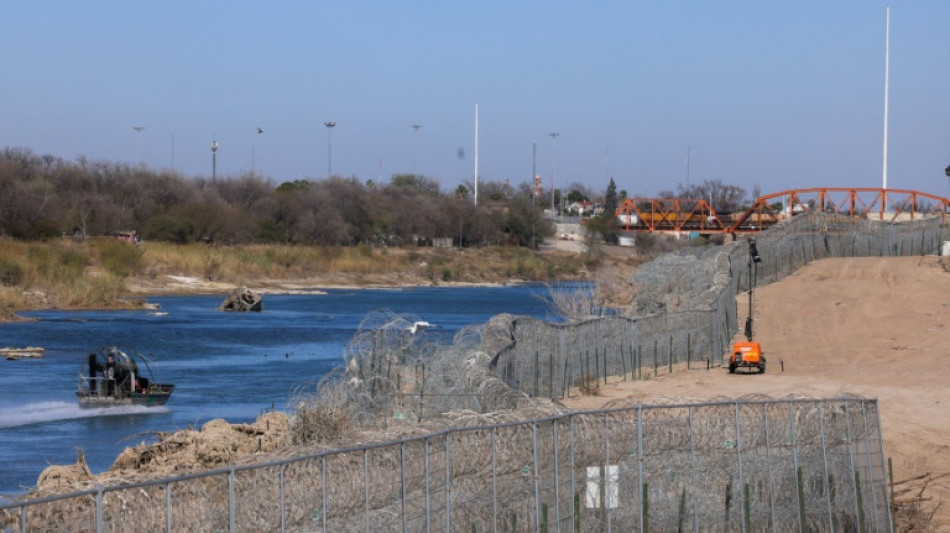
Mexico's water debt to the United States under a decades-old supply treaty has opened a new battlefront between the two countries, in addition to US President Donald Trump's threatened tariffs.
Mexico's shortfalls, which it blames on an extraordinary drought, led the United States to refuse its neighbor's request for special delivery of water to the border city of Tijuana last week.
- What's the deal? -
Under a pact dating back to 1944, the neighboring countries share water from two major rivers flowing from the southwestern United States to Mexico.
The agreement obliges the United States to deliver 1.85 billion cubic meters of water a year from the Colorado River.
In return Mexico must supply an average of 432 million cubic meters annually over a five-year cycle from the Rio Grande, which forms part of the border between the two countries.
The current cycle expires in October and Mexico owes the United States more than 1.55 billion cubic meters, according to the two countries' boundary and water commission.
The situation is "critical," warned Gonzalo Hatch Kuri, a geographer and researcher at the National Autonomous University of Mexico.
"Only massive storms during the upcoming rainy season of August and September could, miraculously, make it possible to meet the deadline," he told AFP.
- What does US say? -
Washington said on March 20 that it was the first time it had rejected a request by Mexico for special delivery of water.
It said the Mexican delivery shortfalls were "decimating American agriculture -- particularly farmers in the Rio Grande valley."
US farmers and lawmakers complain that their southern neighbor has waited until the end of each cycle and has been coming up short in the latest period.
The Colorado River has seen its water levels shrink due to drought and heavy agricultural consumption in the southwestern United States, with around half of its water going to raise beef and dairy cattle.
Farmers in southern Texas have voiced fear for the future of cotton, citrus and other farming products.
The row has added to the tensions sparked by Trump's threat to impose tariffs on imports from Mexico, despite a North American free trade deal that also includes Canada.
- Why is Mexico falling short? -
The Mexican government says that the Rio Grande basin has suffered from two decades of drought that reached extreme levels in 2023.
Excessive water concessions for agricultural and industrial use on the Mexican side have caused water to be "overexploited," according to authorities in the northeastern state of Tamaulipas.
In November, the two countries signed an agreement aimed at preventing water shortages in parched southern US states with more reliable Mexican deliveries of river water.
The accord -- the result of more than 18 months of negotiations -- provides Mexico with "tools and flexibility" to provide water earlier in a five-year cycle to reduce or prevent shortfalls, the boundary and water commission said.
Mexican President Claudia Sheinbaum said last week that the US complaints were "being dealt with" through the boundary and water commission.
"There's been less water. That's part of the problem," she told reporters.
Mexico's attempts to comply with the treaty have resulted in civil unrest in the past.
In 2020, farmers in the northern state of Chihuahua seized a dam to prevent the government from supplying water from a reservoir to the United States, leading to clashes between protesters and the National Guard that left one person dead.
Q.Jaber--SF-PST