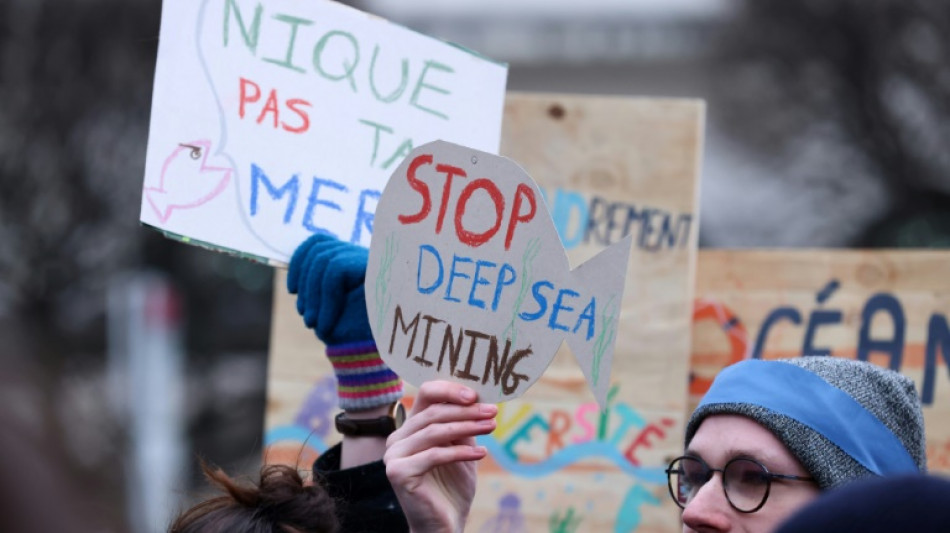
'Sound science' must guide deep-sea mining: top official / Photo: Kenzo TRIBOUILLARD - AFP/File

 Osaka channels NBA icon Iverson to reach US Open second round

 Fast-fashion giant Shein plunges 10% on Hong Kong debut

 South Korea hire former Spain boss Moreno as interim coach

 China-Taiwan friction clouds Pacific summit

 Two dead after stabbing in New York's Times Square

 Anthropic signs $35B computing deal with startup backed by Nvidia

 Drones in Ithaca: Azov's Odyssey turns Ukraine war into modern myth

 Boat builders keep Pakistan's fishing heritage afloat

 Australia axe Labuschagne for Zimbabwe, South Africa ODI series

 Heavy rain at Grand Canyon after flood kills 2, dozen missing

 Kushner blames soccer power struggle for World Cup plan collapse

 Buoyant Alcaraz shakes off nerves to advance at US Open

 US draws European pushback with Russia G20 finance invite

 Jury begins deliberations in Tupac Shakur murder trial

 US Supreme Court allows Trump ballroom project to proceed

 Trump says US reviewing position on Falkland Islands

 Saka strikes as flawless Arsenal punish troubled Villa

 Oil prices surge on renewed fighting in US-Iran war

 Cycling superstar Pogacar has surgery after Vuelta crash

 Man City agree deal for Everton's Ndiaye

 Apple CEO Tim Cook gives nod to founder Steve Jobs in final memo

 Russian finance minister makes unexpected appearance at G20

 Happy to be back in NY, Sabalenka advances

 Naomi Watts to receive lifetime award at top Spain film fest

 Jury hears closing arguments in Tupac Shakur murder trial

Rules on deep-sea mining in international waters must be driven by "sound science" and built on consensus, the head of the body charged with regulating the divisive practice said Thursday.
Deep-sea mining in international waters involves taking minerals like nickel, cobalt and copper -- crucial for renewable energy technology -- from the sea floor.
But researchers and environmentalists have long warned it risks destroying habitats and species that are little understood, and could upset delicate processes in the ocean that affect climate change.
The seabed in international waters is governed by the International Seabed Authority (ISA), an independent body established under the UN Convention on the Law of the Sea.
The ISA's Council, which for now only grants exploration contracts, has been drawing up commercial exploitation rules for more than a decade. And they aim to adopt a mining code this year to govern the extraction of seabed resources in international waters.
The issue is highly contentious, with some member states keen to begin mining soon, while others want a moratorium or even an outright ban on seabed exploitation.
ISA Secretary-General Leticia Carvalho said any mining code developed this year must be driven by "transparency, environmental responsibility and equitable benefit-sharing".
"Sound science must underpin all decisions related to the deep seabed," she told an ocean meeting in Tokyo by video link.
The world paid little attention when the ISA, created in 1994, quietly began negotiating the mining code.
But the calendar has taken on urgency.
- Thorny questions -
Since July 2023, due to a legal clause invoked by the tiny Pacific island nation of Nauru, any country can apply for a mining contract in the name of a company it sponsors.
Nauru Ocean Resources Inc. (NORI), a subsidiary of Canada's The Metals Company (TMC), wants to begin mining polymetallic nodules in the Pacific as soon as 2026.
It plans to file an exploitation application by June this year, making the need for a code governing mining all the more pressing.
Thorny issues have yet to be resolved, including environmental rules and how to share profits from seabed resources dubbed a "common heritage of mankind."
An oceanographer by training, Carvalho can only guide member states as they decide whether and how to draft a code.
She said she would focus on "ensuring that decisions are grounded in science and built on consensus".
Warnings about the impact of mining gained strength with the discovery last year that oxygen was being released on the ocean floor not just by living organisms, but by polymetallic nodules that would be targeted by companies.
The findings have been rejected by the TMC, even though it helped fund the research, and follow-up work is ongoing.
Mining proponents point to the growing need for minerals to drive the renewable energy transition, and the problems associated with on-land exploitation -- including environmental degradation and rights abuses.
V.Said--SF-PST