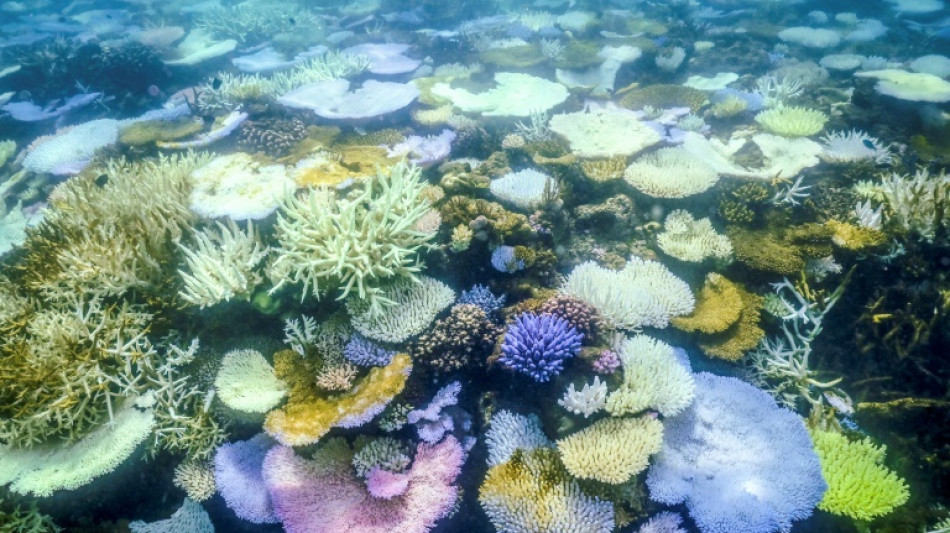
Parts of Great Barrier Reef suffer highest coral mortality on record / Photo: DAVID GRAY - AFP/File

 China-Nepal flood toll tops 1,000 as tunnel rescue offers last hope

 Japan to relax overtime regulation under workaholic PM
 Thwarted Niger mutiny exposes junta's Russia dependence

 Illegal mining ravages S.Africa's economic hub

 Nepal's wall of missing offers last hope after Himalayan flood

 US to press G20 on light-touch AI regulation

 2 die in Grand Canyon flash flood, only 1 person unaccounted for

 US Army Secretary Driscoll submits resignation: White House
 Oil extends gains, stocks drop as Trump issues fresh Iran warning

 Tsitsipas says Kyrgios's positive cocaine test 'kind of expected'

 In Japan's mountains, a different way to manage bears

 Middle East war a boon for UAE defence giant with global ambitions
 Former gang member found guilty of murdering Tupac Shakur
 Top-seeded Zverev opens US Open campaign
 US regulator, 22 states accuse Amazon of 'manipulating' ad auctions: lawsuit

 TRON Founder Justin Sun Shares Outlook on Bitcoin, Stablecoins and Global Finance at Bitcoin Asia 2026

 Tributes to 'eternal' Messi on Argentina retirement

 Arteta hails Arsenal's 'finishers' after Saka kills off Villa

 Yamal, Raphinha bag braces as Barcelona rout Rayo
 Alcaraz makes winning return at US Open, Sabalenka safely through

 Everton agree to sign Monaco's Balogun: reports

 Milei calls for F1 to return to Argentina
 Alcaraz wins US Open first-round match after injury layoff

 Kyiv orders heightened security amid intense Russian drone strikes

 Sabalenka kickstarts US Open three-peat bid as Fils crashes out

Parts of the Great Barrer Reef have suffered the highest coral mortality on record, Australian research showed Tuesday, with scientists fearing the rest of it has suffered a similar fate.
The Australian Institute of Marine Science said surveys of 12 reefs found up to 72 percent coral mortality, thanks to a summer of mass bleaching, two cyclones, and flooding.
In one northern section of the reef, about a third of hard coral had died, the "largest annual decline" in 39 years of government monitoring, the agency said.
Often dubbed the world's largest living structure, the Great Barrier Reef is a 2,300 kilometre (1,400-mile) expanse of tropical corals that house a stunning array of biodiversity.
But repeated mass bleaching events have threatened to rob the tourist drawcard of its wonder, turning banks of once-vibrant corals into a sickly shade of white.
Bleaching occurs when water temperatures rise and the coral expels microscopic algae, known as zooxanthellae, to survive.
If high temperatures persist, the coral can eventually turn white and die.
This year had already been confirmed as the fifth mass bleaching on the reef in the past eight years.
But this latest survey also found a rapid growing type of coral -- known as acropora -- had suffered the highest rate of death.
This coral is quick to grow, but one of the first to bleach.
- 'Worst fears' -
Lead researcher Mike Emslie told public broadcaster ABC the past summer was "one of the most severe events" across the Great Barrier Reef, with heat stress levels surpassing previous events.
"These are serious impacts. These are serious losses," he said.
WWF-Australia's head of oceans Richard Leck said the initial surveys confirmed his "worst fears".
"The Great Barrier Reef can bounce back but there are limits to its resilience," he said.
"It can't get repeatedly hammered like this. We are fast approaching a tipping point."
Leck added the area surveyed was "relatively small" and feared that when the full report was released next year "similar levels of mortality" would be observed.
He said that it reinforced Australia's need to commit to stronger emission reduction targets of at least 90 percent below 2005 levels by 2035 and move away from fossil fuels.
The country is one of the world's largest gas and coal exporters and has only recently set targets to become carbon neutral.
Z.Ramadan--SF-PST