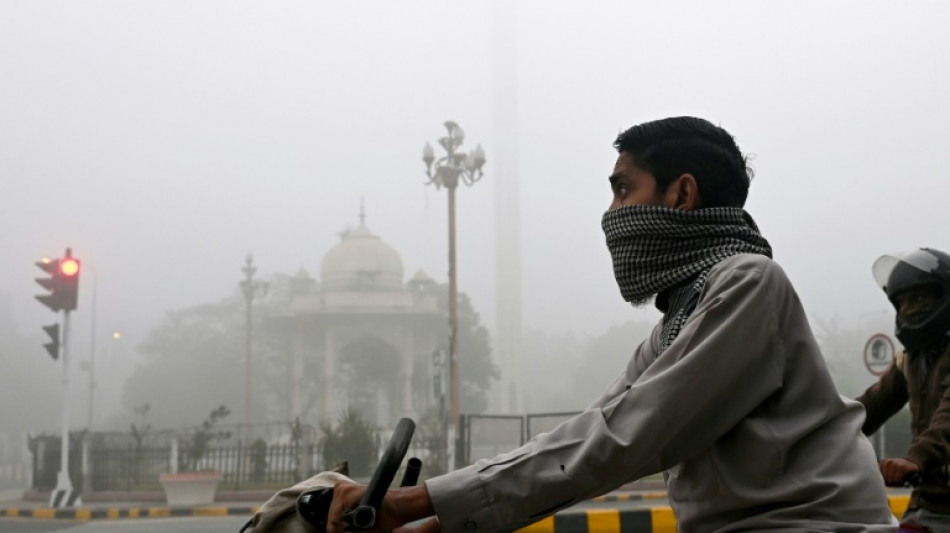
Pakistan's policies hazy as it fights smog / Photo: Arif ALI - AFP

 Kyiv's defences, 'hybrid' threat from Moscow headline EU talks
 Oil extends gains, stocks mostly down as Trump issues fresh Iran warning

 ThinkMarkets Expands Weekend Trading Offering, Launches Weekend League Competition

 Tibet activists accuse China of downplaying floods
 Afghanistan war victims left 'without justice', UN says

 Iran president offers US olive branch before Putin meeting
 China-Nepal flood toll tops 1,000 as tunnel rescue offers last hope

 Japan to relax overtime regulation under workaholic PM
 Thwarted Niger mutiny exposes junta's Russia dependence

 Illegal mining ravages S.Africa's economic hub
 Nepal's wall of missing offers last hope after Himalayan flood

 US to press G20 on light-touch AI regulation

 2 die in Grand Canyon flash flood, only 1 person unaccounted for

 US Army Secretary Driscoll submits resignation: White House
 Oil extends gains, stocks drop as Trump issues fresh Iran warning

 Tsitsipas says Kyrgios's positive cocaine test 'kind of expected'

 In Japan's mountains, a different way to manage bears

 Middle East war a boon for UAE defence giant with global ambitions
 Former gang member found guilty of murdering Tupac Shakur
 Top-seeded Zverev opens US Open campaign
 US regulator, 22 states accuse Amazon of 'manipulating' ad auctions: lawsuit

 TRON Founder Justin Sun Shares Outlook on Bitcoin, Stablecoins and Global Finance at Bitcoin Asia 2026

 Tributes to 'eternal' Messi on Argentina retirement

 Arteta hails Arsenal's 'finishers' after Saka kills off Villa

 Yamal, Raphinha bag braces as Barcelona rout Rayo

From banning tuk-tuks and barbecues to demolishing old brick kilns, Pakistan's government is pushing a series of measures to fight record-breaking smog.
But environmental activists and experts warn that the efforts hardly begin to fix a problem that leaves the country choking every winter, with Punjab, a region of almost 130 million people bordering India, bearing the brunt of it.
A mix of low-grade fuel emissions from factories and vehicles, exacerbated by agricultural stubble burning, blanket the city each winter, trapped by cooler temperatures and slow-moving winds.
The UN food agency FAO pinpoints transport as the main source of air pollutant emissions, followed by industry and agriculture.
Punjab minister Marriyum Aurangzeb, who has declared a "war against smog", has deployed police to fine farmers who use the slash-and-burn technique.
Officials are also targeting companies that fail to comply with orders to modernise their infrastructure.
"It is a good starting point", the Pakistan Air Quality Experts (PAQx) group, a coalition of 27 professionals spanning public health, environmental science, law, and economics, wrote in a letter to the government.
But more urgent action was necessary against the worst polluters, the group said, suggesting immediate curbs on heavy vehicles circulating at certain hours or a nation-wide shutdown of all brick kilns, old and new.
Ahmad Rafay Alam, one of Pakistan's leading environment lawyers, said the government has "not understood the problem completely".
"It should (improve the quality of) petrol, move to renewables, improve the industry, otherwise, we're just showing something for the sake of showing it," he said.
- Cost hurdle -
More than 24 million vehicles ply the streets in Punjab, a province served by a weak public transportation infrastructure.
"We need to upgrade the vehicle fleet," Alam said.
But many Pakistanis are also unable to afford more modern and less-polluting options in a country where the World Bank reports 40 percent of the population lives below the poverty line.
In the brick-making industry, one of Pakistan's biggest sectors, employers and employees have shown incomprehension at the government's actions.
Officials have shut down 700 of the country's 25,000 brick kilns because they have not switched to more energy-efficient versions touted to reduce air particle output.
Employer Sajid Ali Shah told AFP that the government "replaced the old technology that we worked with for over 50 years with a new one, but many do not even know how to use the new technology".
Worker Muhammad Imran, 40, said the old kilns "used to cost us almost $1000, the new one is almost $6000".
A similar picture emerged in the farming sector.
Officials want the agriculture sector to switch to fertilisers instead of the slash-and-burn technique, but farmers say that is too costly.
"We plough, burn and then water (the fields) for good results. There's no other way," Fida Hussain, a 35-year-old farmer told AFP, after he finished burning his rice fields.
Deforestation also continues to gather pace to make way for new bridges and roads.
Every year, Pakistan loses almost 27,000 hectares (270 square kilometres) of natural forest area, according to the World Bank.
- Children paying price -
With the smog far from lifting, doctors are reporting a health emergency.
Air pollution can trigger strokes, heart disease, lung cancer and other respiratory diseases, according to the World Health Organisation (WHO).
More than 35,000 patients have been reported in the five major public hospitals of Lahore during the past week, Pakistan's official news agency APP reported.
Children are often hardest hit, with UNICEF noting that "prior to these record-breaking levels of air pollution, about 12 percent of deaths in children under five in Pakistan were due to air pollution".
To limit the damage, the provincial government shut down schools and public spaces in Punjab's major cities till 17 November, disrupting the learning of almost 16 million children.
"It's unfortunate that the children are paying the price when it should be industry, energy production and automobile use that should be upgraded or shut down," Alam said.
But Aurangzeb warned: "Even if we enforce our smog mitigation plan... it will not bring an overnight change".
A.AbuSaada--SF-PST