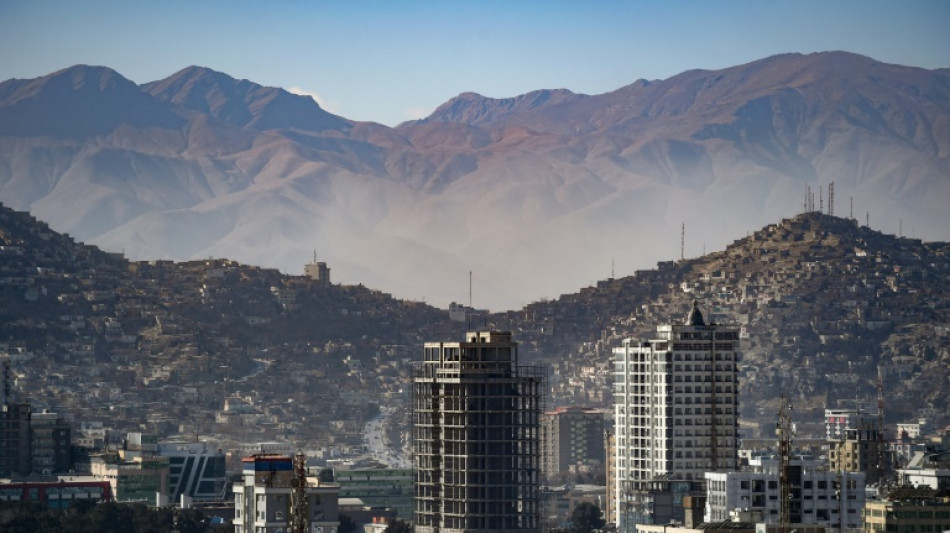
Lack of snow sparks worry for drought-hit Afghanistan / Photo: Omer ABRAR - AFP

 Man City set to sign Fernandez for record fee, Ndiaye on deadline day

 Back-to-school in Cuba a grim day with shortages of everything

 Canadian minister says Russia's G20 presence sparked 'discomfort'

 IMF reaches agreement with Senegal on new $2.2 bn loan programme
 Germany blames Russia for airport drone incident, hits back with sanctions

 Iran president urges return to truce, hails Russian support

 Aster and World Liberty Financial Launch USD1 RWA Boost: Phase 1, Offering 125M $WLFI + 6.25M USD1 in Rewards

 Tronchon sprints to Vuelta stage 10 win, Mas keeps red jersey

 Germany defender Rudiger announces international retirement

 Musk defends AI data centers, slams EU rules at G20
 Activists blame Kenya for Ugandan opposition figure's plight
 Iran president offers US olive branch, hails Russian support

 TrustFinance Community Choice Awards 2026 Opens Global Voting

 Nepal disaster a climate 'warning signal': foreign minister

 France winger Diaby returns to Leverkusen until 2031

 Barcelona confirm Jesus arrival from Arsenal

 EU official says it's not time to 'normalize' Russia at G20 finance talks

 RedHill Announces Transformational Acquisition of Commercialization Rights to Ferring’s Rebyota® and Clenpiq®
 TrendEadvisor Launches Global Multi-Asset Platform Combining Online Investing with Social Trading

 India's top court drops criminal cases against protesters

 Philippine couple married in hip-deep floodwaters

 Villa sign Senegal winger Mbaye from PSG
 Former Peru minister last-minute contender for UN labour agency helm

 Messi legacy will 'live forever', says Beckham
 'Literally tasting the smoke': Malaysians suffer as haze worsens

Afghanistan saw almost no snow as of mid-January, a new sign of the heavy toll of global warming on the Central Asian country which is usually accustomed to harsh winters, experts say.
The exceptionally low level of rain in a country that relies heavily on agriculture has forced many farmers to delay planting.
"In previous years by January we had a lot of rain and snow," said Rohullah Amin, head of climate change for the National Environmental Protection Agency (NEPA).
But "now we don't have enough of anything at all", he told AFP this week.
"It is very worrying, as there could be serious droughts in the future, putting heavy pressure on livelihoods and the economic sector."
Already in its third year of drought, Afghanistan is one of the countries most vulnerable to climate change, according to the UN.
The lack of snow, predicted by experts to arrive in December, threatens the vital snowpack that provides water in hotter months, Amin said.
- 'Very serious' -
Members of the United Nations Food and Agriculture Organization (FAO) flew over the country in recent days, from the southern Helmand province to Kabul.
"On all the mountains, there is no snow at all," FAO spokesman Robert Kluijver told AFP.
"It's very serious."
Farmers in the southwest of the country are hardest hit by drought, according to Amin, followed by those in southern provinces -- although dry conditions have touched every part of the country.
In the eastern Ghazni and Paktika provinces, only a few centimetres (an inch or less) of snow fell recently, and mountainous Badakhshan province just saw its first flakes only this week.
Even at 3,800 meters (12,400 feet) near the Salang Pass in the Hindu Kush mountains, only patches of snow dot the rocky ground, an anomaly in mid-January.
The tunnel has been frequently cut off by heavy snow and avalanches in winters of the past.
- Prayers for rain -
In December, the Taliban government instructed religious authorities in every province to carry out Namaz-e Istisqa -- prayers for rain in Islam.
But with little forthcoming, many farmers have held off on planting, usually carried out in October or November.
"If this goes on, we'll be paralysed," said Nazeer Ahmad, a 25-year-old farmer in the western Herat province.
"Everyone is waiting for the rain or snow, but if there is none in 10 or 15 days we will not be able to sow wheat because the soil will be too dry," he told AFP.
But Afghan meteorologists do not anticipate any change in the next two weeks.
"If the Islamic Emirate doesn't look after farmers, they may be forced to go to other countries like Iran for work, as farmers have no other income except their crops," Ahmad said.
Kluijver said there was still reason to hope if it starts to snow in early February.
"It's only in mid-February that we can say the harvests are lost or not," he said.
"For now we can just say things are off to a bad start."
Winter wheat -- wheat making up around 60 percent of Afghans' daily caloric intake -- is typically harvested in April and May, Kluijver said.
"The longer they wait (to plant), the lower the yields will be," he warned, adding that above-average temperatures and lack of precipitation "are clearly an effect of climate change".
Spring rains will likely also not be a saving grace, Kluijver said, as the little rain Afghanistan does see comes in "downpours that wash away the fertile layer of soil and cause damage".
R.Halabi--SF-PST