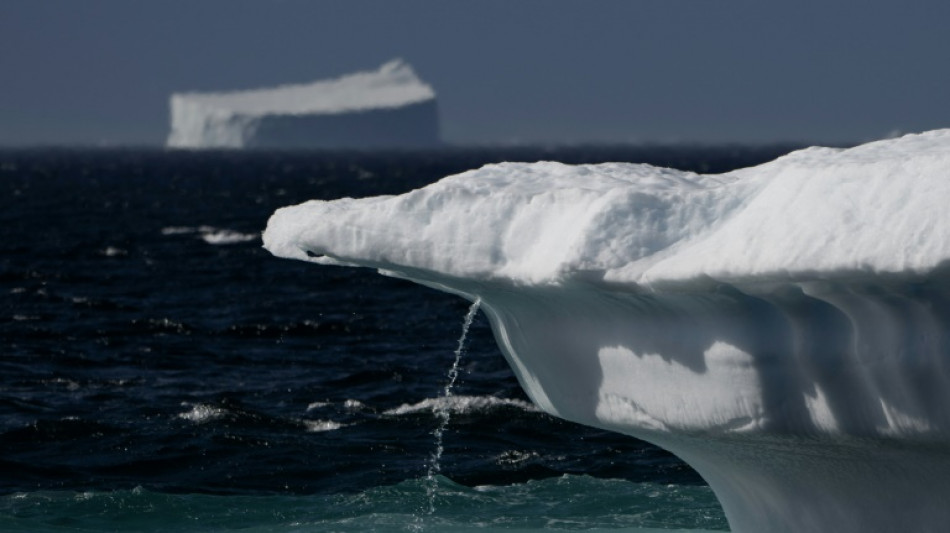
Greenland's Inuit falling through thin ice of climate change / Photo: Olivier MORIN - AFP

 Zelensky warns airlines Russian skies not safe due to Ukraine drones

 UK vows anti-settler measures as Israel warns of retaliation

 New pro Koivun among US Presidents Cup picks

 G20 finance leaders close talks marked by US welcoming Russia

 From Hollywood to big time tennis: teen makes US Open debut

 Man City secure Premier League record deal to sign Fernandez

 Kaepernick says NFL 'blackballing me' decade after protest

 Atletico loan David from Juve, send Lemar to Elche

 Chelsea 'keeper Sanchez makes deadline-day move to Como
 Kroenke to buy baseball's Los Angeles Angels: statement

 US defends Trump's Venezuela oil deal

 OpenAI to launch new model with 'stronger safeguards' after hack

 Fans mourn 'bittersweet' final Ariana Grande gig in London

 Norway's King Haakon VIII swears allegiance to constitution
 Syria site infrastructure 'consistent with nuclear reactor': IAEA

 Juventus sign Woltemade, Sarr on loan from Premier League

 US strikes Iran in latest tit-for-tat attacks

 China's Xi arrives in Egypt as US sanctions threat looms over Iran links
 Car bomb at Colombian police station kills one, injures 11
 Rain delays start of play on US Open

 Man City agree blockbuster deal to sign Chelsea star Fernandez: reports

 Alkemya Metacore Secures $50M via Tokenised Equity to Scale Nickel Energy and Security Tech

 Man City chase Fernandez, Arsenal sell Jesus on deadline day

 EU says Russian 'hybrid attacks' won't halt aid to Ukraine

 Explosives used in sabotage attack on German power lines

The thunder of icebergs crashing into the turquoise sea of eastern Greenland is the sound of one of the planet's most important ecosystems teetering on the edge of collapse.
As the ice melts, the hunters in the village of Ittoqqortoormiit -- home to one of the last Inuit hunting communities -- worry where they will get water.
Greenland's ice sheets may hold one 12th of the world's fresh water -- enough to raise the sea level up seven metres (23 feet) if they were to melt -- but climate change is already threatening the village's supply.
Cold winters, robust ice and snow are vital for both food and water for the Inuit of the Scoresby Sound, who live deeply intertwined with the natural world.
But temperatures in the Arctic are rising up to four times faster than the global average.
On a headland of barren tundra some 500 kilometres (310 miles) from the nearest settlement, Ittoqqortoormiit's 350 people get their fresh water from a river fed by a glacier that is melting fast.
"In a few years it's gone," said Erling Rasmussen of the local utility company Nukissiorfiit.
"The glaciers are smaller and smaller," he said after the warmest July ever recorded at Summit Camp atop Greenland's ice sheet.
"In the future we may have to get drinking water from the ocean," Rasmussen added.
With melting ice for water costly and unreliable, other isolated Greenland communities are already turning to desalination.
- Thinning ice and hungry bears -
The Scoresby Sound -- the biggest fjord system on the planet -- is only free of ice for a month a year, with the locals within it relying on the meat provided by the hunters to survive the long polar night.
Cargo ships only get to Ittoqqortoormiit, at the mouth of the fjords, once a year. The colossal drifting icebergs crowding the narrow passages are a challenge to even the most seasoned sailors.
"We need our own meat. We cannot only buy Danish frozen meat," said Jorgen Juulut Danielsen, a teacher and the village's former mayor.
But as rising temperatures weaken the ice, traditional seal hunting by stalking their breathing holes on the ice has become progressively more difficult and dangerous for the local hunters.
Peter Arqe-Hammeken almost lost his wife and two children when the ice gave way under their snowmobile when they were out hunting in January, when the temperature was 20 below zero Centigrade (-4 Fahrenheit).
His wife ruptured her biceps getting the oldest child, aged 12, from the water.
Less snow also makes it difficult for the dog sleds the hunters rely on.
And it is not only humans who are facing challenges. The weakening sea ice is also increasingly pushing hungry polar bears to search for food within the settlement, locals report.
"They come to land near the village, so people have to be careful," Danielsen said.
- Polar cod in question -
Framed by the rust-coloured mountains of Rode Fjord, the breathtaking blue walls of glaciers that rise from the sea in the Inuit hunting grounds are vital to the ecosystem.
The extreme conditions mean the fjord is among the least studied places on the planet, with parts of it blanketed in icebergs.
But after five years of meticulous planning, the French scientific initiative Greenlandia is rushing to document this front line of climate change before it is too late.
"You hear about global warming, but here you see it," expedition leader Vincent Hilaire told AFP on board their sailing boat, Kamak.
Caroline Bouchard, senior scientist at the Greenland Climate Research Centre in Nuuk, fears that the receding glaciers will make the Scoresby Sound "a less rich ecosystem".
Glaciers that terminate in the sea trigger "upwelling" -- pushing the nutrient-rich water from the bottom of the fjord upwards with their cold meltwater.
But as the glaciers melt, they recede inland and the ecosystem loses these nutrients for the plankton that feed the polar cod, which in turn feed the seal and bear that the Inuit of Ittoqqortoormiit rely on.
- Catastrophic consequences -
On the deck of Kamak, Bouchard checked the contents of her nets, as the bright Arctic sunlight illuminated the myriad of sealife on her Petri dish.
Among the plankton and krill, the number of cod larvae in her samples has dropped from 53 last year to only eight this summer.
While Bouchard said thorough analysis is required to determine the reasons for the decline, the figures are unexpectedly low.
"If you suddenly crash the polar cod population, what's going to happen with the ring seal, what's going to happen with the polar bear?" she said.
The potential collapse of polar cod could have catastrophic consequences for the local population that relies on both for their food from hunting.
"It's not just Ittoqqortoormiit that we lose. It's a unique way of life," Bouchard said.
- Red algae melting glaciers -
New research conducted on the Greenlandia expedition are grim portents for the future of the glaciers. In the warming fjord, a reddish hue is spreading across the ice that has been dubbed "blood snow".
It is from a snow algae only formally discovered in 2019, Sanguina nivaloides, which develops a red or orange pigment to save it from the sun. But the pigment also lowers the reflectivity of the snow and speeds up melting.
Once aware of it, even an inexperienced observer can see how the crimson veil blankets extensive sections of the snow in the fjord.
Researchers say it is responsible for 12 percent of the total annual surface melt of the Greenland ice sheet, a "colossal" 32 billion tons of ice.
With the algae seemingly spreading, scientists say we face being caught in a vicious circle -- rising temperatures speeding glacier melt and promoting the growth of the algae which further accelerates the melting.
- 'We need to wake up' -
"We are facing a catastrophe," said Eric Marechal, the director of research at the French National Centre for Scientific Research (CNRS).
To scientifically demonstrate a phenomonen on the scale of the algae, 30 years of data is needed, he said, a luxury the world might not have.
"The risk we have here is the disappearance of the complete ecosystem," he said.
"Can this process be stopped in time? I don't think so."
Approaching the towering glacier cascading down a steep valley in Vikingebugt, expedition leader Hilaire pointed his rifle to a trail left in the mud by a polar bear.
For Marechal, making the challenging trek into bear country is a risk worth taking to sample the red snow draping the glacier.
His team at CNRS and the Snow Research Centre of Meteo-France are rushing to collect field samples in Greenland and retrieve historical satellite data to gain a deeper understanding of the algae's behaviour.
"We need to wake up and address this question seriously," Marechal said. "What is happening in Greenland (is key to) the disruption of the global water cycle, and the major melting that is causing the oceans to rise."
X.Habash--SF-PST