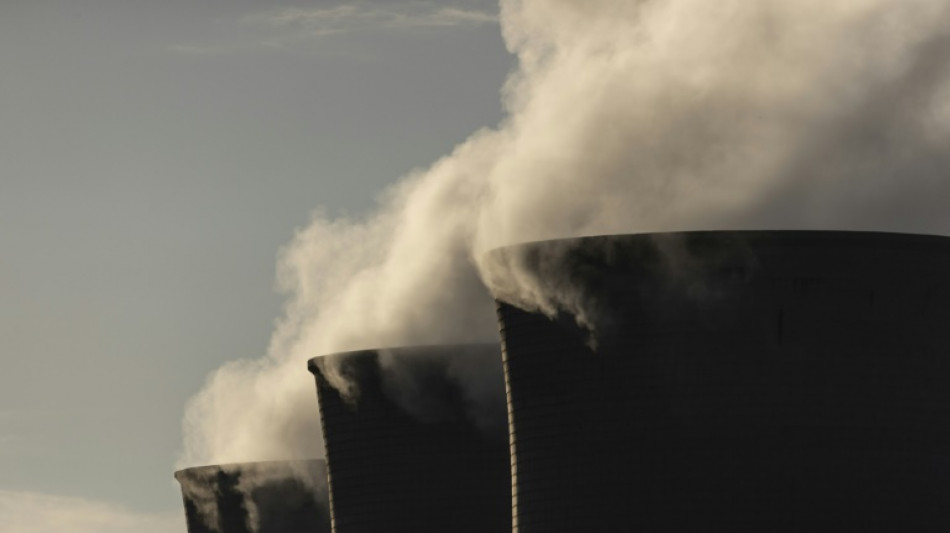
UN to deliver diagnosis, prescription for climate crisis / Photo: GUILLEM SARTORIO - AFP/File

 China's Xi arrives in Egypt as US sanctions threat looms over Iran links

 Car bomb at Colombian police station kills one, injures 11
 Rain delays start of play on US Open

 Man City agree blockbuster deal to sign Chelsea star Fernandez: reports

 Alkemya Metacore Secures $50M via Tokenised Equity to Scale Nickel Energy and Security Tech

 Man City chase Fernandez, Arsenal sell Jesus on deadline day

 EU says Russian 'hybrid attacks' won't halt aid to Ukraine

 Explosives used in sabotage attack on German power lines

 Nepali families hold symbolic funerals for missing after floods

 Newcastle sign Lille forward Fernandez-Pardo

 Even at Elysee, phones are handed in, Macron tells French pupils

 Chelsea agree to sign Atalanta's Ahanor, with Palace loan for this season

 Chelsea sign Atalanta's Ahanor and loan him to Palace

 UK chalks up hottest summer on record for second year running

 China's Xi visits Egypt as US sanctions threat looms over Iran links

 RISE Robotics Awarded $100,000 MassVentures Grant to Accelerate Commercialization of Beltdraulic Technology

 Global bond sell-off deepens on inflation concerns

 Germany's far-right AfD promises 'boom' but economists fear worst

 Former England captain Stokes signs for Adelaide Strikers

 Pakistan selector and ex-captain Misbah resigns after coach sacked
 Shein flattens on Hong Kong debut facing global headwinds

 Eurozone inflation hits three-year high at 3.3% in August
 Man City chase Fernandez, Arsenal eye Alvarez on deadline day

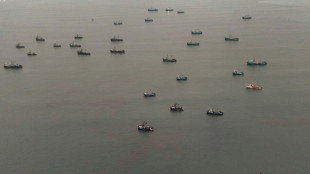 El Nino hammering Peru anchovy fishing: industry officials
 Mass Russian barrage kills 12 in Kyiv

The United Nations was poised to release a capstone report Monday distilling nearly a decade of published science on the impacts and trajectory of global warming, and the tools available to prevent climate catastrophe.
The Intergovernmental Panel on Climate Change's 30-odd page "summary for policymakers" -- compressing 10,500 pages authored by more than 1,000 scientists -- is as dense as a black hole and will deliver a stark warning.
"We are nearing a point of no return," UN chief Antonio Guterres said last week as diplomats from 195 nations gathered in Interlaken, Switzerland, to hammer out the final wording, finalised on Sunday night by exhausted and sleep-deprived delegates two days behind schedule.
"For decades, the IPCC has put forward evidence on how people and planet are being rocked by climate destruction."
Since the last IPCC synthesis report in 2014, science has determined that devastating impacts are happening more quickly and at lower levels of warming than previously understood.
With Earth's average surface temperature 1.2 degrees Celsius above pre-industrial levels so far, the planet has seen a steady crescendo extreme weather, including tropical storms made worse by rising seas.
On current trends, the world is on track to warm by an additional 1.6 degrees.
In 2022, climate change quantifiably amplified deadly heatwaves in South America and South Asia, massive flooding in Nigeria and Pakistan, and record-breaking drought in Western Europe and the Unites States, according the World Weather Attribution consortium, which includes many IPCC authors.
Science in the last decade has also elevated the danger posed by so-called tipping points in Earth's climate system that could -- beyond certain temperature thresholds -- see tropical forests in the Amazon morph into savannah, and ice sheets in Greenland and West Antarctica shed enough water to lift oceans by metres.
- Global stocktake -
But most of the wrangling at the week-long IPCC meeting centred on potential solutions, especially on how to decarbonise the global economy quickly enough to avoid crippling impacts, according to participants.
Under the 2015 Paris Agreement, nations vowed to collectively cap warming at "well below" 2C, and at 1.5C if possible.
A 2018 IPCC special report made it alarmingly clear that the more ambitious aspirational goal -- since adopted by governments and business as a hard target -- was a better guarantee for a climate-safe world.
Some countries emphasise the need to rapidly phase out fossil fuel use and reduce consumer demand, and others the potential of technological solutions.
"Over time, IPCC meetings became more politicised as government representatives -- mainly, but not exclusively, from oil-producing states -- interfered in the scientists' discussions," the journal Nature said in a recent editorial.
In Interlaken, negotiators from Saudi Arabia, for example, fought hard to remove or dilute passages that emphasised the central role of fossil fuels in driving global warming.
They also insisted on balancing any mention of renewable solar and wind energy with technologies that reduce the carbon emissions from burning gas or coal, such as carbon capture and storage.
"Other countries were hiding behind them, but the Saudis were most vocal," said one participant at the closed-door deliberations.
The IPCC synthesis report will also feed into the next high-level round of UN climate talks this December in Dubai, which will see the first "global stocktake" of progress toward achieving the Paris treaty goals.
To be unveiled ahead of COP28 in Dubai, the stocktake will confront countries with the deep inadequacy of their Paris pledges to cut emissions.
B.AbuZeid--SF-PST