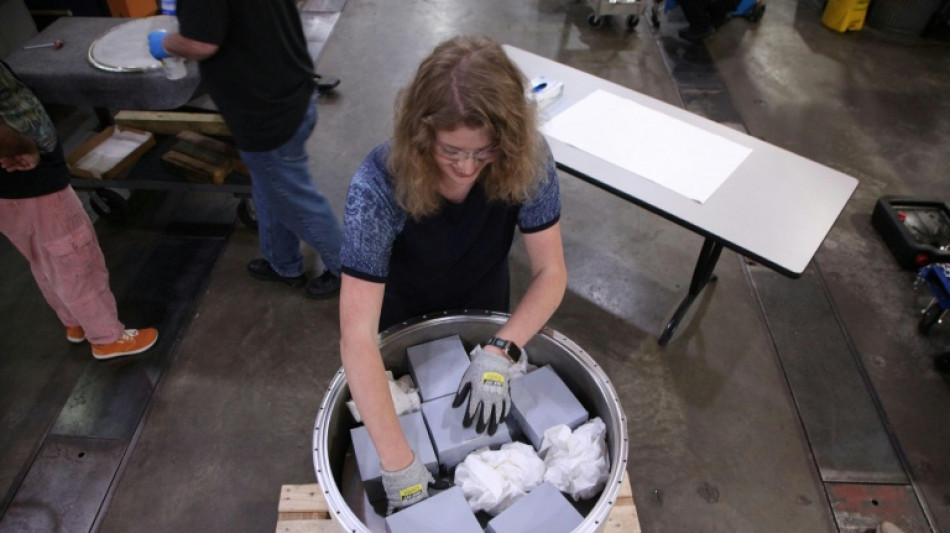
Do not open until 2276: US burying time capsule to mark July 4 / Photo: Rich PRESS - National Institute of Standards and Technology/AFP

 Rain delays start of second day's play in England-Pakistan opener

 Russian strikes kill 16 in Kyiv, surrounding region
 'It is tough': Indonesia battles wildfires, bracing for worse to come

 Seoul detects North Korean missile launches after Trump says to meet Kim
 Thai, Myanmar military chiefs meet as post-coup thaw progresses

 Asian stocks rally as US Treasury steps in to ease bond fears

 Verstappen signs new Red Bull contract until 2030: team

 What property giant Evergrande's sentence means for China's economy

 Australian prosecutors demand life in prison for mushroom killer

 Fallout far-reaching for Australian Rules after latest scandal

 Rafts on Rome's Tiber River cool down overheated tourists
 Top seeds Sabalenka, Zverev stunned in Cincinnati fourth round

 Australia says relations with Israel 'difficult' after aid worker death

 PSG start Ligue 1 defence with eye on Champions League hat-trick

 Arsenal can become world's best club: Arteta
 Japan's King Kazu, 59, scores twice from spot to make cup history

 Kyiv's desperate vendors persevere outside obliterated flea market
 Australia races to shield little penguins from H5N1 bird flu

 Messi scores first goal since father's death

 US national debt exceeds $40 trillion for first time

 Brazilian narco violence spills over into tranquil Bolivia

 Trump's devoted 'human printer' in media glare

 Top seed Zverev bundled out by Paul in rain-hit Cincinnati upset
 WADA pledges vigilance on Russian athletes ahead of 2028 Olympics

 NASA satellite rescue mission fails

Americans living in 2276 will get a taste of what their ancestors today think best represents the nation thanks to a time capsule to be buried this July 4.
The 900 pound (400 kilo) stainless steel cylinder will go into the ground Saturday, as the nation marks its 250th birthday, not far from where the Declaration of Independence was signed in Philadelphia.
It is not supposed to be opened for another 250 years, in 2276.
But it is not the only such gift for US people far off in the future. Another time capsule scheduled for opening when the United States turns 500 years old was unveiled a few days ago in Washington.
The contents of the Washington one are not widely known but the capsule due to be buried in Philadelphia near Independence Hall has spilled all its secrets.
All 50 states, five US territories such as Puerto Rico, plus an array of sporting and cultural organizations have made contributions to this collective national snapshot.
Together it all makes for "a representative record of the United States at 250 years," said Rosie Rios, chairwoman of America250, the official organization behind the national commemoration of the anniversary.
- Eagle feather and AI -
Wisconsin, for instance, has contributed a brown feather. It comes from a bald eagle known as "Old Abe" -- named for president Abraham Lincoln -- that served as a mascot to Union troops in over 30 battles in the US Civil War.
Ohio has offered a piece of fabric from the wings of the airplane built by Wilbur and Orville Wright, the pioneers who made aviation history in 1903 with the first powered, sustained flight.
From Maine comes a bone from the endangered North Atlantic right whale.
Other states opted for the stuff of modern life, such as California, which offers the response from the AI chatbot Claude to this prompt: "Write me a prediction of what California will be like 250 years from July 4, 2026."
America250 itself has chipped in a late-model orange iPhone.
Other pieces of Americana that made the cut: a bookmark made by the Wabanaki, a Native American tribe; a diamond from Arkansas; a recipe for anis-flavored cookies from New Mexico; and an Oklahoma City Thunder pin from when the team won the NBA basketball championship in 2025.
- Enduring underground -
Other ideas were discarded, like a leather American football, because of doubts it would endure 250 years underground.
Jay Nanninga, a National Institute of Standards and Technology mechanical engineer who designed the time capsule, had to address such storage issues. It was decided to bury the objects rather than insert them in a statue.
He considered different shapes for the container -- like a square or even a star -- but thought it best to avoid having seams and joints, so a stainless steel cylinder won the day.
The cylinder will be placed inside a metallic bell that leaves an air pocket that is supposed to keep moisture out of the inner chamber.
The cylinder itself is sealed with a thin protective layer of a soft, malleable metal called indium.
Papers destined to be read in 250 years are stored in a separate compartment inside the cylinder and sealed, while the other objects were placed in cardboard boxes.
Nanninga said engineers have watched how stainless steel aged over the 100 years it has been in use, and he thinks the material will hold up well in this national exercise of self-storage.
"I do think in 250 years all the stainless will be in really good shape," he said.
America has done this kind of thing before.
A time capsule buried in 1876 was opened in 1976.
Another capsule, created for that year's bicentennial, is stored at the National Archives, to be opened in 2076, said Rios.
She said when the new capsule buried in Philadelphia is finally opened in 2276, "we want future generations to have a clear, authentic window into who we were at 250."
"What we valued, what we built, and how we saw ourselves as a nation," she added.
es/llb/dw/msp
E.Aziz--SF-PST