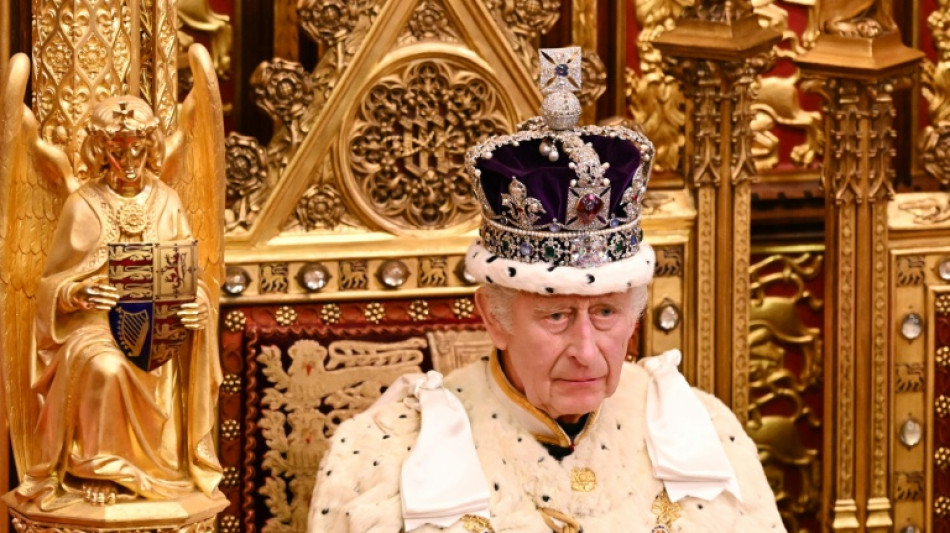
How the British royal family is funded, and where the money goes / Photo: Leon Neal - POOL/AFP

 Rain delays start of second day's play in England-Pakistan opener

 Russian strikes kill 16 in Kyiv, surrounding region

 'It is tough': Indonesia battles wildfires, bracing for worse to come
 Seoul detects North Korean missile launches after Trump says to meet Kim

 Thai, Myanmar military chiefs meet as post-coup thaw progresses

 Asian stocks rally as US Treasury steps in to ease bond fears

 Verstappen signs new Red Bull contract until 2030: team

 What property giant Evergrande's sentence means for China's economy

 Australian prosecutors demand life in prison for mushroom killer

 Fallout far-reaching for Australian Rules after latest scandal
 Rafts on Rome's Tiber River cool down overheated tourists

 Top seeds Sabalenka, Zverev stunned in Cincinnati fourth round

 Australia says relations with Israel 'difficult' after aid worker death

 PSG start Ligue 1 defence with eye on Champions League hat-trick

 Arsenal can become world's best club: Arteta

 Japan's King Kazu, 59, scores twice from spot to make cup history

 Kyiv's desperate vendors persevere outside obliterated flea market

 Australia races to shield little penguins from H5N1 bird flu

 Messi scores first goal since father's death
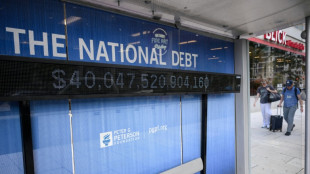 US national debt exceeds $40 trillion for first time

 Brazilian narco violence spills over into tranquil Bolivia
 Trump's devoted 'human printer' in media glare

 Top seed Zverev bundled out by Paul in rain-hit Cincinnati upset
 WADA pledges vigilance on Russian athletes ahead of 2028 Olympics

 NASA satellite rescue mission fails

King Charles III became the first UK monarch in history to reveal how much he has paid in taxes since acceding to the throne in 2022 - some £30 million ($39.6 million).
Buckingham Palace, which released the king's documents on Thursday, said the move was part of its "commitment to transparency" as royal finances come under increasing public scrutiny.
Here AFP looks at where the British royal family gets its money, from the Sovereign Grant to private income worth tens of millions more.
- What is the Sovereign Grant? -
The Sovereign Grant is the annual payment allocated by the UK Treasury to cover the monarch's official duties.
It is also for the running and upkeep of official royal residences, staff support, official travel and hosting official events such as annual garden parties and investitures.
In 2025-2026 the Sovereign Grant rose to £132.1 million, up from £86.3 million in the four previous tax years.
Half of the 2025-2026 funds, some £67.5 million, were "allocated to the preservation and protection of the occupied royal palaces, some of the nation's most iconic heritage buildings," Buckingham Palace said.
The costs for the king's staff came to $33.7 million, and a flight he took with Queen Camilla to Rome in 2025 cost a hefty £126,946.
The grant does not cover all royal expenses. Security costs, for example, are funded separately.
- How is it calculated? -
Introduced in 2012, the Sovereign Grant replaced the centuries-old Civil List system, which was seen as overly complex.
It is a single payment tied to profits from the property management company known as the Crown Estate, which are sent directly to the public purse.
It was set at 12 percent of the Crown Estate profits from two years earlier which have surged mainly due to a windfall from leasing seabed rights to offshore wind developers.
The Sovereign Grant for 2026-2027 will increase to £137.9 million to include the last large tranche of £40.3 million for a 10-year restoration project of Buckingham Palace.
Buckingham Palace confirmed, however, Thursday that for the five years between 2027-2032 the grant will be reset to £99.9 million each year.
The Sovereign Grant is not taxed because it is public money used for official duties.
- What is the Crown Estate? -
The Crown Estate manages a vast property portfolio, now worth £16.7 billion, that includes prime London real estate, rural land, coastal holdings, the Windsor Estate and seabed rights around England, Wales and Northern Ireland.
It is an independent, commercial business that operates separately to the government and the royal household.
The estate is not the monarch's private property and cannot be sold.
In the year ending March 2025, it made £1.1 billion in net profits. But that fell to £487 million in the tax year to this March, due mainly to slumping fees from offshore wind projects.
- What about private income? -
The king received in 2025-2026 some £25.2 million in private income from the Duchy of Lancaster, while the Prince of Wales received £21.6 million from the Duchy of Cornwall.
These two historic estates are the main sources of private income for the monarch and the heir.
They are large, diversified portfolios of land, property, and investments managed like modern businesses.
They earn money by leasing farmland, managing commercial and residential real estate, and holding financial assets.
Both estates are held in trust for future generations and cannot be sold outright.
Their profits fund personal expenses and some official duties, separate from taxpayer-funded support like the Sovereign Grant.
Both the king and William are under no legal obligation to pay taxes on their private income, but do so voluntarily following the example set by the late queen Elizabeth II.
- Personal wealth -
Individual members of the royal family also have personal wealth, mostly from personal investment portfolios and legacies.
The king owns both Balmoral and Sandringham Estates, which were inherited from his mother, Elizabeth.
Unlike for most commoners, assets passed directly from one monarch to the next are exempt from inheritance tax under a long-standing government agreement.
L.Hussein--SF-PST