From birds to fish, how extreme heat causes wildlife to suffer / Photo: Martin LELIEVRE - AFP/File

 Rain delays start of second day's play in England-Pakistan opener

 Russian strikes kill 16 in Kyiv, surrounding region
 'It is tough': Indonesia battles wildfires, bracing for worse to come

 Seoul detects North Korean missile launches after Trump says to meet Kim

 Thai, Myanmar military chiefs meet as post-coup thaw progresses

 Asian stocks rally as US Treasury steps in to ease bond fears

 Verstappen signs new Red Bull contract until 2030: team

 What property giant Evergrande's sentence means for China's economy

 Australian prosecutors demand life in prison for mushroom killer

 Fallout far-reaching for Australian Rules after latest scandal

 Rafts on Rome's Tiber River cool down overheated tourists

 Top seeds Sabalenka, Zverev stunned in Cincinnati fourth round

 Australia says relations with Israel 'difficult' after aid worker death

 PSG start Ligue 1 defence with eye on Champions League hat-trick

 Arsenal can become world's best club: Arteta
 Japan's King Kazu, 59, scores twice from spot to make cup history

 Kyiv's desperate vendors persevere outside obliterated flea market
 Australia races to shield little penguins from H5N1 bird flu

 Messi scores first goal since father's death

 US national debt exceeds $40 trillion for first time
 Brazilian narco violence spills over into tranquil Bolivia

 Trump's devoted 'human printer' in media glare

 Top seed Zverev bundled out by Paul in rain-hit Cincinnati upset

 WADA pledges vigilance on Russian athletes ahead of 2028 Olympics

 NASA satellite rescue mission fails
Like humans, wildlife is increasingly vulnerable as climate change fuels longer and more intense heatwaves, disrupting feeding and breeding, and in extreme cases proving fatal.
The human toll of heatwaves is well documented but their ecological impacts have received less attention.
A study published in March in the journal Nature Ecology and Evolution found that three-quarters of land and ocean species assessed were "negatively impacted" during a major 2021 heatwave across western North America.
Heatwaves can be "brutal" on wildlife, said Gregoire Lois, an ornithologist at the National Museum of Natural History in Paris, which is withering under its second heatwave of the year.
Animals have fewer opportunities to adapt during sudden heatwaves than under gradual warming, he told AFP.
- Birds -
Birds are particularly vulnerable to heat, with a body temperature of between 39C and 42C that rises further during flight or when foraging.
They also lack sweat glands, making it harder to dissipate heat when temperatures soar.
Instead, they cool down through evaporation via their respiratory tracts, a water-intensive mechanism that increases the risk of heat stress and dehydration.
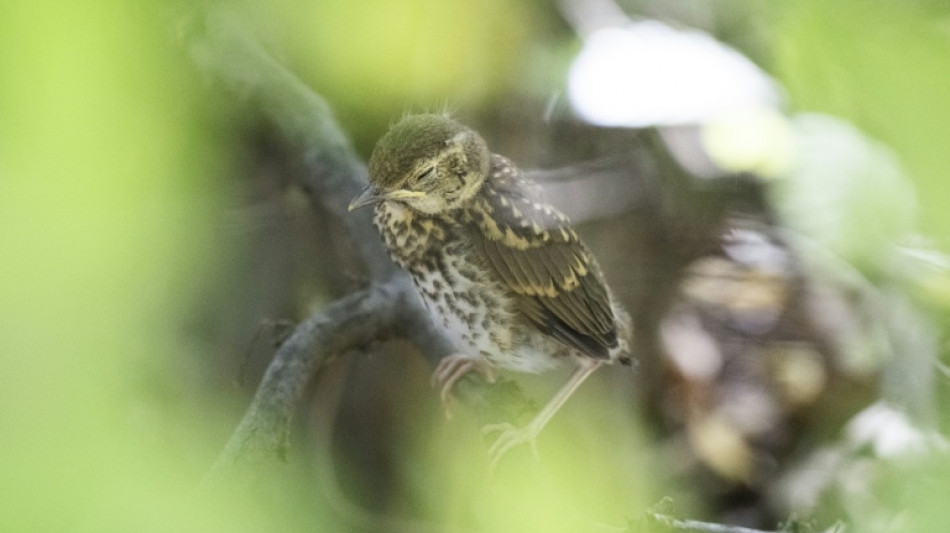
Young birds, still in the nest and unable to fly during the summer heat, are particularly vulnerable.
"The young, suffocating from the heat, sometimes fall from the nest whilst searching for air," said the League for the Protection of Birds, a French wildlife NGO.
Birds that nest under eaves -- such as swifts and swallows -- are most at risk, added.
- Mammals -
Vertebrates regulate their body temperature through panting or sweating but that process "results in greater water loss the smaller the animal is", said Lois.
Anne-Laure Dugue, from the league's 'fauna in distress' programme, said the risk of hyperthermia or dehydration was particularly significant among hedgehogs and certain small rodents.
Mass bat die-offs have been recorded during heatwaves as animals become disoriented and dehydrated.
In January 2026, thousands of flying foxes perished during a heatwave in south-eastern Australia.
Large mammals are not spared either: for species adapted to the cold -- such as bears, bison, reindeer and moose -- their thick fur becomes a hindrance when temperatures rise.
Exposure to even a week of 27C daytime highs greatly increases the chance of koala illness or death, concluded a study of 20 years of observational data published in Biology Letters in May.
Other species like foxes can suffer burns to their paws when they come into contact with scalding surfaces such as tarmac or sand.
- Invertebrates -
Most invertebrates are ectothermic, meaning that their body temperature depends largely on their environment.
Lois said the consequences can be "severe" when their thermal tolerance limit is exceeded.
This is particularly true as their movement is often limited, and sometimes nonexistent. In 2021, during a widespread heatwave in the North Pacific, more than a billion mussels, clams and starfish perished.
- Fish -
In fish, high temperatures reduce the oxygen available in the water while increasing their physiological needs, which can lead to heat stress, disease, reproductive disruption and, in some cases, mass mortality.
During a heatwave across Europe in August 2018, a tonne of fish was found dead in the River Rhine across three Swiss cantons.
- Amphibians and reptiles -
Highly dependent on moisture, frogs, toads and newts suffer during heatwaves, particularly if their watery habitats are parched by drought.
Their permeable skin makes them highly susceptible to dehydration. During heatwaves, they lose water more easily and risk drying out if the humid conditions necessary for their survival are no longer present.
Their reproduction can also be severely affected, particularly when spawning grounds dry out prematurely.
Reptiles like lizards and snakes are not immune either.
They do not regulate their body temperature internally, so must severely restrict their activities during hot spells, threatening their ability to hunt for food.
"Sometimes, as an adaptation strategy, they will become nocturnal... The problem is that prey and food resources are not necessarily active at the same times," said Lois.
M.Qasim--SF-PST