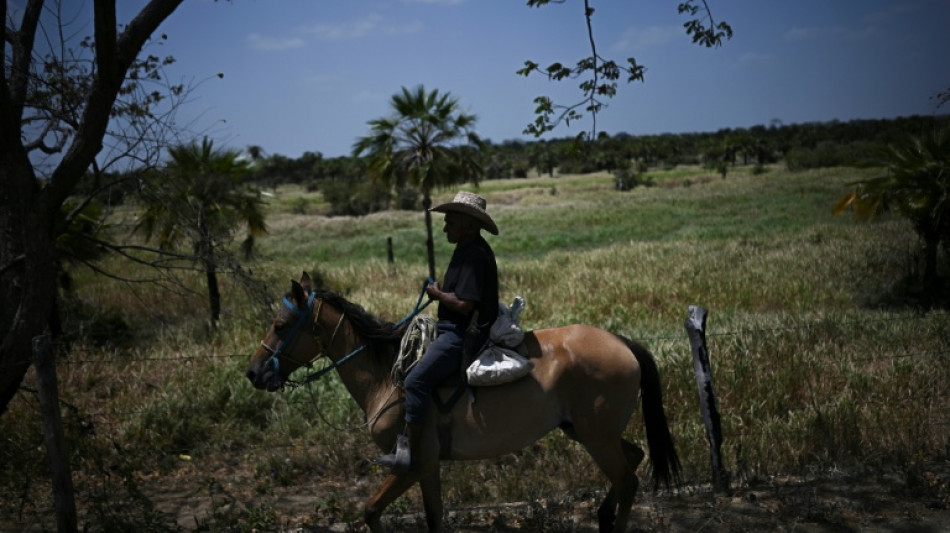
Grabbing the bull by the tail: Venezuela's cowboy sport / Photo: Federico PARRA - AFP

 Last MotoGP race at Phillip Island cancelled due to weather in Marquez setback

 Sri Lanka seeks faster green energy shift after oil shocks
 Riyadh airport resumes flights following Houthi attacks

 'Call of Duty' North Korea invasion edition tops sales charts in South

 Musk accuses Ukraine of violating Starlink's terms of service

 Fed expected to hold rates steady days ahead of US midterms

 More Lula, or back to the Bolsonaros? Brazil votes in cliffhanger

 Jorge Martin out of Australian MotoGP with fracture: team

 Antonelli storms to US Grand Prix pole on weekend he can take title

 Apologetic Alvarez fires Atletico to win against Deportivo
 Lens beat PFC in Ligue 1 matchday impacted by social unrest

 Valkyries hit back against Dream to level WNBA Finals

 'Fighting for our rights': Paris protesters determined to march on

 Clashes break out in Paris, other French cities amid fresh protests
 Spurs seal rare win at Chelsea as Palmer sees red

 Nearly 1,000 arrested in French protests marred by 'elevated' violence: minister

 France extends detention of suspected racist shooter

 Andrade and Nemour star as Biles cheers at world gymnastics champs

 Nigeria's Tinubu defends record as economy bites ahead of election

 'Guiding star' Fuellkrug bags Bremen brace, Leipzig win

 Man City's perfect start ended by Aston Villa, Arsenal go joint-top

 Arsenal sink Everton to join Man City at Premier League summit

 France protests: Latest developments

 French ice dancers Cizeron and Fournier make golden start to season

 Thousands protest crackdown on media in Turkey

Four mounted cowboys jostle for position near the bull pen gate.
When the bull bolts out into the ring, a mad scramble begins as the riders vie to grab its tail and knock it to the ground.
Bull tailing, or "coleo" is to Venezuela's "llanos" (tropical grasslands) what rodeo is to Texas -- an integral part of popular culture that has survived opposition from animal welfare groups.
Unlike their Texan counterparts, "coleadores" don't try to ride the bull or grab it by the horns but rather chase its tail.
The coleo is one of the high points of the annual "llanera" fair in the central city of San Fernando de Apure, a three-day extravaganza of cowboy culture, including fast-paced, swirling "joropo" partner dancing listed on the UN's Intangible Cultural Heritage list.
Experts trace coleo to Spanish colonial times and link it to cattle herding work.
It is also practiced across the border in Colombia's "llanos," as well as in Brazil and Mexico, countries with strong cattle breeding traditions.
Most of the "coleadores" or bull tumblers learn the sport from their fathers or grandfathers. Women and children have also been known to compete.
For Neomar Sanoja, one of the judges, it's Venezuela's "national sport" -- a bold claim in a baseball mad nation.
- 'Feel the adrenaline' -
Rafael Delgado, 35, started competing at around 10, encouraged by his father, a ranch hand.
"It's part of our 'llanero' culture, part of being Venezuelan," he told AFP before entering the ring.
To reach the bull’s tail, riders spur on their horses and when they draw alongside the animal's flanks, perform acrobatic maneuvers to try flip the beast.
The bull writhes, struggles back on its feet and tries to escape along the "manga de coleo," a 200-meter-long sand corridor, with the riders in hot pursuit.
Points vary depending on how the bull tumbles, with extra marks for those who manage to get all four legs in the air.
About 200 competitors took part in the four-minute bouts in San Fernando de Apure, wearing hockey helmets and padding on their arms and legs as armor.
Llanera music blared while a judge narrated the action with rapid-fire delivery.
Florelbis Linares told AFP she wanted to take up coleo despite the misgivings of her coleatero boyfriend, who she watched perform from the stands.
"You really feel the adrenaline watching from here," the 23‑year‑old said, her legs hanging over the guardrail around the ring.
- 'Defenseless animals' -
The bull's suffering is little cause for concern among aficionados of coleo.
Most of the animals who enter the ring are headed for the slaughterhouse.
Luis Garcia, a 32‑year‑old rider, accused critics of the sport of hypocrisy, noting that most show no outrage in the face of intensive cattle rearing and meat consumption.
The AnimaNaturalis animal rights NGO, which is active in Spain and Latin America, has called for the practice to be abolished.
"It is cruelty and an abuse of power by llaneros against defenseless animals," it argued on its website.
"Is this what you call culture?" the Napda Foundation, a Venezuelan animal rights foundation, asked, posting a video of coleo spectators kicking and throwing objects at a bull to force it to get back on its feet.
"The alleged 'humans' behave like beasts. This must stop now."
Y.Zaher--SF-PST