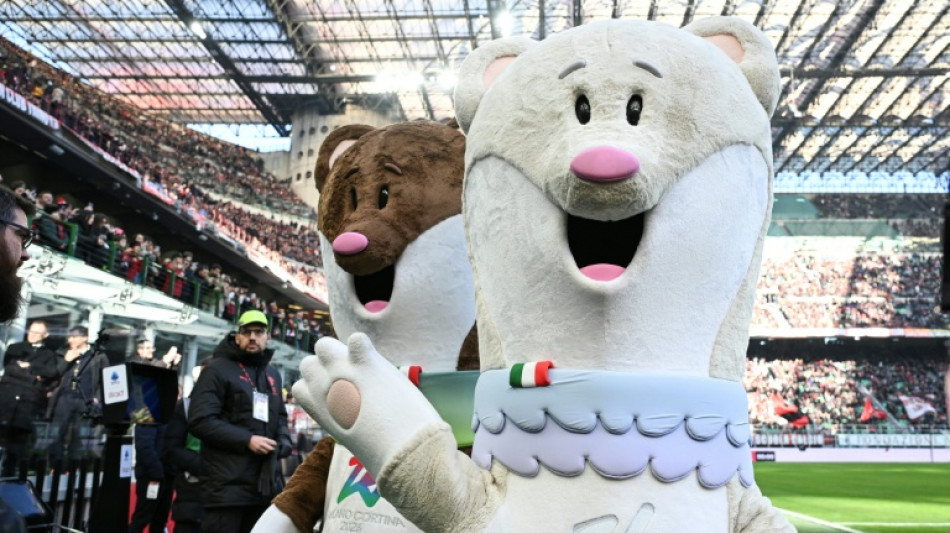
Cuddly Olympics mascot facing life or death struggle in the wild / Photo: Piero CRUCIATTI - AFP

 Stocks retreat as bond yield fears persist, oil rises

 ARKBRIDGE’s David Mali Highlights AI-Driven Risk Management at the Finance Magnates London Summit

 Zuckerberg buys Gothic castle in Ireland: spokesman

 Belgium's fire of the century now 'under control'

 Evergrande's Xu Jiayin: from real-estate tycoon to life in prison

 Spurs eyeing move for Man City's Savinho and Marmoush - reports

 Springboks captain Kolisi to miss first All Blacks Test

 Japan to launch probe for Mars moons in October: space agency

 From beach to Bulls: relaxed Tsunoda savours rare F1 drive

 Prince Harry: key dates in life of returning UK royal

 North Korea launches missiles, Seoul says, after Trump floats Kim meet

 Oil jumps on Iran war tensions, offsetting bond yield fears

 Germany identifies far-right suspect in deadly 1970 antisemitic attack

 PrimeXBT Expands Swap-Free Trading to PXTrader 2.0

 Record number of locations in France top 40C over summer: AFP analysis
 Trump pledges 'economic warfare' on Iran, prompting Tehran derision

 'Girl with a Pearl Earring' in Japan, perhaps for the last time

 Russian strikes kill 13 in Kyiv, surrounding region

 'Simply lovely': Verstappen signs new Red Bull contract until 2030

 Australia coach Walters heading to St Helens after World Cup

 China jails founder, fines disgraced property giant Evergrande

 Russian strikes kill 12 in Kyiv, surrounding region

 US India ambassador's Kashmir remarks rile Pakistan; envoy summoned

 In Senegal's Saint-Louis, traces of slave-trading past fade away

 Russian strikes kill 9 in Kyiv, surrounding region
Tina and Milo, the ermine and stoat mascots of the upcoming 2026 Olympic Games in Italy, are already everywhere -– smiling on stuffed animals, posters, mugs and T-shirts.
But it's another story for their real-life counterparts –- living out of sight and under pressure in the Alps as their snow cover slowly melts away due to climate change.
Ermines and stoats are the same animal -- mustela erminea -- but with the ermine sporting its white winter coat and the stoat its brown one for summer. And while they might be the face of the Olympics, they're disappearing in Italy's Alps, according to the country's only dedicated ermine researcher.
Since 2022, University of Turin doctoral student Marco Granata has been single-handedly monitoring the sinewy, hard-to-spot mammals who inhabit the same mountain peaks where the games will take place, high in the snowy Italian Alps where their winter coats camouflage them from predators.
"The ermine is like a wild ghost. It's a small, elusive animal," Granata told AFP.
"What makes it so interesting to me is the fact that it risks disappearing from entire mountains."
- Easy targets -
The small mammal's ability to molt -- its brown coat turning to white in November -- is what Granata calls a "super power" that's allowed it to survive for thousands of years.
But now it's a liability.
"The ermine faces a mismatch when it finds itself completely white in a world that should be white but is no longer so," Granata said.
Snow cover in the Italian Alps has decreased by half in the last 100 years, according to a study published in December 2024 in the International Journal of Climatology.
With their snow camouflage gone, the white ermines now stand out starkly against their mountain backdrop, becoming easy targets for predators such as hawks, owls or foxes.
Another problem awaits when the energetic carnivores climb to higher altitudes in search of snow -- a lack of prey.
While the ermines are compelled to ascend, the snow voles and mice they depend upon for food have no need to do so, as they don't change colour.
Ski slopes also encroach on ermine habitat because of "competition for the areas where it snows the most," Granata said.
His research predicts ermine habitat in the Italian Alps will decrease by 40 percent by 2100, with ermines forced to climb by an average of 200 metres and the voles staying put.
There is little fuss made in Italy over ermines, which were once heavily hunted for their white pelts to adorn royal ceremonial robes. Scientists have paid them scant attention in recent decades, given the difficulty of gathering data on the fast-moving creatures.
The International Union for Conservation of Nature (IUCN), the world's largest environmental network, last classified the ermine in 2015 as of "least concern" on a list of potentially threatened species.
But that influential list is out of date, argues Granata, who hopes his research will lead to their protection.
"The fact that a doctoral student is the expert on a species shows how little attention has actually been paid to this species," he said.
- 'Invisible world' -
Every fall, Granata hikes Italy's Maritime Alps placing special camera traps -- plastic boxes with a motion-triggered camera inside -- that help him analyse the animal's seasonal patterns.
"You have to think like an ermine," he said, placing the box in areas where the curious mammal might go to find food.
When the snow melts, Granata collects the data from inside the boxes and watches a season's worth of videos and photos.
"It's like unwrapping a gift because you don't know what's inside... you actually see this invisible world," he said.
In one August video, an energetic stoat twists, sniffs and darts around in constant motion as he explores the box.
In October, after learning of the Games' choice of mascot, Granata launched an appeal to the Milano Cortina organisers, asking their sustainability team to help fund university research.
This week they sent a letter declining, which Granata considers a "huge missed opportunity".
The ermine, he said, isn't "just a cute little animal that roams our mountains, but a wild animal at risk of extinction".
A.AlHaj--SF-PST