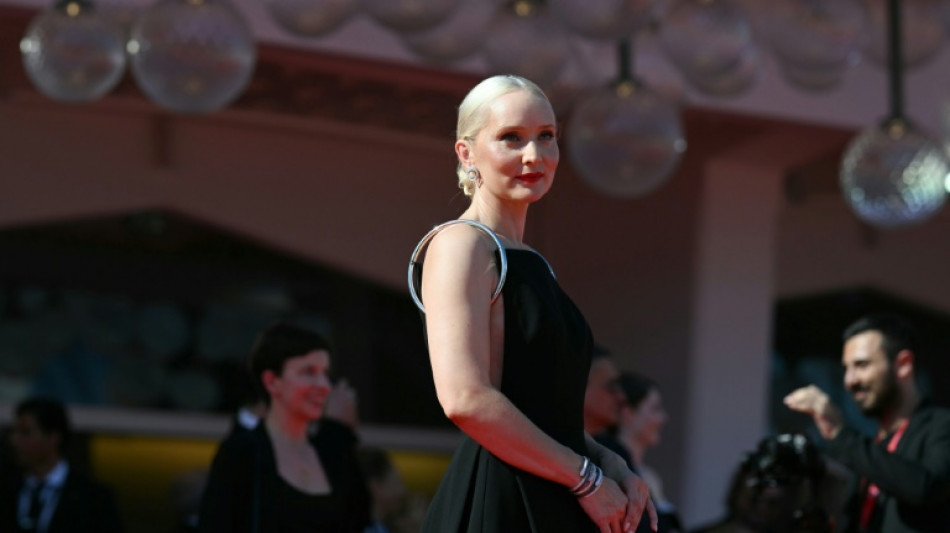
Homage to Shaker feminist in Venice film from Mona Fastvold / Photo: Tiziana FABI - AFP

 Alcaraz to return for US Open title defence

 China's rapid solar expansion hurt bird diversity: study

 President Paul Biya back in Cameroon after 73 days away

 Newcastle boss Jaissle unfazed by lack of respect

 US Open purse to top $100 mn as Grand Slams form player council

 Hull aim to silence critics after unexpected promotion to Premier League

 Pakistan hit back against England after Cox and Root fifties
 Walmart reports mixed results as gas prices drag on US sales growth
 Wang downs Sindhu to break Indian hearts at badminton worlds

 As Europe's rivers recede, shippers scramble to limit damage
 Alonso won't confirm Fernandez will remain at Chelsea after Man City link

 Milky Way's fastest star discovered spinning around black hole

 Kanye West planned concerts trigger frenzy in Russia

 Hungary music festival basks in post-Orban freedom

 Vatican says 'serious concerns' over Israel-Lebanon deal implementation

 Arteta confirms Arsenal want to sign defender after Konsa link

 What's behind the UAE's decision to cut Iran trade ties?

 Barca seal Cancelo return to bolster defence

 Germany reports record 14,000 heat-related deaths this summer

 Alvarez 'focused' says new Atletico team-mate Romero

 West Ham warn fans about 'offensive' Solomon chant

 Huge questions loom over Prince Harry's shock return to UK

 BYDFi Joins Coinfest Asia 2026, Connecting with Institutions, Builders and Traders in Bali

 Max Verstappen: Natural-born winner

 Van Dijk urges Liverpool to make amends for 'unacceptable' season

With "The Testament of Ann Lee", a movie about the founder of the 18th-century Shaker religious movement screening at the Venice Film Festival, director Mona Fastvold sought to honour a figure "on the verge of being erased from memory".
Lee, played by Amanda Seyfried in the film that premiered at Venice this week, was "one of the very first American feminists who fought for equality" between the sexes, but also between all humans, Fastvold told AFP in an interview.
Born in 1736 in Manchester, England into a working-class family, Lee -- or "Mother Ann" as her followers called her -- created the Shaker movement, a Quakers offshoot, whose worship was based on dancing and singing to reach a trance-like state.
The Shakers' principles as imposed by Lee -- perceived as the female reincarnation of Christ -- involved sexual abstinence, pacifism, the rejection of pride and wealth, and manual labour as a form of prayer.
Fastvold said she stumbled upon the Shaker heroine while researching late 18th century religious movements in the United States, where Lee emigrated in 1774 with a few disciples to escape religious persecution in England and establish a Shaker community near New York.
- Religious freedom -
"It was like a religious freedom mecca in America at the time. And people flocked to the United States to try out all kinds of wild different ideas around religion," said the New York-based Norwegian filmmaker.
Her film gives prominence to Shaker hymns, revisited by composer Daniel Blumberg, who won an Oscar this year for the music for "The Brutalist", directed by Fastvold's partner, Brady Corbet. Corbet co-wrote the screenplay for the Ann Lee film, as did Fastvold for "The Brutalist".
Fastvold said she was attracted by Lee's idea of "creating a community where you can be safe".
"That sense of community coming together, singing, dancing, moving, taking each other's pain, and helping each other through that pain... I started to have a real understanding for that aspect of it," said Fastvold.
"I didn't make this movie to be, like, 'Come join the Shakers,'" she said.
"But I do think that I wanted to treat her with a lot of love because if you look at the time that she lived in... what she did was quite extraordinary and the ideas that she had about community and empathy and kindness, and to lead with kindness and love."
- Creative prayer -
According to the filmmaker, there are only three members of the Shaker movement left, as the community slowly dies out.
At its peak around 1840, the movement had 6,000 followers from 19 communities, decades after Lee's death in 1784.
"I wanted to show her a bit as an icon. Like one does in religious paintings, and movies about Joan of Arc or Jesus Christ," Fastvold said.
"All of these male icons have gotten this treatment, how about I take that and give this to this unknown woman?" she asked.
The Shakers are best known today for their furniture, prized in the design world for its functionality and refined aesthetics.
"For them, architecture, creating furniture, creating boxes, it was a form of prayer," Fastvold said.
"That's why their things are so special. That's why people are obsessing over this furniture still, and these objects... There's prayer in that, there's this obsessive prayer in the creation of them."
G.AbuHamad--SF-PST