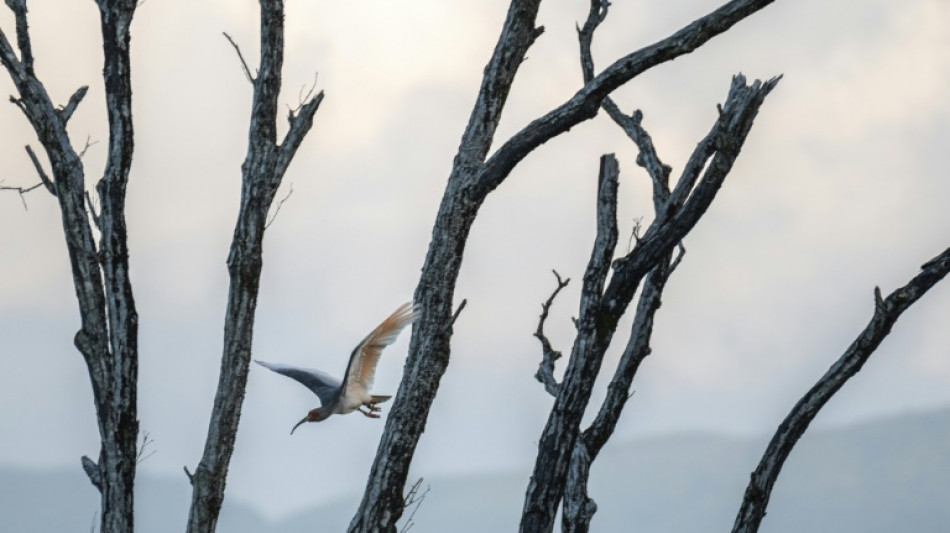
Modern phoenix: The bird brought back from extinction in Japan / Photo: Charly TRIBALLEAU - AFP

 Stocks retreat as bond yield fears persist, oil rises

 ARKBRIDGE’s David Mali Highlights AI-Driven Risk Management at the Finance Magnates London Summit

 Zuckerberg buys Gothic castle in Ireland: spokesman

 Belgium's fire of the century now 'under control'

 Evergrande's Xu Jiayin: from real-estate tycoon to life in prison

 Spurs eyeing move for Man City's Savinho and Marmoush - reports

 Springboks captain Kolisi to miss first All Blacks Test

 Japan to launch probe for Mars moons in October: space agency

 From beach to Bulls: relaxed Tsunoda savours rare F1 drive

 Prince Harry: key dates in life of returning UK royal

 North Korea launches missiles, Seoul says, after Trump floats Kim meet

 Oil jumps on Iran war tensions, offsetting bond yield fears

 Germany identifies far-right suspect in deadly 1970 antisemitic attack

 PrimeXBT Expands Swap-Free Trading to PXTrader 2.0

 Record number of locations in France top 40C over summer: AFP analysis

 Trump pledges 'economic warfare' on Iran, prompting Tehran derision

 'Girl with a Pearl Earring' in Japan, perhaps for the last time

 Russian strikes kill 13 in Kyiv, surrounding region

 'Simply lovely': Verstappen signs new Red Bull contract until 2030

 Australia coach Walters heading to St Helens after World Cup

 China jails founder, fines disgraced property giant Evergrande

 Russian strikes kill 12 in Kyiv, surrounding region

 US India ambassador's Kashmir remarks rile Pakistan; envoy summoned

 In Senegal's Saint-Louis, traces of slave-trading past fade away

 Russian strikes kill 9 in Kyiv, surrounding region

Every day for the past 14 years, 72-year-old Masaoki Tsuchiya has set out before sunrise to search for a bird rescued from extinction in Japan.
Starting his car under star-dotted skies unpolluted by light, he works alone in the pre-dawn chill, marking sightings or absences in a planner, interrupted only by the crackle of a walkie-talkie.
The bird he is looking for is called "toki" in Japanese, and its presence on his home of Sado island is testament to a remarkable conservation programme.
In just under two decades, Japan's population of wild toki has gone from zero to nearly 500, all on Sado, where the bird's delicate pink plumage and distinctive curved beak now draw tourists.
It's a rare conservation success story when one in eight bird species globally are threatened with extinction, and involved international diplomacy and an agricultural revolution on a small island off Japan's west coast.
- A cautionary tale -
Tsuchiya, stocky and spry with an impish grin, doesn't eat breakfast until he has made all his stops, and after years of practice he can spot chicks hidden in nests through the monocular attached to his rolled-down car window.
He points to virtually imperceptible marks on a road or a wall that help him remember where to park and start surveying.
"The number I see at this spot depends on the season," he explains.
Some days dozens of the birds appear in one area, something unimaginable in 2003, when a toki called Kin or "gold" died in a cage on Sado at the record-breaking age of 36.
Her death meant not a single wild-born toki was left in Japan, despite the bird being so synonymous with the country that it is also known as the Japanese crested ibis.
"I knew the day was coming. She was very old and frail," Tsuchiya said. "But it was still a real pity."
Efforts to get Kin to mate with Sado's last wild-born male toki Midori -- meaning "green" -- had long since failed, and she lived out her last years as a curiosity and a cautionary environmental tale.
Her death made national headlines and appeared to mark the end of a long and seemingly futile battle to protect the toki in Japan, where its feathers even inspire the word for peach pink: "toki-iro".
But now so many roam the skies and rice paddies of Sado that local officials have gone from discouraging eager birdwatchers to training guides to help visitors spot the local icon, and the government is even studying reintroducing the bird elsewhere.
- Wiped out -
Wild toki once lived across Japan, as well as in Russia, Taiwan and South Korea.
They were considered a pest that damaged rice plants, but during Japan's Edo era, from 1603 to 1867, hunting restrictions meant only high-ranking officials could actively pursue birds like toki.
That changed in the Meiji era and as guns became more available. Toki meat was believed to have health benefits, and its feathers were favoured for everything from dusters to decorative flourishes on hats.
"Over just 40 years, the toki basically disappeared," said Tsuchiya on an observation deck where visitors now try to spot the bird.
By the early 1930s, only a few dozen toki remained in Japan, mostly on Sado and the nearby Noto peninsula, and the species won protected status.
A fresh threat then emerged during Japan's post-war drive for growth: rising use of chemical fertilisers and pesticides.
Toki feed primarily in rice paddies that mimic marshy wetland habitats and they are undiscriminating diners, eating everything from insects to small crabs and frogs.
The chemicals affected the birds and their food, and by 1981 just five wild toki remained in Japan, all on Sado, where officials took them into protective captivity.
But by bizarre coincidence, the same year a population of seven wild toki was discovered in a remote area of China's Shaanxi province, reviving hopes for the bird's survival.
Sado's captive birds failed to mate, but China's programme had more success, and when then-Chinese president Jiang Zemin made a historic first state visit in 1998 he offered Japan the gift of a pair of toki.
You You and Yang Yang arrived the following year on first-class seats, producing their first chick months later in an event that led national television broadcasts.
Other birds arrived from China, and with time Sado had a large enough population to consider reintroducing the toki to the wild.
But first they had to tackle the use of chemical fertilisers and pesticides on Sado.
"Back then people didn't think about the environment when farming. Their priorities were selling products at a high price and harvesting as much as possible," said Shinichiro Saito, a 60-year-old rice farmer.
Farmers were asked to cut chemical fertilisers and pesticides by half from the level allowed by local rules, but there was pushback.
Fewer chemicals meant smaller harvests, lost income, and more weeding.
And some farmers couldn't see the point of other proposals like underground channels connecting rice fields to rivers to increase the flow of aquatic life.
- 'Toki-friendly' -
Local officials used a carrot-and-stick approach, refusing to buy rice from farmers who rejected the new chemical limits and creating a new premium brand of "toki-friendly" rice for those who did.
But Saito, who was an early adopter, said the real difference came when the first birds were released in 2008.
"It was the toki that changed their minds," he said, with a lop-sided grin.
Even farmers reluctant to adapt were "delighted" to see a bird with almost mythical status on Sado wandering through their fields.
"This is a true story. The toki was almost like an environmental ambassador, it helped create a good environment for itself."
Tsuchiya's daily rounds began with the 2008 release.
He has since witnessed triumphs including the first wild-born chick, and the first chick born to wild-born birds -- moments he describes with the proud anxiety of a parent sending a child off to school for the first time.
He still runs his own business, though the toki feather tucked into his car's folding mirror makes clear where his heart lies.
And the breeding programme has continued, supplemented by birds from China that help broaden the gene pool.
Around 20 birds are released twice a year after graduating from a three-month training programme that prepares them for life outside a cage.
"They learn how to fly, how to find food and to get used to being around humans," explained Tomoki Tsuchiya, who works with Sado's local government to make the island toki-friendly.
City officials even farm around the birds to acquaint them with the sound.
- 'Like family' -
When the first toki were released on Sado, there were so many gaps in knowledge about the species that volunteers analysed their droppings to find out what the birds were eating.
There were missteps: officials prepared a remote mountain location for the release, believing the birds would prefer seclusion, but the toki instead flew down to fields that were frequented by farmers.
Tomoki Tsuchiya's interest in toki was fostered by his father, Masaoki.
But it is a fascination shared by many on Sado, where the bird is rendered in cute mascot form on everything from T-shirts to milk cartons.
"How can I express it? The toki is so important for people on Sado," the 42-year-old said.
"It's like family."
Even after training, a toki's future is precarious: only about half survive predators like snakes and weasels, and the survival rate for newborn chicks is similar.
But enough have thrived that Japan may expand the Sado programme, and there have been successes elsewhere.
China's wild population now numbers over 4,450, and a South Korean project released 40 toki for the first time in 2019.
For Saito, who speaks as toki squawk nearby, the bird's resurrection is part of a bigger achievement on Sado -- a new approach to farming and the environment.
"When this project started, what I dreamed of the most was seeing toki flying overhead while I farmed," he said.
"An environment that is good for toki is an environment that is also safe for humans, and that's something people on Sado can be proud of."
Q.Jaber--SF-PST