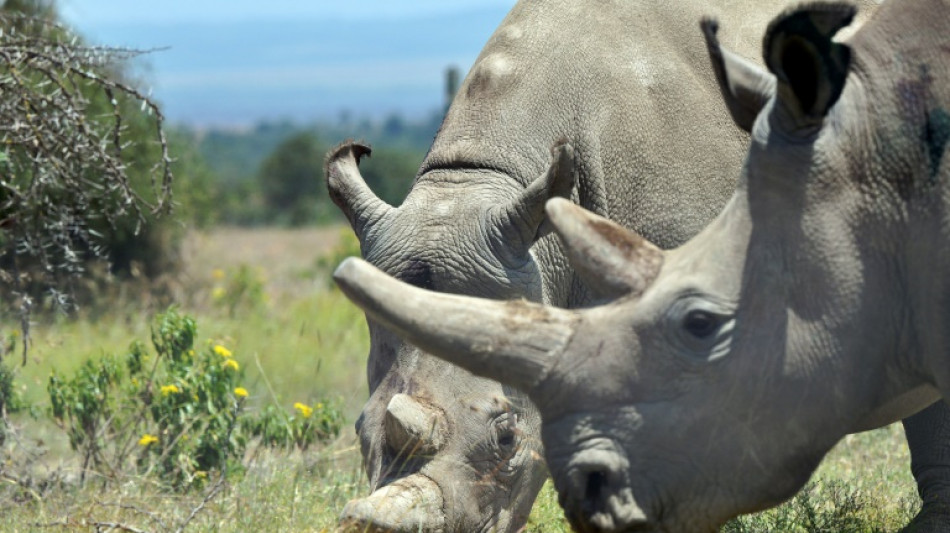
IVF breakthrough could revive nearly extinct rhino species / Photo: TONY KARUMBA - AFP/File

 Brazil's Lula urges tariffs resolution in call with Trump

 Ukraine says 'cynical' Russian strike on shopping centre killed 14
 Heatwave-hit Europe logs over 30,000 excess summer deaths: first figures

 Give LIV Golf 'one more shot,' says DeChambeau

 Duplantis hits the high notes for athletics anthem

 Malaysia's JDT claims unbeaten run world record

 Bolivian economy minister fired after Congress vote
 Russell roars to Dutch GP sprint pole, Antonelli fifth

 Russell takes pole for Dutch GP sprint

 England start life after Bazball with rout of Pakistan

 'Duck run' pest control catching on in S.Africa's winelands
 UK, Canada, Australia slam Israel ending probe into aid worker killings

 Spurs spending spree vital to raise standards: De Zerbi

 US, Canada try to wrap up trade deal before latest Trump deadline

 World No.1 Sinner withdraws from US Open with knee injury

 Judge allows UK rugby brain injury court case to continue to trial

 Trump announces temporary tariff relief on ground beef imports

 Pope to visit San Marino, address Italian political event
 All Blacks just as good as Springboks, says captain Savea

 Romania holding suspected 'low-level agent' after pistols found near Berlin: Germany

 UK forecasts 'biggest' El Nino will smash records, spark hottest year

 Cyclist Alaphilippe attracts tributes as reports say he has quit
 Top-ranked An, holder Yamaguchi reach badminton worlds semi-finals

 Iran president says time to end war while in position of strength

 Antonelli fastest in sole Dutch GP practice session

Scientists have carried out the first successful in vitro fertilisation of a southern white rhino, a major breakthrough that could pave the way to saving its highly endangered northern cousin.
Only two female northern white rhinos remain in existence but neither is capable of carrying a pregnancy to term.
To save the functionally extinct species, researchers from the scientific consortium Biorescue are attempting to implant a lab-grown northern white rhino embryo in a southern surrogate.
The ambitious reproduction programme is the last chance at survival for the northern white rhino species, whose last two members live at the Ol Pejeta Conservancy in Kenya under 24-hour guard to protect them from poachers.
The successful impregnation of a southern white rhino with an embryo of the same species was a "milestone", project leader Thomas Hildebrandt said at a press conference in Berlin.
"We achieved something that was not believed to be possible," Hildebrandt said.
The successful recent trial ended in tragedy when the bull and the surrogate, along with the foetus, were killed by an unrelated infection the scientists believe was caused by bacteria released by a mudslide in their enclosure.
The foetus was only 70 days old at the time but the team said they were confident it could have survived the 16-month pregnancy period.
The next step will see scientists try to repeat the feat with other embryos made with eggs harvested from the surviving females and sperm preserved from two long-dead males.
The team aims to "produce northern white rhino calves in the next two to two-and-a-half years", Hildebrandt said.
- Delicate operation -
To place the embryo in the surrogate, the team of conservationists use a sterile "teaser" bull rhino, whose approaches to the female indicate she is ready to conceive.
The team subsequently carry out the delicate operation in just under an hour with the surrogate under anaesthetic.
The size and delicate anatomy of the white rhinos means the embryo is implanted via the rectum into the uterus.
The trials were carried out using southern white rhino embryos to preserve what scarce genetic material is left from the northern species.
Biorescue has collected eggs from the surviving females, Najin and Fatu, since 2019 but had to retire the elder of the two from the programme in 2021.
The last male, whose name was Sudan, died at the sanctuary in Kenya in 2018.
What northern white rhino sperm has been preserved from now-dead male donors is of "very poor quality", said Cesare Galli from the Italian lab Avantea where the new northern white rhino eggs are fertilised in vitro.
- 'Big day' -
The Biorescue team have 30 fertilised eggs in freezers "waiting for their big day", said Susanne Holtze from the Leibniz Institute for Zoo and Wildlife Research.
The IVF method could potentially provide a model for other endangered species of rhino, such as the endangered Sumatran rhino in South East Asia, according to project leader Hildebrandt.
Rhinos, which have roamed the planet for 26 million years, have very few natural predators but their numbers have been decimated by poaching since the 1970s.
Q.Bulbul--SF-PST