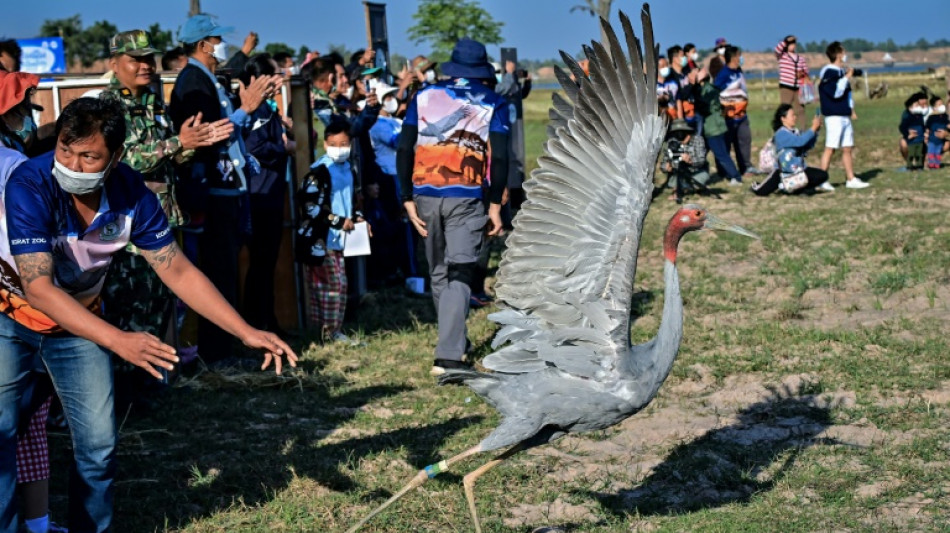
Fly away home: rare Eastern Sarus cranes released in Thailand / Photo: Lillian SUWANRUMPHA - AFP

 William and Harry: Britain's warring royal brothers

 UN holds second informal poll for next leader

 In US mining hub, black lung rates soar

 Champions Arsenal embrace being 'hunted' as Premier League returns

 World No.2 Rybakina retires from Cincinnati clash with Swiatek
 'I heard you missed me': Melania Trump jokes about month out of spotlight

 Amazon Prime Video to invest $2 bn in Latin America productions

 Panama Canal to reduce shipping over El Nino-fueled drought

 Maradona trial on hold over possible medical evidence mix-up

 'Green dilemma': China's solar boom hurt birds, says study

 Pegula hangs on to dispatch Anisimova, reach Cincinnati semi-finals

 US charges woman with IS-inspired plot to blow up New York State Capitol

 What a record-breaking El Nino could mean for the world

 Duplantis edges Karalis to win Lausanne Diamond League pole vault

 Alcaraz to return for US Open title defence

 China's rapid solar expansion hurt bird diversity: study

 President Paul Biya back in Cameroon after 73 days away

 Newcastle boss Jaissle unfazed by lack of respect

 US Open purse to top $100 mn as Grand Slams form player council

 Hull aim to silence critics after unexpected promotion to Premier League

 Pakistan hit back against England after Cox and Root fifties

 Walmart reports mixed results as gas prices drag on US sales growth

 Wang downs Sindhu to break Indian hearts at badminton worlds

 As Europe's rivers recede, shippers scramble to limit damage

 Alonso won't confirm Fernandez will remain at Chelsea after Man City link

As the sun came up, 13 Thai Eastern Sarus cranes were released over a rippling reservoir in northeast Thailand, the latest effort to revive the almost-extinct species in the kingdom.
More commonly known as Thai cranes, the birds nearly disappeared from the country roughly 50 years ago -- they were last spotted in the wild in 1968 -- before a collaboration between the Thai government, Nakhon Ratchasima Zoo and United Nations to save them.
A breeding programme, using fowl donated by Cambodia, began in 1989, with the first reintroduction in 2011.
Sarus cranes are classed by the ICNC as "vulnerable", with an estimated 15,000 remaining in the wild -- with the Thai sub-species having been thought to have disappeared from Thailand's wild wetlands.
But since 2011, more than 150 captively-bred birds -- which can grow to up to six feet (1.8 metres) and weigh almost seven kilograms (15 pounds) -- have been released in Buriram province.
"It is the only place where the Thai cranes are able to live and reproduce on their own," said Governor Chaiwat Chuntirapong.
The birds were transported in large, specially adapted boxes -- their red-feathered heads watching through mesh windows -- from the Wetland and Eastern Sarus Crane Conservation Center where they were bred to the Huai Chorakhe Mak Reservoir.
The latest flock of 13 cranes were released all at once on Christmas Day. The tall birds loudly honked and clumsily flapped as they unsteadily took to the skies accompanied by cheering children and spectators.
It was the final moment in a long journey for the researchers, who carefully nurtured the cranes from hatching, gradually introduced them to the wild and then took them to their final flight to freedom.
"The herdsman wears a suit that hides her body and wears a bird's head puppet on her hands to teach the birds everything from feeding to familiarising them with nature," said Nakhon Ratchasima Zoo researcher Tanat Uttaraviset.
As a result of the long process, roughly 60 to 70 percent of the birds survive in the wild, he said.
Prior to their release, each bird is micro-chipped and tagged, allowing researchers to track them and improve the conservation efforts.
As well as rearing and releasing the cranes, an important part of the programme has been educating people about the species and the environment.
Huai Chorakhe Mak Reservoir was chosen partly thanks to its natural proliferation of water chestnuts -- an important food source for cranes in the dry season.
But their habitat remains threatened by the "widespread invasion of agriculture", said director of Nakhon Ratchasima Zoo Thanachon Kensing.
The zoo has established a learning centre, teaching tourists and locals about how to better care for the environment the birds need to survive.
"Changing villagers' attitudes is difficult," Thanachon admitted.
"But if we can communicate with them... this project will be successful," he said.
Watching his red-headed charges soar off over the sparkling waters, researcher Tanat had just one hope.
"The ultimate goal is to secure the crane population," he said.
B.Khalifa--SF-PST